



Asia School of Business

Global Inquiry, Local Heart

One thing’s for sure: MBAs love a challenge. But few enjoy a challenge more than those successful grads who go on to complete the MBA ‘triple jump’—changing job, sector, and location. The MBA ‘triple jump’ is popular among graduates who crave new professional and personal experiences and are excited by change and novelty.

One such ambitious grad is Oludare Oluwajuyitan (Dare), an Asia School of Business (ASB) MBA alumnus. Mirroring his name, he took a daring leap into the business world after his degree, completing the fabled ‘triple jump’, which gained him a competitive edge within the Thai real estate sphere.

Moving from banking to real estate

MBA grad Dare travelled from his native Nigeria to Kuala Lumpur, Malaysia, to join ASB. With a desire to explore Asia, ASB’s setting at the center of Southeast Asia was an attractive feature for him. “I had never travelled to Asia, and I thought it was a great combo—to be able to visit, study and potentially work in one of the fastest-growing regions in the world,” he reports.

But why an MBA? Having worked as a relationship manager at First Bank of Nigeria for four years, immersed within business and working alongside c-suite executives, Dare still wanted to challenge himself. “I felt I still had a lot to give,” he admits. Through ASB’s Action Learning (AL) program—an initiative where students participate in projects within global companies—Dare gained exposure across television, investments, private equity, and real estate.

AL projects function as a critical bridge between classroom theory and real-life application, he believes. “In class, you have all the data, so it is easier to solve problems and devise a perfect solution,” he adds, “in real life, you realize there is no perfect solution, and you can never have enough data.” Throughout these practical projects, you’ll learn what it takes to be a good decision-maker since you’ll often be thinking on your feet instead of planning and deliberating like you would in a classroom environment.

It ended up being real estate that struck a chord with Dare, who recognized the room for technological growth within the sector. The growing role of property technology, or proptech, showed him the possibilities of applying technology across areas like building design and transactions. “Unlike traditional banking, which I found was a highly regulated environment, in real estate there’s more room and flexibility in terms of strategy and execution,” he notes.

Leveraging ‘Smart X Sharp’ skills when transitioning to a new role

The practical projects you’ll participate in during your MBA will teach you valuable skills to take into your future career. It’s been exactly these skills that have helped Dare pivot from relationship management within the banking sector in Nigeria to business development within real estate in Thailand, where he works as operations and business development manager at a real estate firm in Bangkok.

His position involves improving processes and operating efficiency, which entails collating data from developer projects into the database, reviewing new market data and financial forecasts, and developing business strategies based upon the analytics. Throughout AL projects within multiple host companies, Dare had to learn business frameworks and apply them quickly.

As a result, he honed ‘sharp’ technical skills in managerial analytics and various data analysis tools, which he now uses in his strategy-driven role when interpreting the story behind the data. It wasn’t all about the technical skills, though. By working alongside people from all walks of life across many projects, Dare acquired ‘smart’ intelligent skills like cultural awareness and emotional intelligence, which he’s found to be of “greater importance in the workplace.”

“Working on AL projects in different companies in different countries, in different teams, made me very culturally aware. Now, I feel I can work with anyone, from anywhere, no matter their background,” he states.

Starting a new career in Thailand

For many grads, launching a career in a brand new region can be a great challenge. Before you’ve even started your job, resettling can be complicated. Despite the onerous visa paperwork Dare had to fill out before arriving in Thailand, he reports that he found the visa process relatively straightforward. “There was a great supporting team in Thailand who helped with accommodation and arrival paperwork, which was very important since I do not speak Thai,” he says.

And while he didn’t have an existing network in Thailand, he found it easy to quickly meet new people in the vibrant city of Bangkok. “Thai people are generally friendly and respectful. I’ve found I can easily strike random conversations with strangers. Some have even become very good friends,” he notes. What’s more, his experience on ASB’s AL projects has helped him to make valuable connections in a new country.

It’s helped improve his cultural awareness, transforming him into an ethical and global business leader. For students craving a similar career adventure, Dare believes there’s no better place to start.m“After an MBA, the sky is your limit; you can fly or ‘triple jump’ anywhere you want to.”

Read the full article here.
This article was originally published on BusinessBecause, a network helping MBA students make connections before, during and after their MBA.

Areena Shahril is the Manager for Performance Management and Capability Building at Sapura Energy Berhad. She’s also part of the MBA for Working Professionals (MBA-WP) Class of 2021 at Asia School of Business (ASB). Recently, Areena took some time out to share with us her journey being part of the first MBA-WP cohort. In a conversation with ASB MBA 21’ alumna, Jamie Tam, Areena opened up about her transformative journey and overcoming the challenges that came with completing an MBA amid a pandemic.

“Before the MBA, I used to shy away from new things, but with ASB and the MBA program, I thought: “You know what? What is there to be scared about?” – Areena Shahril, ASB MBA-WP 21’ alumna

Jamie: Can you share what you were doing before the MBA?

Areena: Before I joined the MBA-WP program, I started off my career in Sapura Energy as a junior executive in the Corporate Finance and Investor Relations team at Sapura. After a couple of years, the company started a transformation program and they transferred me to the Change Management office to work on this new initiative. Around that time, I decided that I wanted to do an MBA.

I was at a point where I wanted to test my boundaries but didn’t have time to do much research on what options were out there as I have been balancing both my career and personal life. So, when I heard about the ASB MBA program from the HR team at Sapura, I decided to check the program out. The rest was history! When I started the MBA-WP program, it coincided with the early stages of my transfer to the Change Management office.

What made you decide to take the MBA-WP program? And why ASB?

I was really intrigued by the way ASB marketed the MBA program. They said it was going to be an unconventional journey, and I wanted to test my boundaries. I was working all the time, I had just become a mother of three, and I wanted to push through my limits.

I wanted to see what I could do. This WP program met those criteria. I thought why not do an MBA that I could complete while working, and while being based in Malaysia where I can be close to my children and family? ASB’s WP curriculum ultimately ticked all the boxes.

How has this MBA-WP program impacted your career?

It has impacted my career significantly! Although I was working for the Change Management office at the start of my studies, there was the opportunity for me to join the Organizational Development Team under the People & Culture office just one year into the program. From my experience in the CMO, I thought I could really bring value to the P&C office and that’s when the transfer was made.

Shortly after, I started leading the Capability Development function within the team. My experience in the MBA really helped with this work transition – I was more structured with my thoughts on how to approach work. Everything I learned during classes, I was able to transfer to my work, just a week later. I still remember what I learned in a communications class where we had to learn how to present your PowerPoint decks and send emails effectively.

Till today, those takeaways are at the back of my head when I have to present or do something as simple as writing an email to a colleague. On the technical side of things, our business research methods that we learnt for Action Learning are methods I used everyday to ensure a more structured approach to work and presenting my findings.

I think if I hadn’t joined ASB, I would have never made that transition. Before the MBA, I used to shy away from new things, but with ASB and the MBA program, I thought: “You know what? What is there to be scared about? Treat new things as a mini Action Learning project!”

What were the biggest challenges you faced as a WP? And what did you do to face those challenges?

Time was always the biggest challenge. Then COVID-19 happened and it really threw off our schedule. For instance, we were supposed to be in Boston for our MIT immersion, and we would be physically away from work to manage classes. But because we couldn’t fly to Boston and had to take classes virtually, classes were held at night in Malaysian time (or early mornings for the MIT professors in Boston). In the mornings, we would spend time doing work.

It was really hard to shut work off for some down time to recuperate. But the cohort really helped. We knew we were all going through the same thing together. So we talked to each other all the time. In fact, our full-time MBA counterparts also gave us words of encouragement and that really helped! Even the faculty was also very understanding of the hectic schedule we had.

There was blood, sweat and tears everyday! We knew that we were going through this together, so might as well just bite the bullet and push through. That mentality really pushed us through those crazy weeks of ongoing courses. Until today, I still don’t know how we did it, but we did it!

How has Action Learning been for you? Did you gain any skills that were transferable to your career?

Action Learning (AL) was very interesting for WPs. Since we were the first WP cohort, it was a learning process. Unlike the full-time students who had Action Learning projects in different countries and companies, we had to do AL within our own companies. This was an interesting differentiation from the full-timers. Since AL was very new to us, we didn’t really know what we were doing at the beginning.

But throughout all the projects that I have worked on, AL has taught me that we always need to fall back on what the data shows us, because that is one of the ways to develop more structured thoughts. It’s about contextualizing the data and figuring out how to use it. Data will always be there, scrubbed or not.

My favourite Action Learning project was the third project, where we had to learn how to make a podcast. Prof Loredana and Prof Ambra taught us how to effectively make a podcast that would not be boring. The topic of my podcast was “How to communicate effectively during COVID-19”. I worked on this with Victor and Pyora, two of my WP colleagues from different companies.

This project was particularly fun since we were learning how to do something outside of what we normally do at work. I also worked on an entrepreneurial AL project focusing on increasing employees’ mental health awareness at the workplace with three other WP colleagues.

Our idea was to create a platform to deal with employee mental health awareness by utilizing communities and gathering data to come up with sustainable solutions. This entrepreneurship project made use of a lot of transferable skills.

Now that you have completed your MBA, has ASB delivered on your expectations?

ASB did say we would have an unconventional journey, and we did! I didn’t know what to expect when I first joined, so my advice to future WPs is to expect the unexpected and just do it.

Would you recommend the ASB WP-MBA to others, and why?

Yes, I would recommend it to those who have grit and a hunger for knowledge. This is not an easy program, and I am not going to sugar coat it by saying it will be a breeze; it does take a lot of your time. But the feeling of completing it was just amazing – to know that you finished it. I would recommend this to those who have the stomach for it!

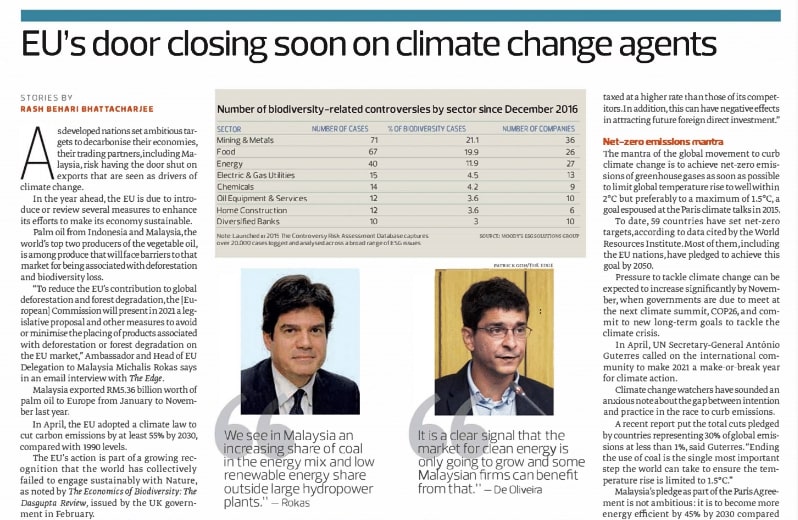
With a RM5.36 billion palm oil industry at stake, Malaysia’s palm oil exports are set to face stricter trade barriers to markets such as the EU, for their association with deforestation and biodiversity loss.

Prof. Renato Lima de Oliveira, Assistant Professor of Business and Society at the Asia School of Business (ASB) and senior fellow at The Institute for Democracy and Economic Affairs (IDEAS), shared his thoughts recently on how Malaysian businesses can respond to these growing trends with The Edge, Malaysia’s leading business and investment weekly publication.

He advocates for putting sustainability at the forefront of business strategy, greater engagement with societal stakeholders, and greater engagement with the government. “It’s a clear signal that the market for clean energy is only going to grow and some Malaysian firms can benefit from that,” said Prof. Renato.

Read the full article HERE.
Originally published by The Edge Malaysia – a business and investment weekly.