Asia School of Business

Edit Content
Executive Education

KUALA LUMPUR, Aug 14 (Bernama) — Economists agree that Malaysia’s gross domestic product (GDP) for the second quarter of 2024 (2Q 2024) will expand by a phenomenal 5.8 per cent from 1Q 2024’s 4.2 per cent.

They said GDP growth will be bolstered by brisk industrial activities, higher crude palm oil prices, fewer unemployed people, and increased spending.

The economists also concur that the economy is well-positioned to expand by between 4.0 and 5.0 per cent for the whole of 2024, with an accounting body stating that global confidence in Malaysia has improved significantly as it has shown notable economic resilience.

Bank Muamalat Malaysia Bhd chief economist Dr Mohd Afzanizam Abdul Rashid said 2Q 2024’s GDP growth would be in line with the Department of Statistics Malaysia (DoSM) advance estimates of 5.8 per cent.

He told Bernama that the economy’s growth momentum would continue into 2Q 2024 beating 1Q 2024’s growth of 4.2 per cent markedly.

Mohd Afzanizam said the prevailing data points suggest Malaysia’s economy is expected to do well in June.

He highlighted that the country recorded higher growth in the volume index of services and the industrial production index, which rose by 6.7 per cent and 4.5 per cent, respectively, in 2Q 2024.

He added that crude palm oil production has increased by double-digits to 15.9 per cent from 3.4 per cent previously, indicating increased export income from the country’s top non-oil commodity earner.

Besides this, Mohd Afzanizam pointed out that the unemployment rate has remained at 3.3 per cent for three consecutive quarters, but the number of unemployed individuals has declined to 557,800 in 2Q 2024 from 561,100 in 1Q 2024.

“On that note, Malaysia’s employment markets may have reached full employment status, meaning there are plenty of jobs to be found and more people have jobs and have been receiving income.

“The introduction of flexible withdrawal accounts by the Employees Provident Fund, along with cash transfer programmes, will allow for a higher growth trajectory in the immediate terms.

“Hence, 2Q 2024’s GDP should be higher than the previous quarter,” he said.

Ozer Karagedikli, professor of practice and director of the Central Banking Research Centre at Asia School of Business, agreed with Mohd Afzanizam, saying GDP is estimated to expand by 5.8 per cent, fostering optimism over the nation’s economic strength.

Karagedikli said Malaysia’s economic potential is substantial, and a growth rate between 4.0 and 5.5 per cent can be achieved.

He said the range is wide and cautioned that the situation is complex because achieving consistent growth close to six per cent might be challenging.

“It is not so simple as achieving consistent growth rates close to 6.0 per cent year after year is possible but might prove challenging without significant reforms to enhance the economy’s productivity and competitiveness,” he said.

Meanwhile, the latest Global Economic Conditions Survey by the Association of Chartered Certified Accountants (ACCA) and Institute of Management Accountants found a slight improvement in global confidence among accountants and finance professionals in Malaysia’s economy, especially for 2Q 2024.

In a statement, the ACCA said that the Asia Pacific region, including Malaysia, has shown notable resilience, providing key insights into regional economic trends and risk priorities.

“Malaysia, as part of the Asia Pacific region, has mirrored these positive trends. The country’s manufacturing sector has seen a notable uptick, driven by increased global demand and advancements in technology,” it said. 

The ACCA said the survey found that the Malaysian government’s recent initiatives to boost the digital economy and enhance infrastructure have further supported the growth.

“Key policies such as the National Investment Aspirations and the Malaysia Digital Economy Blueprint have been instrumental in driving economic resilience,” it added.

Juwai IQI global chief economist Shan Saeed also expects GDP to hover between 4.0 to 4.5 per cent in 2Q 2024, driven by Malaysia’s overall solid economic growth amid global economic uncertainties, geopolitical risk and the collapse of equity markets in the West. 

He said global economic uncertainties have led Malaysia’s economy to remain a beneficiary and continue to attract investment as investors would move to countries where infrastructure investment is solid. 

“Consumption and investment (among the indicators of GDP) are expected to be strong, bolstering economic stability. Meanwhile, tourists’ arrival, integrated circuit technology (ICT), and commodities exports are sending positive signals to the market,” he said.

On July 19, DoSM reported an estimated 5.8 per cent expansion in 2Q 2024, up from 4.2 per cent in the previous quarter and the highest growth since 7.4 per cent in 4Q 2022.

For the first half of 2024, chief statistician Datuk Seri Mohd Uzir Mahidin said GDP rose by 5.0 per cent versus 4.1 a year ago, and Malaysia’s economy is expected to continue its growth momentum, supported by domestic and export-driven factors, with a positive outlook for the rest of the year.

Bank Negara Malaysia (BNM) will release the official 2Q 2024 GDP data on Friday.

Malaysia on track to meet 2024 GDP forecast

Mohd Afzanizam opined that Malaysia is on track to meet its range forecast for its GDP of between 4.0 per cent to 5.0 per cent this year.

“Risks to growth are fairly balanced for now, given that the major economies are still growing in a positive territory. What matters now is the upside risk arising from the rationalisation of fuel subsidies, especially on RON95,” he said.

Additionally, Mohd Afzanizam said the pricing behaviour among businesses indicated a tendency for prices to be raised, which would translate into an expectation of higher inflation.

“On that note, the BNM is expected to keep its current monetary policy stance at status as it needs to strike the right balance between promoting economic growth and keeping the risks of higher inflation at bay.

“At 3.00 per cent, the OPR appears to be at the right spot for BNM to remain supportive of the economy,” he added.

Meanwhile, Shan foresees Malaysia’s 2024 GDP edging up from 4.3 per cent to 4.8 per cent, which is supported by macroeconomic stability, higher commodity prices, ICT/semiconductor attraction, and ⁠strategic geography.

“Higher oil prices would benefit the government in terms of consolidating the fiscal side of the balance sheet.

“ICT demand is growing globally. Malaysia is in a perfect position to supply more, thus creating jobs and more revenue for companies and helping the GDP growth at the macro level,” he said.

Additionally, Shan said that geographically, Malaysia is located at a strategic point as 80 per cent of China’s trade moves through the Strait of Malacca, while 25 per cent of global oil supplies also pass through the same seaway.

“This makes Malaysia an ideal location for many investors to consider the country for long-term investment and resource deployment,” he said.

According to BNM, the Malaysian economy is projected to grow between 4.0 per cent and 5.0 per cent in 2024, underpinned by continued expansion in domestic demand and improvement in external demand.

In its Economic and Monetary Review 2023 report, the central bank said growth will be driven by resilient domestic expenditure, with additional support from the expected recovery in exports.

“Tourism is expected to improve further while implementing new and ongoing multi-year projects by both the private and public sectors would support investment activity. 

“Nevertheless, domestic growth remains subject to downside risks from both external and domestic factors,” BNM added.

Originally published by Bernama.

KUALA LUMPUR: Unjuran awal Keluaran Dalam Negara Kasar (KDNK) Malaysia yang menunjukkan ekonomi berkembang 5.8 peratus pada suku kedua 2024, mendorong keyakinan terhadap keteguhan ekonomi negara, kata Profesor Ozer Karagedikli (bergambar).

Karagedikli yang juga Professor of Praxtice dan Pengarah Pusat Penyelidikan Perbankan Pusat di Asia School of Business (ASB) itu berkata, Malaysia mempunyai potensi ekonomi yang besar, justeru kadar pertumbuhan ini mungkin tercapai.

Read the full article HERE.
Originally published by Utusan Sarawak.

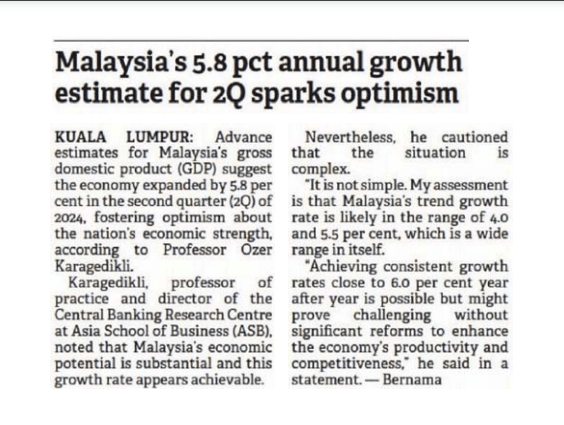
KUALA LUMPUR: Advance estimates for Malaysia’s gross domestic product (GDP) suggest the economy expanded by 5.8 per cent in the second quarter (2Q) of 2024, fostering optimism about the nation’s economic strength, according to Professor Ozer Karagedikli.

Karagedikli, professor of practice and director of the Central Banking Research Centre at Asia School of Business (ASB), noted that Malaysia’s economic potential is substantial and this growth rate appears achievable.

Nevertheless, he cautioned that the situation is complex.

“It is not simple. My assessment is that Malaysia’s trend growth rate is likely in the range of 4.0 and 5.5 per cent, which is a wide range in itself.

“Achieving consistent growth rates close to 6.0 per cent year after year is possible but might prove challenging without significant reforms to enhance the economy’s productivity and competitiveness,” he said in a statement. – Bernama

Originally published by The Borneo Post

KUALA LUMPUR: Unjuran awal Keluaran Dalam Negara Kasar (KDNK) Malaysia yang menunjukkan ekonomi berkembang 5.8 peratus pada suku kedua 2024, mendorong keyakinan terhadap keteguhan ekonomi negara, kata Profesor Ozer Karagedikli.

Karagedikli yang juga Professor of Practicedan Pengarah Pusat Penyelidikan Perbankan Pusat di Asia School of Business (ASB) itu berkata, Malaysia mempunyai potensi ekonomi yang besar, justeru kadar pertumbuhan ini mungkin boleh dicapai.

Bagaimanapun, beliau dalam kenyataan hari ini menegaskan situasi ini adalah kompleks.

“Ini tidak mudah. Penilaian saya adalah trend kadar pertumbuhan Malaysia mungkin berada dalam julat 4.0 hingga 5.5 peratus, iaitu julat yang luas.

“Mencapai kadar pertumbuhan yang konsisten hampir 6.0 peratus tahun demi tahun adalah munasabah, tetapi mungkin menghadapi cabaran tanpa pembaharuan ketara untuk meningkatkan produktiviti dan daya saing ekonomi,” katanya.

Beliau turut menekankan ketidaktentuan ekonomi global boleh menimbulkan risiko kepada prospek ekonomi Malaysia.

“Angka KDNK terkini mewujudkan banyak aspek untuk dibincangkan oleh ahli ekonomi sektor kewangan.

“Bagaimanapun, bagi pembuat dasar dan orang ramai, cabaran sebenar terletak dari segi mengekalkan kadar pertumbuhan itu dari masa ke masa. Ini adalah sesuatu yang kita harapkan,” kata Karagedikli.

Jabatan Perangkaan Malaysia (DOSM) pada 19 Julai mengumumkan ekonomi Malaysia diunjurkan berkembang 5.8 peratus pada suku kedua 2024, meningkat daripada 4.2 peratus pada suku sebelumnya.

Ia merupakan pertumbuhan tertinggi sejak suku keempat 2022 yang mencatatkan 7.4 peratus.

Bank Negara Malaysia (BNM) dijangka mengumumkan data rasmi KDNK suku kedua 2024 pada Jumaat.

Originally published by Berita Harian.

KUALA LUMPUR: Advance estimates for Malaysia’s gross domestic product (GDP) suggest the economy expanded by 5.8 per cent in the second quarter (2Q) of 2024, fostering optimism about the nation’s economic strength, according to Professor Ozer Karagedikli.

Karagedikli, professor of practice and director of the Central Banking Research Centre at Asia School of Business (ASB), noted that Malaysia’s economic potential is substantial and this growth rate appears achievable.

Nevertheless, he cautioned that the situation is complex.

“It is not simple. My assessment is that Malaysia’s trend growth rate is likely in the range of 4.0 and 5.5 per cent, which is a wide range in itself.

“Achieving consistent growth rates close to 6.0 per cent year after year is possible but might prove challenging without significant reforms to enhance the economy’s productivity and competitiveness,” he said in a statement.

He also pointed out that global economic uncertainties might pose risks to Malaysia’s economic outlook.

“The latest GDP figure offers much for financial sector economists to discuss.

“However, for policymakers and the broader public, the real challenge lies in sustaining such growth rates over time. That is something we all hope for,” Karagedikli added.

On July 19, the Department of Statistics Malaysia reported an estimated 5.8 per cent expansion in 2Q 2024, up from 4.2 per cent in the previous quarter and the highest growth since 7.4 per cent in 4Q 2022.

Bank Negara Malaysia is set to release the official 2Q 2024 GDP data on Friday.

Originally published by Bernama.

The financial demands of achieving net zero emissions by 2050 present a challenge unparalleled in human history. While infrastructure fi- nance was the previous big-ticket financing scheme to grab every- one’s attention, the scale of investment needed for net zero far exceeds anything we have seen before. The transformation required to decarbonise our global economy necessitates not only substantial capital but also innovative financial mechanisms and a fundamental shift in thinking.

Comparing financial needs: Infrastructure versus net zero

Just over a decade ago, the McKinsey Glob- al Institute estimated that US$57 trillion would be required for global infrastructure investments from 2013 to 2030, translat- ing into an annual spend of US$3.3 tril- lion. Southeast Asia alone needed US$800 billion per year between 2010 and 2020. Despite these vast sums, a 2018 update revealed a 10% funding gap for sanctioned projects in Asia.

In stark contrast, the financial require- ments for achieving net zero are even more daunting. According to McKinsey’s Net Zero Transition report (January 2022), about US$9.2 trillion annually is needed for in- vestments in energy and land use systems from 2023 to 2050. This figure represents about 7.5% of global gross domestic product (GDP), equivalent to half of all corporate profits and a quarter of all tax revenues in 2020. The financial burden is enormous, demanding unprecedented collaboration between the public and private sectors.

The urgency of climate action

Limiting global warming to 1.5°C is critical to preventing the most severe and irreversible impact of climate change. Achieving this goal involves capping future net emissions of carbon dioxide at 570 gigatonnes from 2018 onwards and reaching net zero emissions by 2050. At current emission rates, the world will exceed this target by 2031.

Meeting the 1.5°C target requires rapid and large-scale decarbonisa- tion efforts, supported by signifi- cant economic incentives. This ne- cessitates fundamental changes in various sectors, including energy, agriculture and transport.Compa- nies must invest heavily in decar- bonisation technologies, and high carbon footprint individuals must adapt their lifestyle.

Borrowing our approach instead of reinventing the wheel

To achieve net zero, we need effective finan- cial strategies for food, forestry and carbon capture, along with sector reforms. Even with rapid fossil fuel emission reductions, deforestation must decrease by 75% by 2030. Large-scale, nature-based carbon removal, like reforestation and restoring peatlands and seagrass, is essential. An acre of ocean seagrass can sequester 335kg of carbon an- nually, and the world’s peatlands seques- ter about 370 billion kilograms annually, or 500kg per acre. Peat soils contain more carbon than any other terrestrial ecosys- tem, highlighting the importance of pre- serving and restoring these carbon sinks.

There could perhaps be a review of the way in which the carbon experts issue cred- its, which currently focuses on “addition- ality”- the process of issuing credits for carbon-reducing activities that wouldn’t occur without the carbon credit market. Drawing from a financial economics analogy, equilibrium implies no ar- bitrage. Conversely, if arbitrage exists, there is no equilibrium. Applying this logic, existing conservation efforts in seagrass meadows, forest reserves and peatlands should also qualify for carbon credits. This expanded definition would leverage their immense potential in carbon sequestration.

Innovative financing models

Meeting the financial demands of net zero requires innovative “blended financing” models that leverage both public and private capital. One such model is the Managed Co-Lending Portfolio Programme (MCPP) by the In- ternational Finance Corporation (IFC).This syndication lending structure, supported by credit enhancements such as first-loss guarantees, enables the IFC to co-invest in a portfolio of loans on infrastructure projects with institutional investors. The recent launch of the MCPP One Planet facil- ity focuses on climate-smart investments aligned with the Paris Agreement.

Another example is the IFC/Amundi Green Cornerstone Bond Fund, which chan- nels capital from institutional investors into sustainable bond issuances in developing countries. Blended finance approach lev- erages public or multilateral development bank (MDB) capital to attract significantly more private investment. The IFC-Amundi structured fund, for instance, attracted 16 times as much private investment, demon- strating the effectiveness of this model.

Establishing a carbon credit market

To further support net zero financing, establishing an ESG-compliant auction market for carbon credits is essential. This platform should promote spot trading of standardised carbon credit contracts that adhere to leading international stand- ards, such as the Verified Carbon Standard (VCS).Standardised contracts could bundle credits from various projects, including nature-based solutions. A liquid trading platform would allow for the efficient exchange of carbon credits, with prices varying from US$0.02 per kilogram in emerging exchanges to as high as US$0.10 per kilogram in the European Union’s emissions trading schemes.

Digitalising carbon credits through se- curity tokens could democratise access, allowing retail investors to participate in and trade these assets, protecting existing carbon sinks while funding reforestation, seagrass transplantation and peatland res- toration projects.

Achieving net zero is an extraordinary challenge that requires a comprehensive, multifaceted approach. By leveraging in- novative financing models that go beyond goodwill and donations, enhancing carbon credit markets and encouraging green investments, we can mobilise the nec- essary resources to transform our global economy. Malaysia, with its strengths in shariah-compliant financial instruments, institutions and blended finance, is well po- sitioned to lead the way.A concerted effort from governments, the private sector and academia is crucial to establishing sound financial policies and sustainable invest- ment vehicles that will guide us towards a net zero future.

Originally published by The Edge.

Fourier’s GR-1 humanoid robots are displayed on Thursday during the World Artificial Intelligence Conference (WAIC) in Shanghai, China, on July 4, 2024. (AFP/AFP)

Quaternary education is the fourth level of education following an undergraduate degree, or to put it simply, postgraduate study.

Asia School of Business CEO Sanjay Sarma said Indonesia needed to develop the quaternary education sector in the country to better equip the working- age population against generational challenges.

Quaternary education is the fourth level of education following an undergraduate degree, or to put it simply, postgraduate study. 

“Technology changes so fundamentally, AI’s [artificial intelligence] impact on the economy is going to be very significant, and that’s not the only technology that’s changing the economy,” he told The Jakarta Post on Aug. 1, saying that the quaternary system had huge potential because everyone was migrating jobs.

“Even biotech is changing the economy in ways that you probably don’t realize. So the rest of the world is also struggling. But Indonesia has an opportunity […] because of its demographic dividend. So it’s gold. Invest in a gold mine.”

Most Indonesians do not go to universities, with roughly 30 percent of the population having studied at this level, according to Statistics Indonesia data from 2023. Elementary to senior high school fared better, with between 86 and 100 percent participation.

Tertiary and quaternary education have been largely limited to households within the highest tier out of five expenditure groups in Indonesia, with participation reaching over 50 percent, whereas those from the lowest tier only saw around 17 percent gaining a university-level education, according to Statistics Indonesia data.

However, Sarma said “money is not the issue” when it comes to innovating education, but vision.

“A good university is going to act like a start-up. It’s a mentality. It’s the entrepreneurial mindset where you’re probing the unknown,” he said, suggesting Indonesia adopt a two-pronged strategy to develop its quaternary education secretary.

First, the country could start with exploratory and experimental licenses as well as incentives “to change the game” in the educational system, Sarma said. Second, the government could take a couple of public universities and create sandboxes.

“Where they change the game, where they create a program that is within, where they teach engineering completely differently. This is a known model,” he explained.

“Start-ups and education are intertwined. Behave like a start- up, use technology created by start-ups, create start-ups.”

Living MIT graduates who have started and built for-profit companies do not qualify as a nation. However, if they did, they’d be the world’s 10th largest economy, with gross revenue ranking between Russia and India’s GDP of $2.097 trillion and $1.877 trillion, respectively, according to a report released by MIT in 2015.

As of 2014, the report estimates, MIT alumni have launched 30,200 active companies, employing roughly 4.6 million people, and generating roughly $1.9 trillion in annual revenue.

Originally published by The Jakarta Post.

Cover Trust enhances employee engagement, supports active learning, encourages ESG efforts, and fosters a positive attitude toward technological advancements, according to a survey by PwC Malaysia and ASB (Photo: Thirdman from Pexels)

It’s widely known that trust in a work setting acts as the cornerstone of effective leadership, cohesive teamwork, and a productive work environment. To that end, a recent comprehensive study conducted by PwC Malaysia and the ASB has shed light on the intricate dynamics of trust in the workplace, offering valuable insights for both employees and employers.

As part of the Building Trust Awards 2023, PwC Malaysia and ASB ran a survey between August 14 and September 8, 2023, with more than 11,000 respondents from their finalist companies and found that building a high-trust organisation is not merely an ethical imperative but a strategic advantage. Trust enhances employee engagement, supports active learning, encourages environmental sustainability (ESG) efforts, and fosters a positive attitude toward technological advancements. 

By prioritising fairness, transparency, and respect, organisations can create a work environment where trust thrives, ultimately leading to enhanced performance and a more cohesive corporate culture. Employers must recognise the multifaceted nature of trust and strive to address the unique needs and perceptions of their diverse workforce. By doing so, they can leverage trust as a powerful motivational force, driving both individual and organisational success.

Here are more key findings from PwC Malaysia and ASB’s Trust & Leadership Survey Study 2023.

The essence of trust
Trust, as conceptualised in the study, is not a one-size-fits-all notion but varies uniquely across relationships. The foundational aspects of trust include competence, benevolence, and integrity. Competence refers to the organisation’s ability to perform its duties effectively, benevolence indicates the company’s genuine concern for its employees’ welfare, and integrity involves sticking to one’s word and upholding ethical standards.

Employees’ trust in their organisations is pivotal, encompassing their confidence in the company’s competence and benevolence. The study highlights that employees generally trust their employers more than other institutions like NGOs, media, or the government, emphasising the crucial role employers play in shaping workplace trust dynamics.

Trust operates at various levels within an organisation
  1. Trusting the company: Employees’ belief in the organisation’s overall competence and concern for their well-being.
  2. Trusting the supervisor: The extent to which employees feel comfortable allowing their supervisors to influence important work-related issues.
  3. Trusting coworkers: The level of trust employees have in their peers and colleagues.

Interestingly, while 53 per cent of employees trust their supervisors, a significant 29 per cent remain uncomfortable with supervisors having substantial influence over crucial matters. This indicates a gap that needs addressing to enhance supervisory relationships.

Benefits of a high-trust environment

The study reveals several compelling benefits associated with high-trust environments. Employees who trust their company are more likely to engage in active learning, supporting organisational efforts toward ESG, and embracing new technologies such as AI. For instance, 87 per cent of employees who trust their company are active learners, compared to just 13 per cent who do not trust their organisation.

Moreover, trust significantly influences employees’ perception of future rewards. A staggering 93 per cent of employees who trust their company believe their efforts will be rewarded in the future, compared to only seven per cent among those who do not trust their company. This correlation underscores the motivational power of trust in driving employee performance and engagement.

The role of fairness and justice

Fairness and justice play critical roles in trust-building within an organisation. The study identifies four key predictors of employee trust:

  1. Distributive justice: Fairness in resource distribution, such as pay, rewards, and promotions.
  2. Procedural justice: Transparency and clarity in the procedures for performance assessment and reward allocation.
  3. Interpersonal justice: The culture of respect and empathy in interpersonal interactions.
  4. Informational justice: Timeliness and transparency of communication.

For instance, employees’ perception of distributive justice significantly affects their trust levels. An overwhelming 83 per cent of those who perceive distributive injustice distrust their company, compared to just 12 per cent who perceive justice. This highlights the necessity for fair and transparent practices to foster trust.

Demographic variations in trust perceptions
The study also delves into how different demographic groups perceive trust and justice within the workplace. Notably, employees without managerial power report worse diversity climate and justice perceptions compared to their managerial counterparts. Additionally, women experience significantly lower levels of justice and a worse workplace diversity climate than men. These disparities suggest that a uniform approach to trust-building may not be effective and that tailored strategies are required to address diverse employee experiences.
 
Originally published by Tatler Asia.

WOMEN are increasingly entering the freelance economy, particularly through e-commerce and social media platforms.

TalentCorp group COO Siva Kumeren A Narayanan identified a discrepancy in women’s participation in the formal labour force, which has not yet achieved the 60% threshold, even though their enrolment rates in higher education have reached 63%

“More women are engaging in the gig economy, for example through social media and e-commerce platforms. While this is a positive development, it does not always translate into formal labour force participation.

“Gig economy is also changing the way the formal education route is taken up and workforce entries are pathing — something the government is studying further,” he said at the Leadership Summit Series on the Future of People@Work recently.

The summit was organised by the Asia School of Business (ASB) which gathered industry leaders, scholars, and human resource (HR) experts to analyse the future of work and the obstacles it presents.

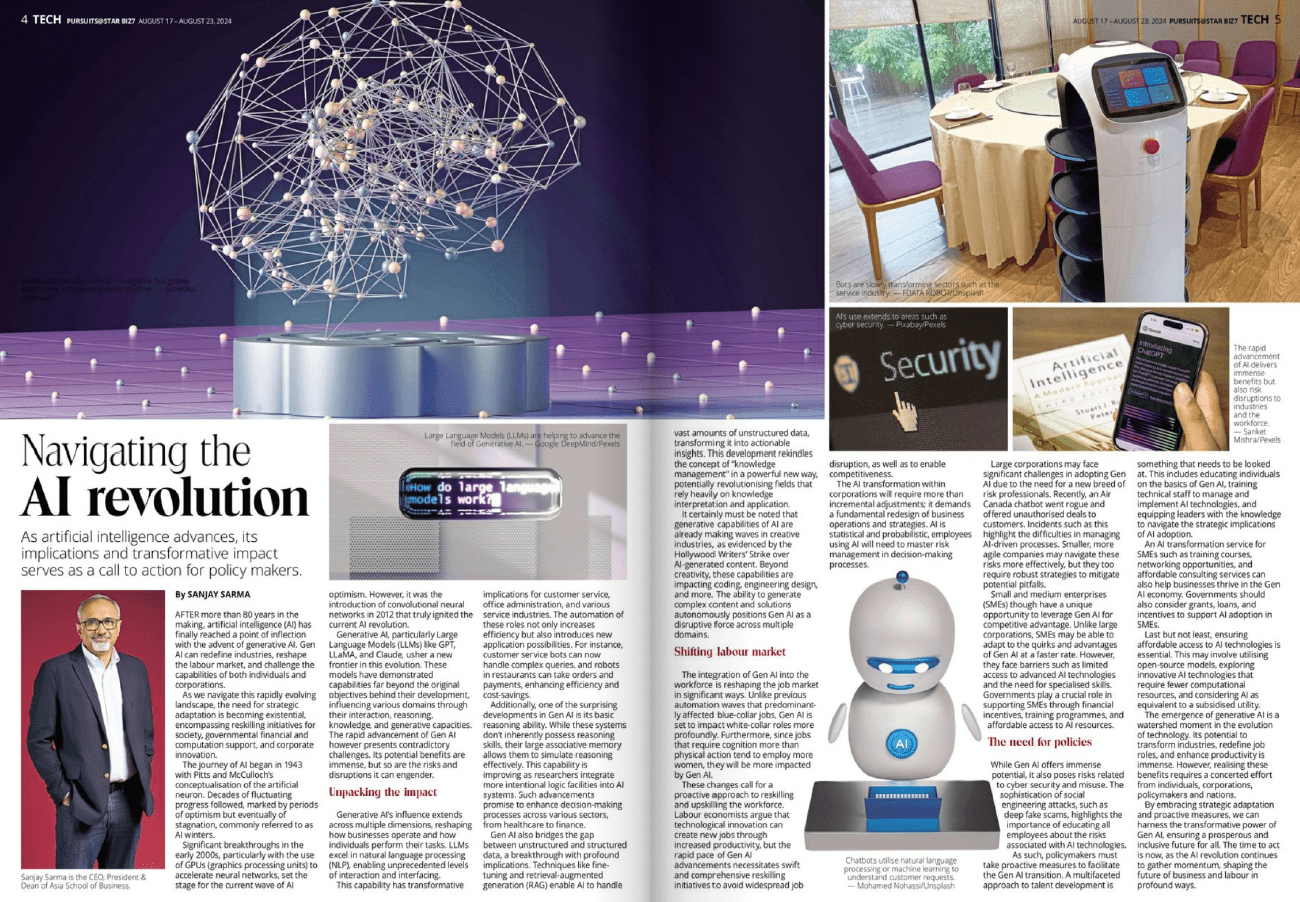
ASB CEO, president and dean Sanjay Sarma discussed the advantages of artificial intelligence (AI) and digital transformation.

He anticipated a future in which technology not only improves industries but also transforms work structures, fostering inclusive and dynamic environments.

“The future of work involves more than technology. It is about reimagining how we connect, collaborate, and grow.

“AI has transformed industries through how it integrates everything including green finance, fintech, ESG sustainability, Internet of things (IoT) and biotech,” he said.

Sanjay added that this evolution is not just a leap in technology but a revolution in how tasks and organisations are structured.

He said the AI and digital transformation critically rest on continuous learning and adaptability, so workforces remain resilient and innovative amid rapid changes.

Meanwhile, FinTech entrepreneur and BFM Radio founder Malek Ali emphasised the importance of adaptability and continuous learning in the interim.

He noted that adaptability, continuous learning, creativity, problem-solving, critical thinking, emotional intelligence, and curiosity are the greatest assets in this era of rapid change.

“To fully harness the power of AI, we must integrate it into our education system,” he said, adding that investing in AI will strengthen workforces and drive innovation and resilience.

Additionally, an associate professor at ASB, Alexander Eng, underscored the significance of understanding employee perceptions and attitudes to ensure the successful implementation of AI strategies in the workplace, thereby incorporating a human perspective into the AI discourse.

Additionally, Citi Malaysia chief Human Resources officer Tooba Modassir emphasised the evolving skill sets required for the future workforce, namely flexibility and adaptability.

“Even when sourcing for talent, we are focused on hiring for skills, competencies and culture fit.

“In a rapidly evolving job market, it is imperative to equip employees with the ability to learn and grow continuously,” he said.

He advised organisations to foster a culture of continuous learning and innovation, and encourage employees to take ownership of their development.

Meanwhile, Bursa Malaysia Group Sustainability director Ahmad Hezri Adnan touched on sustainability.

He said since the Paris Agreement in 2015, there has been a coordinated effort by businesses, governments, and society to adopt sustainable practices.

“We are witnessing a significant shift towards transparency and accountability in environmental reporting, which is crucial for achieving our sustainability goals.

“Companies must integrate these practices into their core operations and their talent force in order to drive such meaningful change,” he said.

Originally published by The Malaysian Reserve.

Asia School of Business, P&G and Temasek Foundation CSS Impact Report 2024 highlights five key findings of smallholders programme

THE P&G Center of Sustainable Small owners (CSS), at the Asia School of Business (ASB) recently announced the release of the CSS Impact Report 2024 on June 15 highlighting the performance and impact of the P&G Smallholders Program.

The programme is a collaboration between ASB, P&G and Temasek Foundation, which aims to promote sustainable and good agricultural practices, and facilitate the production of certified sustainable palm oil from among independent smallholders in the districts of Pontian and Batu Pahat in Johor Baru, Malaysia.

The report through March 2024 highlights the significant achievements and insights gained over the course of the programme. Some of the key findings include:

  • Increased certification rates: Over 400 smallholder farmers have now achieved the internationally recognised Roundtable for Sustainable Palm Oil (RSPO) Independent Smallholder (ISH) Certification (RISS) under the programme, with a further 400 ISHS anticipated to be certified by the end of 2025
  • Enhanced livelihoods: 306 certified independent smallholders have received a total of USD 42,630 (over RM200,000) in premium in 2021-2023 for their certified palm produce, increasing their livelihoods.
  • Environmental impact: Implementation of good agricultural practices promoting better waste and chemical management among smallholder farmers, including the right use and application of fertilisers.
  • Community empowerment: CSS facilitated the establishment of Pertubuhan Tani Niaga Lestari Negeri Johor (Pertaniaga), an associ ation that is owned 100% by independent smallholders, and has guided it through training, certification and yield improvement leading to a path of continuous improvement. Pertaniaga membership has now increased to over 700 smallholders.
  • Training and awareness: Theprogramme has also developed a simplified CSS curriculum on Good Agricultural Practices (GAP). Since July 2022, CSS has successfully trained 1,972 smallholder farmers on GAP and Best Management Practices. This GAP training and awareness is set to expand its reach through collaborations with state and district agricultural departments and farmer associations.

The Center for Sustainable Small owners (CSS) was first launched in 2019 by funding from Procter & Gamble (P&G) to deliver on its Ambition 2030 goals through the P&G smallholders initiative. Under ASB, CSS is committed to empowering and improving smallholders’ livelihoods through traceability, compliance and capacity building through training and implementation of sustainable and best in class agricultural practices in accordance with global standards.

P&G Chemicals Sustainability Program director Francis Wiederkehr shared, “The P&G Smallholder Program is entering its fifth year, and we are proud to have seen it go from strength to strength. “It has demonstrated the power of research driven but practically focused and inclusive on the ground programmes in fostering sustainable agriculture.

This year’s report once again underlines the importance of collaboration and shared responsibility among all the players across the supply chain. And it demonstrates the role of RSPO certification can play in promoting environmental stewardship and economic resilience among smallholders,” Wiederkehr added. Meanwhile, Temasek Foundation Climate & Liveability head Heng Li Lang reiterated the foundation’s commitment to supporting people centered sustainable development.

“The programme embarks on a continuous improvement strategy to enhance livelihoods of independent smallholders through sustainable and good agricultural practices including waste, peat and nutrient management. We are happy to partner with ASB and P&G to catalyse impact over the long term with the reduction of the overall ecological footprint of oil palm production by these very small farmers.”

ASB chief executive officer, president and dean Dr Sanjay Sarma noted that, “The outcomes reflected in this report are a testament to the dedication and hard work of the CSS Research Center at ASB along with the smallholder organisation Pertaniaga. “We are happy that this collaboration between ASB, P&G and Temasek Foundation is able to create such a positive impact,” he added.

Malaysia is the second largest palm oil producer globally. There are over 275,000 independent palm oil smallholder farmers in Malaysia, who collectively account for an estimated 17% of total oil palm planted area in the country. Compared to organised smallholders, independent smallholders have smaller land areas and limited access to knowledge, technology and guidance.

Originally published by The Star.