Asia School of Business

Edit Content
Executive Education

It’s no secret that technology is transforming business education at a faster rate than ever. At the heart of this digital transformation are exciting advancements in AI, the Internet of Things (IoT), and biotechnology — just to name a few.

As the business landscape shifts, B-schools are jockeying for position, rolling out different learning formats to accommodate students from all corners of the world. According to its dean, Asia School of Business, based in Kuala Lumpur, Malaysia, is stepping up to the challenge, blending traditional and digital learning while maintaining focus on flexibility, accessibility, and cutting-edge educational frameworks.

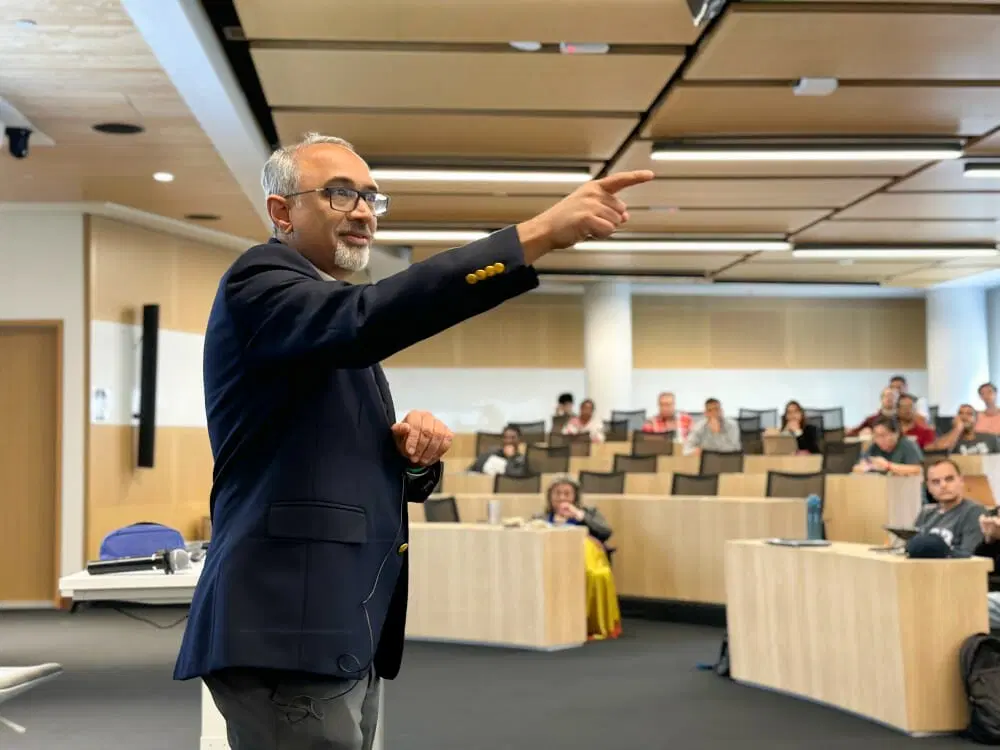
“It is, in my view, a matter of time before students demand an even greater degree of agility,” ASB Dean Sanjay Sarma tells Poets&Quants.

‘ASB is particularly keen on action learning projects’

ASB has offered their MBA in collaboration with MIT Sloan for the past ten years, and recently redesigned the program to a 12-month format. The program is taught with signature MIT flair, emphasizing practical, real-world experiential learning within industries and organizations across Asia and the U.S.

With roots from MIT and developed at ASB, their hybrid ACE (Agile Continuous Education) program incorporates both video learning and live sessions, that leads to either masters programs or specializations.

At the forefront of the program is Sarma, the Fred Fort Flowers and Daniel Fort Flowers professor of mechanical engineering at MIT, who is not only ASB’s dean but also its CEO and president. He and his ASB colleagues are preparing students to face global challenges during this era of dramatic digital transformation, integrating advanced technologies and AI into the curriculum in a way that other institutions of higher learning will inevitably seek to emulate.

At the core of everything they do is embracing the mutability of business education — essential at a time of great and rapid change. “There are so many things that could change — what are we teaching, who is teaching it, do we have the capacity to teach it,” Sarma says. “ASB is particularly keen on action learning projects, so we put students in the field — an MIT concept.”

Below, see highlight from Poets&Quants’ interview with Sarma, edited for length and clarity.

What are the biggest challenges you’re currently facing with digital transformation?

It’s about disintegrating and reintegrating. Let’s say you wanted to learn about AI, crypto or carbon credits. Where do you go?

What we are doing is creating these hybrid courses where you watch the videos when you can, such as on the weekends. You don’t have to leave your job – you watch the videos when you can. You’re a weekend warrior and you master the topic when you can.

How is AI being utilized at ASB and how it is transforming teaching methods?

There are a few different levels. First, much of what professors use is automated, and a lot it is customer service based.

The next is in using AI to generate codes to write classroom games and simulations.

The third is using AI as a tutor. It can ask you questions, and you as the student can ask it questions.

The other thing about AI is, it’s going to be something you have to retrain yourself in every six to nine months because every thing has changed so much. I spend about two to three hours a week reading up on the latest myself.

The faculty have lots of discussions about AI, and we are small, so we can do that. The systems naturally absorb AI. AI tools creep in even for those professors who don’t use it often. You just have to be open-minded right now.

How is ASB preparing students to tackle these unique challenges in the global business world?

We are fundamentally rethinking our curriculum around technology.

ASB students spend weeks at a time at MIT. We introduced AI as a course and we also have a data science course.

That’s another thing for professors – they have to fundamentally rethink their curriculum.

The second piece of this is what we are doing – developing agile continuous education with our hybrid courses, which are micro-credentials that are modular, stackable and transferable to our MBA or Executive MBA, or specializations in areas such as sustainability or organizational management.

Sanjay Sarma: “It is, in my view, a matter of time before students demand an even greater degree of agility”

What other impacts do you believe the integration of advanced technologies will have on traditional business school models?

Business is changing so fast, and traditional business schools teach what needs to be taught right from the front lines.

Is the MBA worth it? These tools mean that there are so many new delivery methods. Do you want to be a movie theater in the age of Netflix? That’s the question. Adjust and adapt.

There are so many things that could change — what are we teaching, who is teaching it, do we have the capacity to teach it. ASB is particularly keen on action learning projects, so we put students in the field — an MIT concept.

How do you as a professor ensure that the curriculum remains relevant?

Its not easy. It’s very difficult to do. A lot of these fields have evolved over  a hundred years and there’s a playbook on how to teach it.

The fundamentals don’t change much,  but pretty much everything else changes when technology changes so rapidly. Take marketing, before and after TikTok. There’s a difference in the choices you make and the way you segment customers. Everything changes.

With my own technical work, I’ve changed the way I operate within the last three months. I’ve changed the way I write documents, the way I develop curriculum, the way I interact with my colleagues, the way I do research, and the way that I interact with my staff has changed.

The way I take notes, the way I do follow ups. I travel extensively, the time it takes me to plan travel has been cut in half.  I use Chat GPT, Perplexity and other tools. They all make serious mistakes. But I have achieved a level of expertise in these areas. I learn things faster now – things that would have in the past taken me weeks and months to learn.

Everything gets faster — it’s game-changing.

How important is it for MBA graduates to be proficient in emerging technologies?

100%. If you’re working at a bank as a young person, you’re going to have to take on challenges like how to use large language models in customer service. How do you address the risks of large language models, and what do you do when a large language model  makes a mistake?

Same with modern payment systems, crypto, carbon credits, I could name a hundred other similar examples. It’s really important because the vast majority of graduates are going to be at the forefront of a very significant change.

Originally published by Poets&Quants.

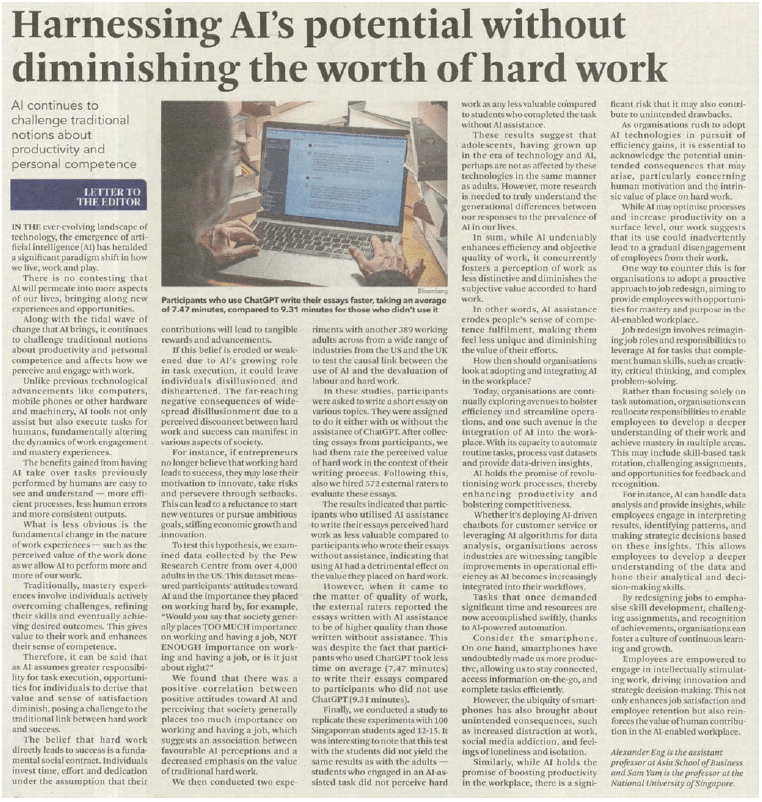
AI continues to challenge traditional notions about productivity and personal competence

IN THE ever-evolving landscape of technology, the emergence of artificial intelligence (AI) has heralded a significant paradigm shift in how we live, work and play. 

There is no contesting that AI will permeate into more aspects of our lives, bringing along new experiences and opportunities. 

Along with the tidal wave of change that AI brings, it continues to challenge traditional notions about productivity and personal competence and affects how we perceive and engage with work. 

Unlike previous technological advancements like computers, mobile phones or other hardware and machinery, AI tools not only assist but also execute tasks for humans, fundamentally altering the dynamics of work engagement and mastery experiences. 

The benefits gained from having AI take over tasks previously performed by humans are easy to see and understand — more efficient processes, less human errors and more consistent outputs. 

What is less obvious is the fundamental change in the nature of work experiences — such as the perceived value of the work done as we allow AI to perform more and more of our work. 

Traditionally, mastery experiences involve individuals actively overcoming challenges, refining their skills and eventually achieving desired outcomes. This gives value to their work and enhances their sense of competence. 

Therefore, it can be said that as AI assumes greater responsibility for task execution, opportunities for individuals to derive that value and sense of satisfaction diminish, posing a challenge to the traditional link between hard work and success. 

The belief that hard work directly leads to success is a fundamental social contract. Individuals invest time, effort and dedication under the assumption that their contributions will lead to tangible rewards and advancements. 

If this belief is eroded or weakened due to AI’s growing role in task execution, it could leave individuals disillusioned and disheartened. The far-reaching negative consequences of widespread disillusionment due to a perceived disconnect between hard work and success can manifest in various aspects of society. 

For instance, if entrepreneurs no longer believe that working hard leads to success, they may lose their motivation to innovate, take risks and persevere through setbacks. This can lead to a reluctance to start new ventures or pursue ambitious goals, stifling economic growth and innovation. 

To test this hypothesis, we examined data collected by the Pew Research Centre from over 4,000 adults in the US. This dataset measured participants’ attitudes toward AI and the importance they placed on working hard by, for example, “Would you say that society generally places TOO MUCH importance on working and having a job, NOT ENOUGH importance on working and having a job, or is it just about right?” 

We found that there was a positive correlation between positive attitudes toward AI and perceiving that society generally places too much importance on working and having a job, which suggests an association between favourable AI perceptions and a decreased emphasis on the value of traditional hard work. 

We then conducted two experiments with another 389 working adults across from a wide range of industries from the US and the UK to test the causal link between the use of AI and the devaluation of labour and hard work. 

In these studies, participants were asked to write a short essay on various topics. They were assigned to do it either with or without the assistance of ChatGPT. After collecting essays from participants, we had them rate the perceived value of hard work in the context of their writing process. Following this, also we hired 572 external raters to evaluate these essays. 

The results indicated that participants who utilised AI assistance to write their essays perceived hard work as less valuable compared to participants who wrote their essays without assistance, indicating that using AI had a detrimental effect on the value they placed on hard work. 

However, when it came to the matter of quality of work, the external raters reported the essays written with AI assistance to be of higher quality than those written without assistance. This was despite the fact that participants who used ChatGPT took less time on average (7.47 minutes) to write their essays compared to participants who did not use ChatGPT (9.31 minutes). 

Finally, we conducted a study to replicate these experiments with 100 Singaporean students aged 12-15. It was interesting to note that this test with the students did not yield the same results as with the adults — students who engaged in an AI-assisted task did not perceive hard work as any less valuable compared to students who completed the task without AI assistance. 

These results suggest that adolescents, having grown up in the era of technology and AI, perhaps are not as affected by these technologies in the same manner as adults. However, more research is needed to truly understand the generational differences between our responses to the prevalence of AI in our lives. 

In sum, while AI undeniably enhances efficiency and objective quality of work, it concurrently fosters a perception of work as less distinctive and diminishes the subjective value accorded to hard work. 

In other words, AI assistance erodes people’s sense of competence fulfilment, making them feel less unique and diminishing the value of their efforts. 

How then should organisations look at adopting and integrating AI in the workplace? 

Today, organisations are continually exploring avenues to bolster efficiency and streamline operations, and one such avenue is the integration of AI into the workplace. With its capacity to automate routine tasks, process vast datasets and provide data-driven insights, 

AI holds the promise of revolutionising work processes, thereby enhancing productivity and bolstering competitiveness. 

Whether it’s deploying AI-driven chatbots for customer service or leveraging AI algorithms for data analysis, organisations across industries are witnessing tangible improvements in operational efficiency as AI becomes increasingly integrated into their workflows. 

Tasks that once demanded significant time and resources are now accomplished swiftly, thanks to AI-powered automation. 

Consider the smartphone. On one hand, smartphones have undoubtedly made us more productive, allowing us to stay connected, access information on-the-go, and complete tasks efficiently. 

However, the ubiquity of smartphones has also brought about unintended consequences, such as increased distraction at work, social media addiction, and feelings of loneliness and isolation. 

Similarly, while AI holds the promise of boosting productivity in the workplace, there is a significant risk that it may also contribute to unintended drawbacks. 

As organisations rush to adopt AI technologies in pursuit of efficiency gains, it is essential to acknowledge the potential unintended consequences that may arise, particularly concerning human motivation and the intrinsic value of place on hard work. 

While AI may optimise processes and increase productivity on a surface level, our work suggests that its use could inadvertently lead to a gradual disengagement of employees from their work. 

One way to counter this is for organisations to adopt a proactive approach to job redesign, aiming to provide employees with opportunities for mastery and purpose in the AI-enabled workplace. 

Job redesign involves reimagining job roles and responsibilities to leverage AI for tasks that complement human skills, such as creativity, critical thinking, and complex problem-solving. 

Rather than focusing solely on task automation, organisations can reallocate responsibilities to enable employees to develop a deeper understanding of their work and achieve mastery in multiple areas. This may include skill-based task rotation, challenging assignments, and opportunities for feedback and recognition. 

For instance, AI can handle data analysis and provide insights, while employees engage in interpreting results, identifying patterns, and making strategic decisions based on these insights. This allows employees to develop a deeper understanding of the data and hone their analytical and deci- sion-making skills. 

By redesigning jobs to emphasise skill development, challenging assignments, and recognition of achievements, organisations can foster a culture of continuous learning and growth. 

Employees are empowered to engage in intellectually stimulating work, driving innovation and strategic decision-making. This not only enhances job satisfaction and employee retention but also reinforces the value of human contribution in the AI-enabled workplace. 

  • Alexander Eng is the assistant professor at Asia School of Business and Sam Yam is the professor at the National University of Singapore. 

Originally published by The Malaysian Reserve.

THE pace of economic activity in Malaysia has been accelerating since the second half of 2023. The Malaysian economy grew at an annual rate of 3.3% in Q3 2023, 3% in Q4 2023, and 3.9% Q1 2024.

The advance reading of the Q2 2024 figure indicates a significant jump, with an annual growth rate of 5.8%. This has understandably created a sense of optimism about the strength of the Malaysian economy.

Financial markets and private sector economists, particularly those in commercial banks, closely monitor these figures, as GDP figures provide important insights into the economy’s cyclical position, inflationary pressures, and the likely response from the central bank.

While this strong economic growth figure is certainly welcome, I would like to caution readers from two perspectives.

First, these advance figures are preliminary and subject to revisions-often substantial ones-as more data becomes available.

It is common for the Department of Statistics Malaysia (DOSM) to adjust these estimates as they refine their data. This practice is not unique to Malaysia; it is standard in every country.

Second, indeed, GDP figures matter greatly for the livelihoods of ordinary Malaysians.

However, the long-term prosperity of a country depends on whether such strong growth rates can be sustained over an extended period without triggering inflationary pressures or other economic imbalances.

What truly matters in the long run is the economy’s trend growth rate. Estimating this trend growth rate is challenging, as it is unobserved and subject to considerable uncertainty.

Therefore, it is important to ask if the 5.8% growth rate is within the range of sustainable growth.

In other words, can the Malaysian economy produce this rate of growth year after year for a considerable period of time?

Malaysia is a country of huge potential and this rate of growth is probably achievable. However, it is not simple.

My assessment is that Malaysia’s trend growth rate is likely in the range of 4–5.5%, which is a wide range in itself.

In arriving at this figure, I looked at the growth rate since 2014,which is significantly slower than the previous ten years.

It is important to understand the source of this slowdown that started even before COVID-19.

Achieving consistent growth rates close to 6% year after year is indeed possible but might prove challenging without significant reforms to enhance the economy’s productivity and competitiveness.

Furthermore, the global economic environment is becoming increasingly uncertain, with many head winds.

Recession fears are growing in the United States, and China’s contribution to global growth is not what it once was.

These external factors could pose risks to Malaysia’s economic outlook. In short, for financial sector economists, the latest GDP figure offers much to discuss.

However, for policymakers and the broader public, the real challenge lies in sustaining such growth rates over time. That is something we all hope for. 

Ozer Karagedikli is a Professor of Practice and the Director of the Central Banking Research Centre at the Asia School of Business Kuala Lumpur.

Originally published by Focus Malaysia.

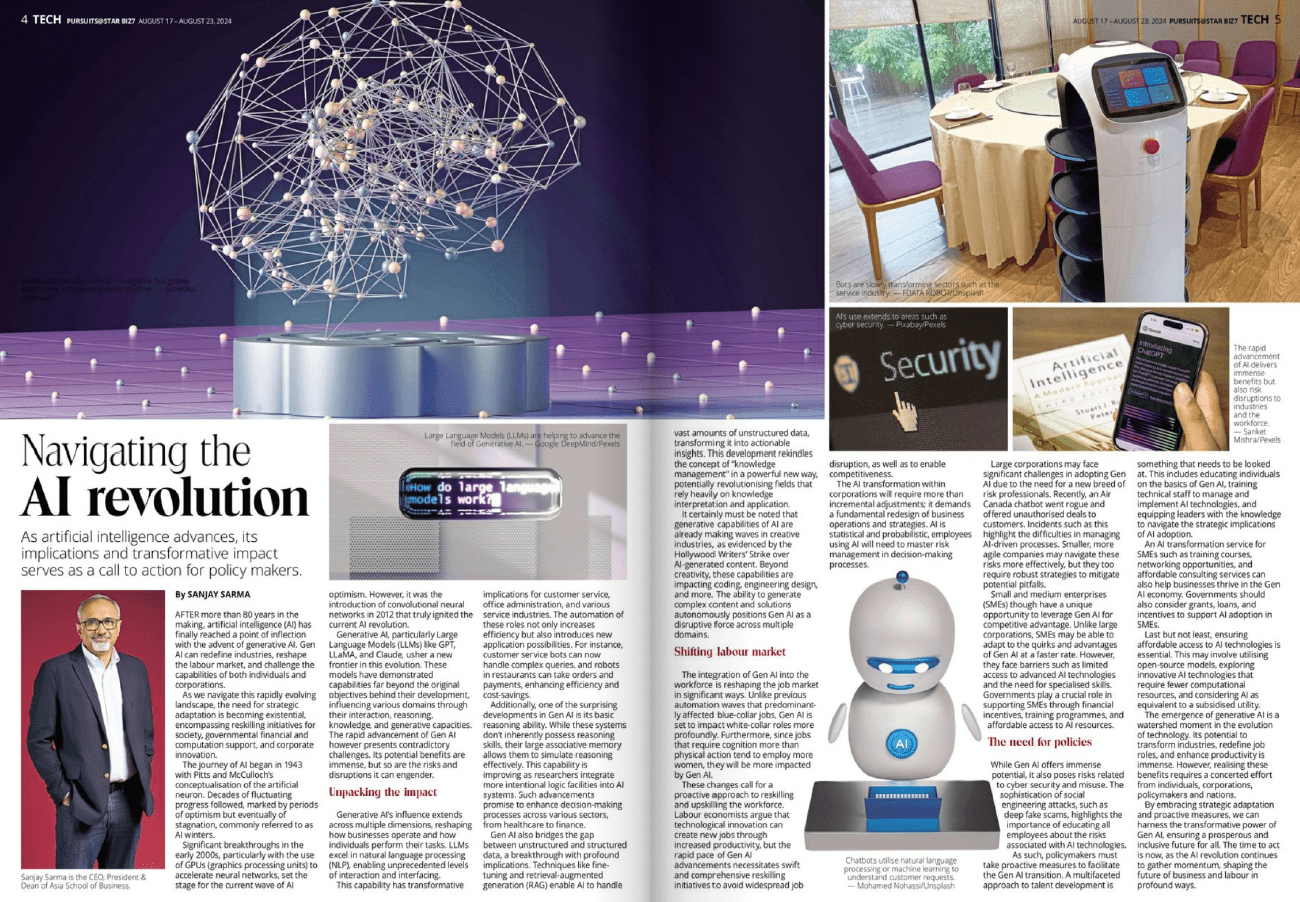
As artificial intelligence advances, its implications and transformative impact serves as a call to action for policy makers

AFTER more than 80 years in the making, artificial intelligence (AI) has finally reached a point of inflection with the advent of generative AI. Gen AI can redefine industries, reshape the labour market, and challenge the capabilities of both individuals and corporations.

As we navigate this rapidly evolving landscape, the need for strategic adaptation is becoming existential, encompassing reskilling initiatives for society, governmental financial and computation support, and corporate innovation.

Read the full article HERE.
Originally published by The Star.

KUALA LUMPUR: Kalangan ahli ekonomi yakin Keluaran Dalam Negara Kasar (KDNK) Malaysia bagi suku kedua 2024 akan berkembang pada 5.8 peratus berbanding 4.2 peratus pada suku pertama tahun ini. Mereka berpendapat pertumbuhan KDNK akan dirangsang oleh aktiviti perindustrian yang rancak, harga minyak sawit mentah lebih tinggi, pengangguran yang berkurangan dan peningkatan perbelanjaan.
 
Ahli ekonomi turut bersetuju ekonomi berada dalam kedudukan baik untuk berkembang antara 4.0 dan 5.0 peratus bagi keseluruhan 2024, dengan badan perakaunan memaklumkan, keyakinan global terhadap Malaysia meningkat dengan ketara berikutan telah mempamerkan daya tahan ekonomi yang jelas. Ketua Ahli Ekonomi Bank Muamalat Malaysia Bhd Dr Mohd Afzanizam Abdul Rashid berkata pertumbuhan KDNK suku kedua 2024 akan sejajar dengan unjuran awal Jabatan Perangkaan Malaysia (DOSM) sebanyak 5.8 peratus.
 
Bercakap kepada Bernama, beliau berkata momentum pertumbuhan ekonomi akan berterusan sehingga suku kedua 2024, mengatasi pertumbuhan suku pertama 2024 sebanyak 4.2 peratus. Mohd Afzanizam berkata data semasa menunjukkan ekonomi Malaysia dijangka berkembang baik pada Jun. Beliau menekankan bahawa negara mencatat pertumbuhan lebih tinggi dalam indeks volum perkhidmatan dan indeks pengeluaran perindustrian, masing-masing meningkat 6.7 peratus dan 4.5 peratus, pada suku kedua 2024.
 
Beliau berkata pengeluaran minyak sawit mentah naik dua angka kepada 15.9 peratus berbanding 3.4 peratus sebelum ini, menunjukkan peningkatan pendapatan eksport daripada sumber pendapatan komoditi bukan minyak utama negara. Selain itu, Mohd Afzanizam berkata kadar pengangguran kekal pada 3.3 peratus untuk tiga suku berturut-turut, tetapi jumlah pengangguran susut kepada 557,800 pada suku kedua 2024 daripada 561,100 pada suku pertama 2024.
 
“Sehubungan itu, pasaran pekerjaan Malaysia mungkin telah mencapai status pekerjaan penuh, menandakan terdapat banyak pekerjaan boleh diisi dan lebih ramai rakyat mempunyai pekerjaan dan meraih pendapatan. “Pengenalan akaun pengeluaran fleksibel oleh Kumpulan Wang Simpanan Pekerja, di samping program pemindahan tunai, akan memungkinkan trajektori pertumbuhan yang lebih tinggi dalam tempoh terdekat.
 
“Sehubungan itu, KDNK suku kedua 2024 sewajarnya lebih tinggi berbanding suku sebelumnya,” kata beliau. Professor of Practice dan Pengarah Pusat Penyelidikan Perbankan Pusat di Asia School of Business Ozer Karagedikli senada dengan Mohd Afzanizam, sambil menyatakan KDNK yang diunjur berkembang 5.8 peratus, mendorong keyakinan terhadap keteguhan ekonomi negara. Karagedikli berkata Malaysia mempunyai potensi ekonomi yang besar, justeru kadar pertumbuhan antara 4.0 dan 5.5 peratus mungkin boleh dicapai.
 
Beliau berkata memandangkan julat berkenaan adalah luas, keadaan sedemikian adalah rumit berikutan untuk mencapai pertumbuhan konsisten hampir enam peratus dijangkakan mencabar. “Ia tidak semudah itu memandangkan untuk mencapai kadar pertumbuhan yang konsisten hampir 6.0 peratus tahun demi tahun adalah munasabah, tetapi mungkin berdepan cabaran, tanpa pembaharuan ketara untuk meningkatkan produktiviti dan daya saing ekonomi,” katanya.
 
Sementara itu, Kaji Selidik Situasi Ekonomi Global oleh Persatuan Akauntan Bertauliah Berkanun (ACCA) dan Institut Akauntan Pengurusan mendapati keyakinan akauntan dan profesional kewangan global meningkat terhadap ekonomi Malaysia, terutama bagi suku kedua 2024. ACCA dalam kenyataan berkata rantau Asia Pasifik, termasuk Malaysia, telah menunjukkan daya tahan yang ketara, memberikan gambaran lebih jelas mengenai hala tuju aliran ekonomi serantau dan keutamaan risiko.
 
“Malaysia, sebagai sebahagian daripada rantau Asia Pasifik, telah mencerminkan arah aliran positif ini. Sektor pembuatan negara telah menyaksikan peningkatan yang ketara, didorong oleh peningkatan permintaan global dan kemajuan teknologi,” katanya. Menurutnya tinjauan itu mendapati inisiatif kerajaan Malaysia baru-baru ini untuk merangsang ekonomi digital dan meningkatkan infrastruktur terus menyokong pertumbuhan itu.
 
“Dasar utama seperti Aspirasi Pelaburan Nasional dan Pelan Tindakan Ekonomi Digital Malaysia telah memainkan peranan penting dalam memacu daya tahan ekonomi,” katanya. Ketua Ahli Ekonomi Global Juwai IQI Shan Saeed turut mengunjurkan KDNK bergerak antara 4.0 hingga 4.5 peratus pada suku kedua 2024, didorong oleh pertumbuhan ekonomi Malaysia yang kukuh secara keseluruhan, dalam keadaan ketidaktentuan ekonomi global, risiko geopolitik dan kejatuhan pasaran ekuiti di barat.
 
Beliau berkata ekonomi global yang tidak menentu telah menyebabkan ekonomi Malaysia kekal sebagai penerima manfaat dan terus menarik pelaburan berikutan pelabur akan berpindah ke negara yang mempunyai pelaburan infrastruktur yang kukuh. “Penggunaan dan pelaburan (antara petunjuk KDNK) dijangka teguh, sekali gus memperkukuh kestabilan ekonomi. Sementara itu, ketibaan pelancong, teknologi litar bersepadu (ICT), dan eksport komoditi memberi isyarat positif kepada pasaran,” katanya.
 
Pada 19 Julai, DOSM mengumumkan ekonomi Malaysia diunjurkan berkembang 5.8 peratus pada suku kedua 2024, meningkat daripada 4.2 peratus pada suku sebelumnya serta pertumbuhan tertinggi sejak suku keempat 2022 yang mencatatkan 7.4 peratus. Ketua Perangkawan Datuk Seri Dr Mohd Uzir Mahidin berkata, bagi separuh pertama 2024, KDNK meningkat 5.0 peratus berbanding 4.1 tahun lepas.
 
Katanya ekonomi Malaysia dijangka meneruskan momentum pertumbuhan, disokong oleh faktor domestik dan didorong oleh eksport, dengan prospek yang positif sepanjang tahun ini. Bank Negara Malaysia (BNM) akan mengeluarkan data rasmi KDNK suku kedua 2024 pada Jumaat.
 

Malaysia berada di landasan tepat capai unjuran KDNK 2024

Mohd Afzanizam berpendapat Malaysia berada di landasan yang tepat untuk mencapai unjuran julat KDNK antara 4.0 peratus hingga 5.0 peratus tahun ini. “Risiko kepada pertumbuhan agak seimbang buat masa ini berikutan ekonomi utama masih berkembang dalam zon positif. Apa yang penting pada masa ini adalah risiko kenaikan yang terhasil daripada rasionalisasi subsidi bahan api, terutama RON95,” katanya.
 
Selain itu, Mohd Afzanizam berkata pendirian dalam kalangan perniagaan dari segi penetapan harga menunjukkan kecenderungan untuk meningkatkan harga, yang akan diterjemahkan kepada jangkaan inflasi yang lebih tinggi. “Sehubungan itu, BNM dijangka mengekalkan pendirian dasar monetari semasanya memandangkan ia perlu mencapai keseimbangan yang wajar antara menggalakkan pertumbuhan ekonomi dan mengelak risiko inflasi lebih tinggi.
 
“Pada 3.00 peratus, OPR dilihat berada pada kedudukan wajar untuk BNM terus menyokong ekonomi,” kata beliau. Sementara itu, Shan mengunjurkan KDNK Malaysia pada 2024 menokok daripada 4.3 peratus kepada 4.8 peratus, didorong oleh kestabilan makroekonomi, harga komoditi yang lebih tinggi, tarikan (ICT)/semikonduktor dan geografi yang strategik. “Harga minyak yang lebih tinggi akan memberi manfaat kepada kerajaan dari segi mengukuhkan bahagian fiskal lembaran imbangan.
 
Shan berkata, di samping itu, dari segi geografi, Malaysia terletak dalam kedudukan strategik memandangkan 80 peratus daripada perdagangan China bergerak melalui Selat Melaka manakala 25 peratus daripada bekalan minyak global turut merentas laluan laut yang sama. “Ini menjadikan Malaysia sebagai lokasi ideal kepada ramai pelabur mempertimbangkan negara ini bagi pelaburan jangka panjang dan penggunaan sumber,” katanya.
 
Menurut BNM, ekonomi Malaysia diunjurkan berkembang antara 4.0 dan 5.0 peratus pada 2024, disokong oleh permintaan dalam negeri yang terus berkembang dan peningkatan permintaan luaran. Dalam laporan Tinjauan Ekonomi dan Monetari 2023, bank pusat berkata pertumbuhan akan dipacu oleh perbelanjaan dalam negeri yang berdaya tahan, dengan sokongan tambahan daripada jangkaan pemulihan dalam eksport.
 
“Pelancongan dijangka terus bertambah baik manakala pelaksanaan projek berbilang tahun yang baharu dan sedia ada oleh sektor swasta dan awam akan menyokong aktiviti pelaburan. “Bagaimanapun, pertumbuhan dalam negeri masih tertakluk kepada risiko pertumbuhan menjadi perlahan disebabkan oleh faktor luaran dan dalam negeri,” menurut BNM.
 
Originally published by Astro AWANI.

Recent tech layoffs in the last two years have seemingly fuelled business school enrolment. How has an MBA qualification helped these individuals in their careers?

By Nick Harland

“Absolutely horrendous,” is how one former tech worker describes the job market at the moment. “So saturated,” adds on another former tech employee Dylan Reiling. For Krysten Klosowski, the reasons for her former employer’s cutbacks were simple: “They grew too big too fast.”

These stories are becoming ever more familiar in the tech industry, which not long ago was seen as almost bulletproof. The COVID era saw wild growth that precipitated giddy rounds of hiring: both Amazon and Meta doubled their headcount from 2019 to 2021. But a storm of factors described by Deloitte as “high inflation, elevated interest rates, and considerable macroeconomic and global uncertainties” soon led to industry-wide cutbacks.

The speed of the turnaround was astonishing. According to job loss tracker Layoffs.fyi, the first quarter of 2022 saw an estimated 9,909 lay-offs across the industry. By the first quarter of 2023, that figure had skyrocketed to 167,574.

Yet education has long provided an escape route for people in times of economic strife. By the time industry lay-offs peaked in early 2023, business schools had already started making moves to attract those displaced workers. Application windows were wedged open indefinitely, test waivers waved in front of applicants, while the normally-premium admissions consulting was offered for free.

But when we hear about industry lay-offs, it can be easy to focus on the headline numbers rather than the personal stories of the thousands who lost their jobs. What happened to those ex-tech workers who made the bold leap into an MBA? And what does it say about the wider winds of change in the industry?

Although some voices predicted that online learning would become the post-COVID study format of choice, it hasn’t quite worked out that way. According to figures from the US National Center for Education, in 2018/19 the proportion of students taking online courses was 35 percent. In 2021, that figure skyrocketed to 59 percent. But that proved to be its high water mark. It has since fallen year-on-year to 53 percent – below 2021’s peak, yet still above pre-pandemic levels.

Those figures are also reflected in student demand for MBA programmes. In 2020, a staggering 84 percent of business schools reported a growth in applications for online programmes. By 2022, that figure had fallen to just 19 percent .

Clearly those lockdown-fuelled levels of interest were never going to be sustained. But as demand starts to level off, distance learning looks to be entering its next phase. Because although interest in the format is higher than pre-pandemic levels, questions around its credibility continue to linger. One global survey from this year found that 44 percent of online students still think an in-person course is more valuable. Another study revealed that the majority of employers believe in-person courses provide employees with better technical, leadership and communication skills. Just 54 percent of those employers valued online and in-person programmes equally.

So how can schools overcome these preconceptions? Sandra Affenito is the chief academic officer and provost of Post University in the US, which has been offering online courses since 1996. Affenito believes robust accreditation is one way of dispelling some of those doubts. “You want to make sure you have that seal of approval from accrediting bodies,” Affenito explains. “It’s key – not only for our students, but we also want to make sure what we do is measured. It makes sure our online programmes meet the standard, so that means optimal delivery and rigour.”

Career reset

Dylan Reiling had never considered an MBA before. In his thirties, and holding down a senior tech role in San Francisco, it didn’t seem like he would ever need one. “Truthfully, at that point in my career I assumed I wasn’t going to get an MBA,” he tells QS Insights Magazine. “I feel like tech – compared to other industries like consulting or finance – you don’t need an MBA as much.”

Up until that point, Reiling’s career had followed the Silicon Valley playbook. Having worked for some top-tier tech names in the Bay Area region since 2017, he joined a bright young San Fran startup in October 2021. It had just attracted Series C funding and was seemingly heading towards a bright future. So far, so Silicon Valley. But within a year, that growth capital gradually shrunk away. Reiling was laid off a year later, his future suddenly uncertain.

“It definitely wasn’t a great time,” he recalls. “For context, I had just moved into a one-bedroom in San Francisco, which is very expensive. But once I was laid off, I only received three weeks of severance, I didn’t really have health insurance, so it immediately became a big financial burden. I was almost immediately draining my savings just trying to pay rent and health insurance and very basic things.”

The timing couldn’t have been worse. Tech lay-offs were almost at their peak, with budgets withering and hiring halted. Reiling started job hunting straight away, but discovered a very different market to the one he had known. He reached the final round of interviews five or six times, but was knocked back each time. “There was always another applicant from a bigger company with more experience,” he laments.

Eventually, Reiling faced one rejection too many. “I remember exactly which final round it was when it happened again. I thought: ‘This obviously isn’t working.’ It wasn’t until the market beat me down that I realised I needed a plan B.” Reiling started seriously considering an MBA, and ended up winning a place on the programme at Kellogg School of Management in Illinois.

Others faced similar headwinds at similar times. Krysten Klosowski had held down sales roles at the likes of Salesforce and DocuSign, but was laid off from her job at Airtable in December 2022. Most of her team had been there for less than a year. It was a similar story for Risa Ichwandiani, who had been Head of Commercial at the air logistics provider Teleport until May 2024.

Like Reiling, it wasn’t a pleasant time in Klosowki’s life. “Amid the layoff, it was tough dealing with the unknown and uncertainty that it comes with,” she recalls. But unlike Reiling, an MBA had long been swimming around her thoughts. “An MBA was something that I had always planned to get, but being laid off helped me put that plan into action.”

For Ichwandiani, the lay-off also represented a chance to reset. “Normally, I would feel nervous with the uncertainty,” she says. “But I had long thought about doing an MBA, so the timing aligned perfectly.”

After Texas McCombs waived test requirements and extended their third application round, Klosowski successfully applied for the school’s full-time MBA programme. Ichwandiani, meanwhile, joined the MBA programme at the Asia School of Business in Kuala Lumpur, Malaysia. A new chapter was about to begin.

The paths followed by these students are becoming increasingly common – and those winds of change are also being felt at the other side of the admissions table. Gale G. Nichols is the Executive Director of the full-time MBA programme at Kelley School of Business in Indiana. Although Kelley didn’t see a surge of applications amid the lay-offs – ‘”t normally goes the other way” – she acknowledges that a once-boiling industry has now reduced to a simmer.

“Tech has definitely become more popular over the time that I’ve worked here,” she says. “It is a very hot area, but it has been a bit more challenging for students to get jobs in tech over the last year or so. It has been more competitive and they have been cutting back on hiring.”

With more and more tech workers starting an MBA, it feels like we’re on the verge of a culture clash. “I think people in tech are generally under the view that an MBA doesn’t add a lot, that it’s more valuable to have experience… they really value more where you worked than where you went to school,” says Reiling.

Still, he has noticed an increase in the number of MBAs in the tech industry in recent years and himself is experiencing the career uptick that it can provide. “The biggest thing and the end goal for me going into this programme was positioning me for a job,” he says. “And I do think it’s done a great job at that. During my interview process I was getting interview offers from basically all of my target companies – Salesforce, Apple, Amazon… I don’t think that would have been possible without an MBA.”

For Klosowski, the programme at Texas McCombs has more than met her expectations. She has used it as a chance to pivot, taking the opportunity to explore new areas and potential new directions in her career. Similarly, Ichwandiani’s MBA has provided her with the career reset that she hoped it would. She’s now working for a startup in Southeast Asia, with one eye on a COO role in the future.

As these students can attest, being laid off is a challenging time in life. It makes you question yourself, your abilities and your priorities in life. The situation they were faced with may not have come about by choice. But it did mean a chance to take stock and reassess their own priorities. Nichols has noticed those shifting priorities among Kelley students.

“A lot of students want to do something more meaningful nowadays,” she says. “I think many students are looking for that deeper gratification, and they’re no longer just driven by salary or working for a big-name company.”

Education can provide new direction in life and act as a springboard to brighter things. But tough economic times should not be seen as a land grab for new students. Now more than ever, universities must offer students that meaning and gratification they’re increasingly looking for in the workplace.

“Looking back now, I consider myself lucky,” says Klosowski. “Because it gave me time to think about what I really wanted for my future.”

Reiling is more cautious about his unexpected career change – though it’s trending in the right direction. “We’ll have to see how it works out in the long-term,” he says. “For better or worse, it has been a new life experience. I’m in a new part of the country in a new city, experiencing new things – although I’m hesitant to call it a blessing in disguise until I see the long-term picture.”

Whether an MBA provides that gratification for these students remains to be seen. But one thing seems certain: this career path is one we’re likely to see more of in the coming years.

Originally published by BQS Insights.

KUALA LUMPUR: Kalangan ahli ekonomi yakin Keluaran Dalam Negara Kasar (KDNK) Malaysia bagi suku kedua 2024 akan berkembang pada 5.8 peratus berbanding 4.2 peratus pada suku pertama tahun ini.

Mereka berpendapat, pertumbuhan KDNK akan dirangsang oleh aktiviti perindustrian yang rancak, harga minyak sawit mentah lebih tinggi, pengangguran yang berkurangan dan peningkatan perbelanjaan.

Ahli ekonomi turut bersetuju ekonomi berada dalam kedudukan baik untuk berkembang antara 4.0 dan 5.0 peratus bagi keseluruhan 2024, dengan badan perakaunan memaklumkan, keyakinan global terhadap Malaysia meningkat dengan ketara berikutan telah mempamerkan daya tahan ekonomi yang jelas.

Ketua Ahli Ekonomi Bank Muamalat Malaysia Bhd, Dr Mohd Afzanizam Abdul Rashid, berkata pertumbuhan KDNK suku kedua 2024 akan sejajar dengan unjuran awal Jabatan Perangkaan Malaysia (DOSM) sebanyak 5.8 peratus.

Bercakap kepada Bernama, beliau berkata momentum pertumbuhan ekonomi akan berterusan sehingga suku kedua 2024, mengatasi pertumbuhan suku pertama 4.2 peratus.

Mohd Afzanizam berkata, data semasa menunjukkan ekonomi Malaysia dijangka berkembang baik pada Jun.

Beliau menekankan bahawa negara mencatat pertumbuhan lebih tinggi dalam indeks volum perkhidmatan dan indeks pengeluaran perindustrian, masing-masing meningkat 6.7 peratus dan 4.5 peratus, pada suku kedua 2024.

Beliau berkata, pengeluaran minyak sawit mentah naik dua angka kepada 15.9 peratus berbanding 3.4 peratus sebelum ini, menunjukkan peningkatan pendapatan eksport daripada sumber pendapatan komoditi bukan minyak utama negara.

Selain itu, Mohd Afzanizam berkata kadar pengangguran kekal pada 3.3 peratus untuk tiga suku berturut-turut, tetapi jumlah pengangguran susut kepada 557,800 pada suku kedua 2024 daripada 561,100 pada suku pertama 2024.

“Sehubungan itu, pasaran pekerjaan Malaysia mungkin telah mencapai status pekerjaan penuh, menandakan terdapat banyak pekerjaan boleh diisi dan lebih ramai rakyat mempunyai pekerjaan dan meraih pendapatan.

“Pengenalan akaun pengeluaran fleksibel oleh Kumpulan Wang Simpanan Pekerja (KWSP), di samping program pemindahan tunai, akan memungkinkan trajektori pertumbuhan yang lebih tinggi dalam tempoh terdekat.

“Sehubungan itu, KDNK suku kedua 2024 sewajarnya lebih tinggi berbanding suku sebelumnya,” kata beliau.

Professor of Practice dan Pengarah Pusat Penyelidikan Perbankan Pusat di Asia School of Business, Ozer Karagedikli senada dengan Mohd Afzanizam, sambil menyatakan KDNK yang diunjur berkembang 5.8 peratus, mendorong keyakinan terhadap keteguhan ekonomi negara.

Karagedikli berkata, Malaysia mempunyai potensi ekonomi yang besar, justeru kadar pertumbuhan antara 4.0 dan 5.5 peratus mungkin boleh dicapai.

Beliau berkata, memandangkan julat berkenaan adalah luas, keadaan sedemikian adalah rumit berikutan untuk mencapai pertumbuhan konsisten hampir enam peratus dijangkakan mencabar.

“Ia tidak semudah itu memandangkan untuk mencapai kadar pertumbuhan yang konsisten hampir 6.0 peratus tahun demi tahun adalah munasabah, tetapi mungkin berdepan cabaran, tanpa pembaharuan ketara untuk meningkatkan produktiviti dan daya saing ekonomi,” katanya.

Sementara itu, Kaji Selidik Situasi Ekonomi Global oleh Persatuan Akauntan Bertauliah Berkanun (ACCA) dan Institut Akauntan Pengurusan mendapati keyakinan akauntan dan profesional kewangan global meningkat terhadap ekonomi Malaysia, terutama bagi suku kedua 2024.

ACCA dalam kenyataan berkata, rantau Asia Pasifik, termasuk Malaysia, telah menunjukkan daya tahan yang ketara, memberikan gambaran lebih jelas mengenai hala tuju aliran ekonomi serantau dan keutamaan risiko.

“Malaysia, sebagai sebahagian daripada rantau Asia Pasifik, telah mencerminkan arah aliran positif ini. Sektor pembuatan negara telah menyaksikan peningkatan yang ketara, didorong oleh peningkatan permintaan global dan kemajuan teknologi,” katanya.

Menurutnya, tinjauan itu mendapati inisiatif kerajaan Malaysia baru-baru ini untuk merangsang ekonomi digital dan meningkatkan infrastruktur terus menyokong pertumbuhan itu.

“Dasar utama seperti Aspirasi Pelaburan Nasional dan Pelan Tindakan Ekonomi Digital Malaysia telah memainkan peranan penting dalam memacu daya tahan ekonomi,” katanya.

Ketua Ahli Ekonomi Global Juwai IQI Shan Saeed turut mengunjurkan KDNK bergerak antara 4.0 hingga 4.5 peratus pada suku kedua 2024, didorong oleh pertumbuhan ekonomi Malaysia yang kukuh secara keseluruhan, dalam keadaan ketidaktentuan ekonomi global, risiko geopolitik dan kejatuhan pasaran ekuiti di barat.

Beliau berkata, ekonomi global yang tidak menentu telah menyebabkan ekonomi Malaysia kekal sebagai penerima manfaat dan terus menarik pelaburan berikutan pelabur akan berpindah ke negara yang mempunyai pelaburan infrastruktur yang kukuh.

“Penggunaan dan pelaburan (antara petunjuk KDNK) dijangka teguh, sekali gus memperkukuh kestabilan ekonomi. Sementara itu, ketibaan pelancong,teknologi litar bersepadu (ICT), dan eksport komoditi memberi isyarat positif kepada pasaran,” katanya.

Pada 19 Julai, DOSM mengumumkan ekonomi Malaysia diunjurkan berkembang 5.8 peratus pada suku kedua 2024, meningkat daripada 4.2 peratus pada suku sebelumnya serta pertumbuhan tertinggi sejak suku keempat 2022 yang mencatatkan 7.4 peratus.

Ketua Perangkawan, Datuk Seri Dr Mohd Uzir Mahidin, berkata, bagi separuh pertama 2024, KDNK meningkat 5.0 peratus berbanding 4.1 tahun lalu.

Katanya, ekonomi Malaysia dijangka meneruskan momentum pertumbuhan, disokong oleh faktor domestik dan didorong oleh eksport, dengan prospek yang positif sepanjang tahun ini.

Bank Negara Malaysia (BNM) akan mengeluarkan data rasmi KDNK suku kedua 2024 pada Jumaat.

Mohd Afzanizam berpendapat Malaysia berada di landasan yang tepat untuk mencapai unjuran julat KDNK antara 4.0 peratus hingga 5.0 peratus tahun ini.

“Risiko kepada pertumbuhan agak seimbang buat masa ini berikutan ekonomi utama masih berkembang dalam zon positif. Apa yang penting pada masa ini adalah risiko kenaikan yang terhasil daripada rasionalisasi subsidi bahan api, terutama RON95,” katanya.

Selain itu, Mohd Afzanizam berkata pendirian dalam kalangan perniagaan dari segi penetapan harga menunjukkan kecenderungan untuk meningkatkan harga, yang akan diterjemahkan kepada jangkaan inflasi yang lebih tinggi.

“Sehubungan itu, BNM dijangka mengekalkan pendirian dasar monetari semasanya memandangkan ia perlu mencapai keseimbangan yang wajar antara menggalakkan pertumbuhan ekonomi dan mengelak risiko inflasi lebih tinggi.

“Pada 3.00 peratus, OPR dilihat berada pada kedudukan wajar untuk BNM terus menyokong ekonomi,” kata beliau.

Sementara itu, Shan mengunjurkan KDNK Malaysia pada 2024 menokok daripada 4.3 peratus kepada 4.8 peratus, didorong oleh kestabilan makroekonomi, harga komoditi yang lebih tinggi, tarikan (ICT)/semikonduktor dan geografi yang strategik.

“Harga minyak yang lebih tinggi akan memberi manfaat kepada kerajaan dari segi mengukuhkan bahagian fiskal lembaran imbangan.

Shan berkata, di samping itu, dari segi geografi, Malaysia terletak dalam kedudukan strategik memandangkan 80 peratus daripada perdagangan China bergerak melalui Selat Melaka manakala 25 peratus daripada bekalan minyak global turut merentas laluan laut yang sama.

“Ini menjadikan Malaysia sebagai lokasi ideal kepada ramai pelabur mempertimbangkan negara ini bagi pelaburan jangka panjang dan penggunaan sumber,” katanya.

Menurut BNM, ekonomi Malaysia diunjurkan berkembang antara 4.0 dan 5.0 peratus pada 2024, disokong oleh permintaan dalam negeri yang terus berkembang dan peningkatan permintaan luaran.

Dalam laporan Tinjauan Ekonomi dan Monetari 2023, bank pusat berkata pertumbuhan akan dipacu oleh perbelanjaan dalam negeri yang berdaya tahan, dengan sokongan tambahan daripada jangkaan pemulihan dalam eksport.

“Pelancongan dijangka terus bertambah baik manakala pelaksanaan projek berbilang tahun yang baharu dan sedia ada oleh sektor swasta dan awam akan menyokong aktiviti pelaburan.

“Bagaimanapun, pertumbuhan dalam negeri masih tertakluk kepada risiko pertumbuhan menjadi perlahan disebabkan oleh faktor luaran dan dalam negeri,” menurut BNM.

Originally published by Berita Harian.

KUALA LUMPUR, 14 Ogos (Bernama) — Kalangan ahli ekonomi yakin Keluaran Dalam Negara Kasar (KDNK) Malaysia bagi suku kedua 2024 akan berkembang pada 5.8 peratus berbanding 4.2 peratus pada suku pertama tahun ini.

Mereka berpendapat pertumbuhan KDNK akan dirangsang oleh aktiviti perindustrian yang rancak, harga minyak sawit mentah lebih tinggi, pengangguran yang berkurangan dan peningkatan perbelanjaan.

Ahli ekonomi turut bersetuju ekonomi berada dalam kedudukan baik untuk berkembang antara 4.0 dan 5.0 peratus bagi keseluruhan 2024, dengan badan perakaunan memaklumkan, keyakinan global terhadap Malaysia meningkat dengan ketara berikutan telah mempamerkan daya tahan ekonomi yang jelas.

Ketua Ahli Ekonomi Bank Muamalat Malaysia Bhd Dr Mohd Afzanizam Abdul Rashid berkata pertumbuhan KDNK suku kedua 2024 akan sejajar dengan unjuran awal Jabatan Perangkaan Malaysia (DOSM) sebanyak 5.8 peratus.

Bercakap kepada Bernama, beliau berkata momentum pertumbuhan ekonomi akan berterusan sehingga suku kedua ​​2024, mengatasi pertumbuhan suku pertama 2024 sebanyak 4.2 peratus.

Mohd Afzanizam berkata data semasa menunjukkan ekonomi Malaysia dijangka berkembang baik pada Jun.

Beliau menekankan bahawa negara mencatat pertumbuhan lebih tinggi dalam indeks volum perkhidmatan dan indeks pengeluaran perindustrian, masing-masing meningkat 6.7 peratus dan 4.5 peratus, pada suku kedua 2024.

Beliau berkata pengeluaran minyak sawit mentah naik dua angka kepada 15.9 peratus berbanding 3.4 peratus sebelum ini, menunjukkan peningkatan pendapatan eksport daripada sumber pendapatan komoditi bukan minyak utama negara.

Selain itu, Mohd Afzanizam berkata kadar pengangguran kekal pada 3.3 peratus untuk tiga suku berturut-turut, tetapi jumlah pengangguran susut kepada 557,800 pada suku kedua 2024 daripada 561,100 pada suku pertama 2024.

“Sehubungan itu, pasaran pekerjaan Malaysia mungkin telah mencapai status pekerjaan penuh, menandakan terdapat banyak pekerjaan boleh diisi dan lebih ramai rakyat mempunyai pekerjaan dan meraih pendapatan.

“Pengenalan akaun pengeluaran fleksibel oleh Kumpulan Wang Simpanan Pekerja, di samping program pemindahan tunai, akan memungkinkan trajektori pertumbuhan yang lebih tinggi dalam tempoh terdekat.

“Sehubungan itu, KDNK suku kedua 2024 sewajarnya lebih tinggi berbanding suku sebelumnya,” kata beliau.

Professor of Practice dan Pengarah Pusat Penyelidikan Perbankan Pusat di Asia School of Business Ozer Karagedikli senada dengan Mohd Afzanizam, sambil menyatakan KDNK yang diunjur berkembang 5.8 peratus, mendorong keyakinan terhadap keteguhan ekonomi negara.

Karagedikli berkata Malaysia mempunyai potensi ekonomi yang besar, justeru kadar pertumbuhan antara 4.0 dan 5.5 peratus mungkin boleh dicapai.

Beliau berkata memandangkan julat berkenaan adalah luas, keadaan sedemikian adalah rumit berikutan untuk mencapai pertumbuhan konsisten hampir enam peratus dijangkakan mencabar.

“Ia tidak semudah itu memandangkan untuk mencapai kadar pertumbuhan yang konsisten hampir 6.0 peratus tahun demi tahun adalah munasabah, tetapi mungkin berdepan cabaran, tanpa pembaharuan ketara untuk meningkatkan produktiviti dan daya saing ekonomi,” katanya.

Sementara itu, Kaji Selidik Situasi Ekonomi Global oleh Persatuan Akauntan Bertauliah Berkanun (ACCA) dan Institut Akauntan Pengurusan mendapati keyakinan akauntan dan profesional kewangan global meningkat terhadap ekonomi Malaysia, terutama bagi suku kedua 2024.

ACCA dalam kenyataan berkata rantau Asia Pasifik, termasuk Malaysia, telah menunjukkan daya tahan yang ketara, memberikan gambaran lebih jelas mengenai hala tuju aliran ekonomi serantau dan keutamaan risiko.

“Malaysia, sebagai sebahagian daripada rantau Asia Pasifik, telah mencerminkan arah aliran positif ini. Sektor pembuatan negara telah menyaksikan peningkatan yang ketara, didorong oleh peningkatan permintaan global dan kemajuan teknologi,” katanya.

Menurutnya tinjauan itu mendapati inisiatif kerajaan Malaysia baru-baru ini untuk merangsang ekonomi digital dan meningkatkan infrastruktur terus menyokong pertumbuhan itu.

 “Dasar utama seperti Aspirasi Pelaburan Nasional dan Pelan Tindakan Ekonomi Digital Malaysia telah memainkan peranan penting dalam memacu daya tahan ekonomi,” katanya.

Ketua Ahli Ekonomi Global Juwai IQI Shan Saeed turut mengunjurkan KDNK bergerak antara 4.0 hingga 4.5 peratus pada suku kedua 2024, didorong oleh pertumbuhan ekonomi Malaysia yang kukuh secara keseluruhan, dalam keadaan ketidaktentuan ekonomi global, risiko geopolitik dan kejatuhan pasaran ekuiti di barat.

Beliau berkata ekonomi global yang tidak menentu telah menyebabkan ekonomi Malaysia kekal sebagai penerima manfaat dan terus menarik pelaburan berikutan pelabur akan berpindah ke negara yang mempunyai pelaburan infrastruktur yang kukuh.

“Penggunaan dan pelaburan (antara petunjuk KDNK) dijangka teguh, sekali gus memperkukuh kestabilan ekonomi. Sementara itu, ketibaan pelancong, teknologi litar bersepadu (ICT), dan eksport komoditi memberi isyarat positif kepada pasaran,” katanya.

Pada 19 Julai, DOSM mengumumkan ekonomi Malaysia diunjurkan berkembang 5.8 peratus pada suku kedua 2024, meningkat daripada 4.2 peratus pada suku sebelumnya serta  pertumbuhan tertinggi sejak suku keempat 2022 yang mencatatkan 7.4 peratus.

Ketua Perangkawan Datuk Seri Dr Mohd Uzir Mahidin berkata, bagi separuh pertama 2024, KDNK meningkat 5.0 peratus berbanding 4.1 tahun lepas.

Katanya ekonomi Malaysia dijangka meneruskan momentum pertumbuhan, disokong oleh faktor domestik dan didorong oleh eksport, dengan prospek yang positif sepanjang tahun ini.

Bank Negara Malaysia (BNM) akan mengeluarkan data rasmi KDNK suku kedua 2024 pada Jumaat.

Malaysia berada di landasan tepat capai unjuran KDNK 2024

Mohd Afzanizam berpendapat Malaysia berada di landasan yang tepat untuk mencapai unjuran julat KDNK antara 4.0 peratus hingga 5.0 peratus tahun ini.

“Risiko kepada pertumbuhan agak seimbang buat masa ini berikutan ekonomi utama masih berkembang dalam zon positif. Apa yang penting pada masa ini adalah risiko kenaikan yang terhasil daripada rasionalisasi subsidi bahan api, terutama RON95,” katanya.

Selain itu, Mohd Afzanizam berkata pendirian dalam kalangan perniagaan dari segi penetapan harga menunjukkan kecenderungan untuk meningkatkan harga, yang akan diterjemahkan kepada jangkaan inflasi yang lebih tinggi.

“Sehubungan itu, BNM dijangka mengekalkan pendirian dasar monetari semasanya memandangkan ia perlu mencapai keseimbangan yang wajar antara menggalakkan pertumbuhan ekonomi dan mengelak risiko inflasi lebih tinggi.

“Pada 3.00 peratus, OPR dilihat berada pada kedudukan wajar untuk BNM terus menyokong ekonomi,” kata beliau. 

Sementara itu, Shan mengunjurkan KDNK Malaysia pada 2024 menokok daripada 4.3 peratus kepada 4.8 peratus, didorong oleh kestabilan makroekonomi, harga komoditi yang lebih tinggi, tarikan (ICT)/semikonduktor dan geografi yang strategik.

“Harga minyak yang lebih tinggi akan memberi manfaat kepada kerajaan dari segi mengukuhkan bahagian fiskal lembaran imbangan.

Shan berkata, di samping itu, dari segi geografi, Malaysia terletak dalam kedudukan strategik memandangkan 80 peratus daripada perdagangan China bergerak melalui Selat Melaka manakala 25 peratus daripada bekalan minyak global turut merentas laluan laut yang sama.

“Ini menjadikan Malaysia sebagai lokasi ideal kepada ramai pelabur mempertimbangkan negara ini bagi pelaburan jangka panjang dan penggunaan sumber,” katanya.

Menurut BNM, ekonomi Malaysia diunjurkan berkembang antara 4.0 dan 5.0 peratus pada 2024, disokong oleh permintaan dalam negeri yang terus berkembang dan peningkatan permintaan luaran.

Dalam laporan Tinjauan Ekonomi dan Monetari 2023, bank pusat berkata pertumbuhan akan dipacu oleh perbelanjaan dalam negeri yang berdaya tahan, dengan sokongan tambahan daripada jangkaan pemulihan dalam eksport.

“Pelancongan dijangka terus bertambah baik manakala pelaksanaan projek berbilang tahun yang baharu dan sedia ada oleh sektor swasta dan awam akan menyokong aktiviti pelaburan.

“Bagaimanapun, pertumbuhan dalam negeri masih tertakluk kepada risiko pertumbuhan menjadi perlahan disebabkan oleh faktor luaran dan dalam negeri,” menurut BNM.

Originally published by Bernama.

KUALA LUMPUR, Aug 14 (Bernama) — Economists agree that Malaysia’s gross domestic product (GDP) for the second quarter of 2024 (2Q 2024) will expand by a phenomenal 5.8 per cent from 1Q 2024’s 4.2 per cent.

They said GDP growth will be bolstered by brisk industrial activities, higher crude palm oil prices, fewer unemployed people, and increased spending.

The economists also concur that the economy is well-positioned to expand by between 4.0 and 5.0 per cent for the whole of 2024, with an accounting body stating that global confidence in Malaysia has improved significantly as it has shown notable economic resilience.

Bank Muamalat Malaysia Bhd chief economist Dr Mohd Afzanizam Abdul Rashid said 2Q 2024’s GDP growth would be in line with the Department of Statistics Malaysia (DoSM) advance estimates of 5.8 per cent.

He told Bernama that the economy’s growth momentum would continue into 2Q 2024 beating 1Q 2024’s growth of 4.2 per cent markedly.

Mohd Afzanizam said the prevailing data points suggest Malaysia’s economy is expected to do well in June.

He highlighted that the country recorded higher growth in the volume index of services and the industrial production index, which rose by 6.7 per cent and 4.5 per cent, respectively, in 2Q 2024.

He added that crude palm oil production has increased by double-digits to 15.9 per cent from 3.4 per cent previously, indicating increased export income from the country’s top non-oil commodity earner.

Besides this, Mohd Afzanizam pointed out that the unemployment rate has remained at 3.3 per cent for three consecutive quarters, but the number of unemployed individuals has declined to 557,800 in 2Q 2024 from 561,100 in 1Q 2024.

“On that note, Malaysia’s employment markets may have reached full employment status, meaning there are plenty of jobs to be found and more people have jobs and have been receiving income.

“The introduction of flexible withdrawal accounts by the Employees Provident Fund, along with cash transfer programmes, will allow for a higher growth trajectory in the immediate terms.

“Hence, 2Q 2024’s GDP should be higher than the previous quarter,” he said.

Ozer Karagedikli, professor of practice and director of the Central Banking Research Centre at Asia School of Business, agreed with Mohd Afzanizam, saying GDP is estimated to expand by 5.8 per cent, fostering optimism over the nation’s economic strength.

Karagedikli said Malaysia’s economic potential is substantial, and a growth rate between 4.0 and 5.5 per cent can be achieved.

He said the range is wide and cautioned that the situation is complex because achieving consistent growth close to six per cent might be challenging.

“It is not so simple as achieving consistent growth rates close to 6.0 per cent year after year is possible but might prove challenging without significant reforms to enhance the economy’s productivity and competitiveness,” he said.

Meanwhile, the latest Global Economic Conditions Survey by the Association of Chartered Certified Accountants (ACCA) and Institute of Management Accountants found a slight improvement in global confidence among accountants and finance professionals in Malaysia’s economy, especially for 2Q 2024.

In a statement, the ACCA said that the Asia Pacific region, including Malaysia, has shown notable resilience, providing key insights into regional economic trends and risk priorities.

“Malaysia, as part of the Asia Pacific region, has mirrored these positive trends. The country’s manufacturing sector has seen a notable uptick, driven by increased global demand and advancements in technology,” it said. 

The ACCA said the survey found that the Malaysian government’s recent initiatives to boost the digital economy and enhance infrastructure have further supported the growth.

“Key policies such as the National Investment Aspirations and the Malaysia Digital Economy Blueprint have been instrumental in driving economic resilience,” it added.

Juwai IQI global chief economist Shan Saeed also expects GDP to hover between 4.0 to 4.5 per cent in 2Q 2024, driven by Malaysia’s overall solid economic growth amid global economic uncertainties, geopolitical risk and the collapse of equity markets in the West. 

He said global economic uncertainties have led Malaysia’s economy to remain a beneficiary and continue to attract investment as investors would move to countries where infrastructure investment is solid. 

“Consumption and investment (among the indicators of GDP) are expected to be strong, bolstering economic stability. Meanwhile, tourists’ arrival, integrated circuit technology (ICT), and commodities exports are sending positive signals to the market,” he said.

On July 19, DoSM reported an estimated 5.8 per cent expansion in 2Q 2024, up from 4.2 per cent in the previous quarter and the highest growth since 7.4 per cent in 4Q 2022.

For the first half of 2024, chief statistician Datuk Seri Mohd Uzir Mahidin said GDP rose by 5.0 per cent versus 4.1 a year ago, and Malaysia’s economy is expected to continue its growth momentum, supported by domestic and export-driven factors, with a positive outlook for the rest of the year.

Bank Negara Malaysia (BNM) will release the official 2Q 2024 GDP data on Friday.

Malaysia on track to meet 2024 GDP forecast

Mohd Afzanizam opined that Malaysia is on track to meet its range forecast for its GDP of between 4.0 per cent to 5.0 per cent this year.

“Risks to growth are fairly balanced for now, given that the major economies are still growing in a positive territory. What matters now is the upside risk arising from the rationalisation of fuel subsidies, especially on RON95,” he said.

Additionally, Mohd Afzanizam said the pricing behaviour among businesses indicated a tendency for prices to be raised, which would translate into an expectation of higher inflation.

“On that note, the BNM is expected to keep its current monetary policy stance at status as it needs to strike the right balance between promoting economic growth and keeping the risks of higher inflation at bay.

“At 3.00 per cent, the OPR appears to be at the right spot for BNM to remain supportive of the economy,” he added.

Meanwhile, Shan foresees Malaysia’s 2024 GDP edging up from 4.3 per cent to 4.8 per cent, which is supported by macroeconomic stability, higher commodity prices, ICT/semiconductor attraction, and ⁠strategic geography.

“Higher oil prices would benefit the government in terms of consolidating the fiscal side of the balance sheet.

“ICT demand is growing globally. Malaysia is in a perfect position to supply more, thus creating jobs and more revenue for companies and helping the GDP growth at the macro level,” he said.

Additionally, Shan said that geographically, Malaysia is located at a strategic point as 80 per cent of China’s trade moves through the Strait of Malacca, while 25 per cent of global oil supplies also pass through the same seaway.

“This makes Malaysia an ideal location for many investors to consider the country for long-term investment and resource deployment,” he said.

According to BNM, the Malaysian economy is projected to grow between 4.0 per cent and 5.0 per cent in 2024, underpinned by continued expansion in domestic demand and improvement in external demand.

In its Economic and Monetary Review 2023 report, the central bank said growth will be driven by resilient domestic expenditure, with additional support from the expected recovery in exports.

“Tourism is expected to improve further while implementing new and ongoing multi-year projects by both the private and public sectors would support investment activity. 

“Nevertheless, domestic growth remains subject to downside risks from both external and domestic factors,” BNM added.

Originally published by Bernama.

Scheduled Preventive Maintenance

We will be performing preventive maintenance on the ASB website on:

Date: Sunday, December 7, 2025
Time: 12:00 AM – 3:00 AM (Malaysia Time)

During this period, the website will be unavailable to access. We apologize for any inconvenience and appreciate your understanding.