




ChatGPT, AI, and the Evolution of Education In the rapidly shifting landscape of technology and education, few individuals have their fingers as firmly on the pulse as Professor Sanjay Sarma. With a career spanning decades in academia and innovation, Professor Sanjay has watched the sunrise of AI technologies, such as ChatGPT, and traced their trajectories as they reshape our world.
As these technologies gain momentum, their influence seeps into every sector, not least of which is tertiary education. Professor Sanjay, with his extensive experience in Open Learning, is uniquely positioned to predict and interpret these tidal shifts. The critical question on everyone’s mind is, “To what extent will AI change education?”
About Professor Sanjay Sarma
Professor Sanjay Sarma’s journey in academia and technology has been nothing short of inspiring. This journey began at the prestigious Indian Institute of Technology, from where he received his bachelor’s degree. Further education at Carnegie Mellon University and the University of California at Berkeley resulted in a master’s degree and a PhD, respectively. Armed with this solid academic foundation, Sanjay embarked on a career that would see him break boundaries and redefine norms.
He served as the Vice President for Open Learning at MIT, where he also co-founded the Auto-ID Center. His pioneering work led to the development of many key technologies that form the backbone of the EPC suite of RFID standards, now a staple in industries worldwide. Professor Sanjay also brought his innovative thinking to the entrepreneurial world, founding OATSystems and serving as its Chief Technology Officer before it was acquired by Checkpoint Systems in 2008.
His remarkable journey doesn’t stop there. He serves on the boards of GS1US, Hochschild Mining, and several start-up companies, including Top Flight Technologies, a testament to his wide-ranging influence across various sectors. He was recently appointed as the new CEO and Dean of The Asia School of Business (ASB) where he is set to navigate the waves of change that AI is bringing to tertiary education.
Professor Sanjay Sarma’s varied background, rich with achievements and practical experience, positions him uniquely to comment on the future of technology, particularly the role of AI in education. Professor Sanjay has been living and breathing AI before it became a buzzword, delving deep into its potential for years. As we navigate this new age, his insights become ever more relevant and pressing.
Professor Sanjay Sarma offers a unique perspective on how AI will shape tertiary education. Will it spell doom or deliverance for our future graduates? Let’s delve into this insightful interview.
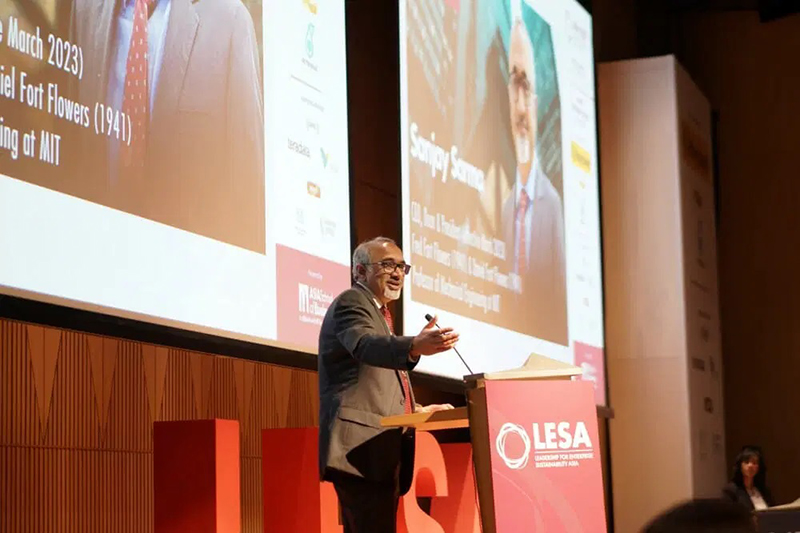
How do you think AI will revolutionise the education system?
I think that AI’s influence on education can go in both good and bad directions. It’s not unusual to see many educational institutions express concern about how AI could potentially disrupt the education system – for instance, students may misuse it to write essays. Such concerns are valid but futile – it’s akin to shaking your fist at the clouds, demanding the rain to stop.
The imminent influence of AI on education will undoubtedly challenge educators, urging them to wield this new tool effectively to improve education. This won’t be a trivial task. I see two broad areas where AI will make a substantial impact.
Firstly, AI can serve as an excellent coach and a co-passenger on the journey of learning. This requires educators and institutions to identify ways to utilize AI as a mentor. This mentoring role of AI can extend to various areas, from helping write code to diagnose problems. Khan Academy has demonstrated how ChatGPT-4 can function as a tutor, assisting students in problem-solving.
The second area where AI will influence education is what I like to call “outperformance.” It’s like a tiger that’s always chasing us, pushing us to outrun it. The people and educational institutions that can surpass AI’s capabilities will enjoy significant success.
Despite its many strengths, AI can often be wrong. So, the essential skill becomes the ability to identify when AI errs. This is what outperformance entails – the people who can surpass AI’s abilities. Regardless of our sentiments, it will undoubtedly influence education. We cannot simply wish it away.
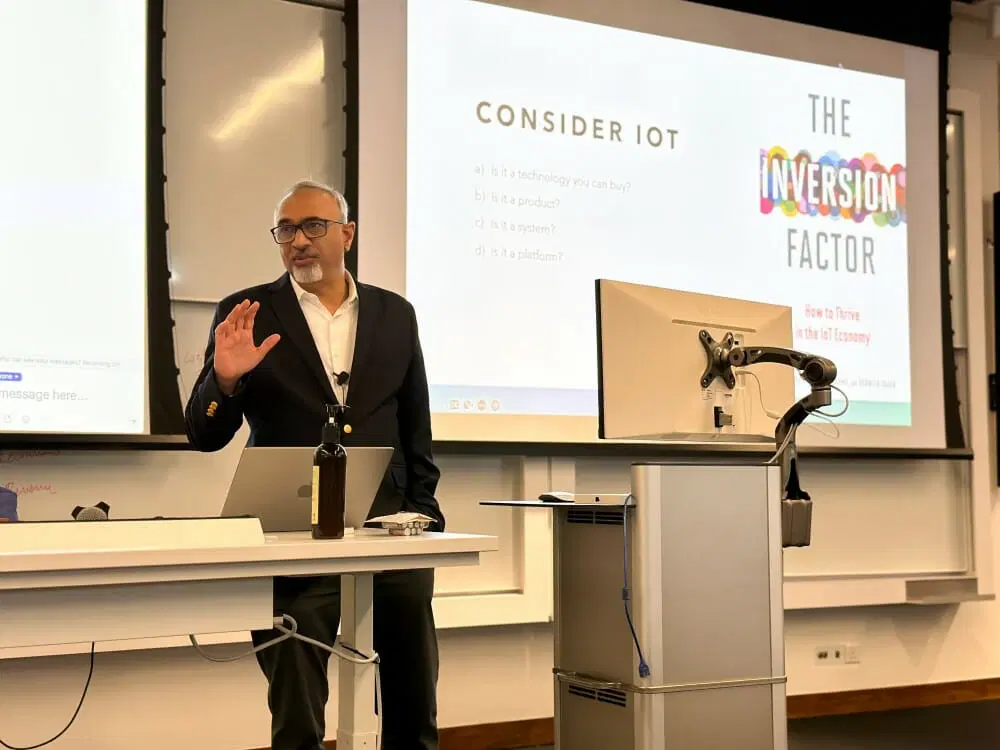
What’s your personal opinion on ChatGPT? And do you use it?
Yes, I do use it. It would be intellectually dishonest to say I don’t. However, the key lies in how I use it. ChatGPT is an extraordinary tool – it’s the first time we’re engaging with a system that can carry on a rather cogent conversation. Like humans, it’s not always correct, but it gets it right a significant amount of the time.
The surprise element of ChatGPT lies not just in its ability as a language model but also as a knowledge model. It made me realise how profoundly we are defined by our language, and how language encodes a lot of knowledge. It’s quite astounding and it changes the dynamics of things, even for tech giants like Google.
As for my usage, I employ it as a co-pilot, much like Microsoft’s portrayal. Just the other day, I was drafting my own bio. On a whim, I decided to use ChatGPT to assist. While I had to revise and correct some parts, the overall process became substantially quicker – it probably saved me about 15 minutes. So, I do see it as an assistant, but an assistant that can make mistakes. It’s crucial to remember that you still need to be in control.
The use of ChatGPT on assignments – Is it considered cheating? And how do you manage that?
Yes, if a student is asked to write an essay and they use ChatGPT, that would be considered cheating. But trying to prohibit this entirely is akin to telling someone to swim in a lake but not swallow any water. It’s nearly impossible.
The solution lies in designing assignments in a way that ChatGPT becomes a part of it and students have to work around it. For instance, you could have students generate an essay using ChatGPT and then critique it.
It is about embracing “outperformance.” We need to redesign our assignments accordingly. Just as we don’t check spellings any more thanks to the automatic spell-check in Word, we need to move a step beyond and learn to outrun ChatGPT.
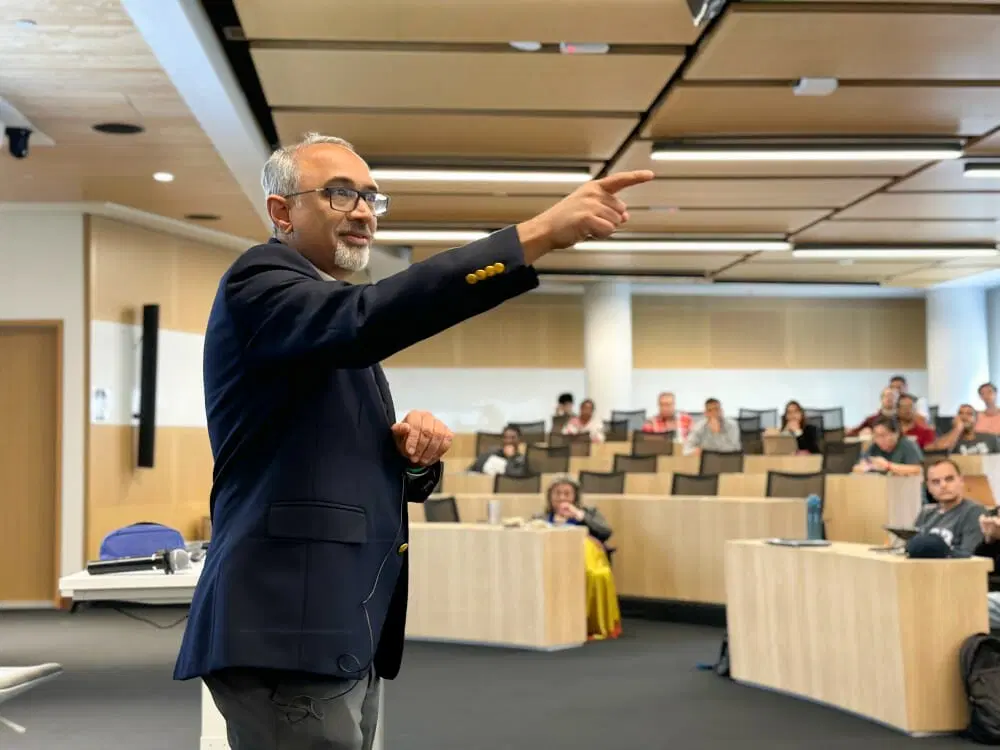
Do you believe AI will help or hinder future graduates?
It will do both, in my opinion. It will help some while it may hinder others. Let me explain. For a lot of graduates who fall in the middle of the pack, AI might hurt them. There’s a risk that AI might take over their jobs, especially if their skills are common or easily replicable by machines. So, yes, for good writers, for instance, this could pose a problem.
However, individuals who possess extraordinary abilities, be it cognitive or physical, are likely to be least affected by AI. For now, robotics can do coarse motor skills but struggles with fine motor skills. It can drive a truck, but can’t, say, perform delicate stitching work or create nuanced art. Similarly, AI can do amazing things within its capabilities, but at the extremes of sophistication, it falls short.
So, for those who can outperform or perform tasks beyond AI’s capabilities, AI can serve as an excellent support system or an assistant. But for those whose tasks and skills fall within the sweet spot of AI’s capabilities, the technology can indeed be highly competitive and possibly disruptive.
What are some of the industries that will benefit the most from AI? And which ones do you think will see a major shift in the way they work?
Clearly, anything related to language is immediately impacted. Coding will also be significantly affected as AI can write remarkable code. However, even within coding, there will still be high-value jobs – the outperformers as I call them. Architect roles, for instance, will become more valuable, while those who write more basic code may see their jobs diminish.
Similarly, for someone who crafts the theme of a magazine or a story, their jobs will become more valuable, while routine tasks of writing based on prompts and facts might be automated. Someone still needs to edit the output and find errors. So, jobs that require outperformance will increase, while the standard ones will be impacted.
Look at the banking sector for an example. ATMs replaced the job of dispensing cash, but it led to an increase in the need for roles that give financial advice. In conclusion, I truly believe that education and learning are the oxygen of the new modern economy.
The Asia School of Business: Revolutionizing Learning
In the midst of this technology-driven evolution, the Asia School of Business (ASB) stands as a beacon of innovative education. Established by Bank Negara Malaysia and MIT Sloan School of Management, ASB is leading the way in management education, championing transformative and principled leaders through its award-winning Action Learning-based curriculum. With Professor Sanjay’s guidance as the new CEO and Dean, ASB is set to navigate the waves of change that AI is bringing to tertiary education.
Find out more about their MBA program.
Originally published by The Peak.