



Asia School of Business

Global Inquiry, Local Heart

Conventionally, an MBA is the pinnacle of business education achievement. In recent years, however, a segment of MBA holders – particularly those with a passion for research – have opted to pursue a PhD in related fields as well.

One such determined individual is Andrew Foley, Asia School of Business MBA Class of 2018 alumni. Recipient of the MIT Sloan Dean’s award for academic excellence during his time at ASB, Andrew is currently a PhD student at the Johnson Graduate School of Management at Cornell University, pursuing a doctorate in Management.

Before that, however, Andrew obtained an MBA from Asia School of Business and was a research associate at the Massachusetts Institute of Technology while completing his MBA. Recently, Andrew was named a “Leader of Tomorrow” for life at the St. Gallen Symposium in Switzerland.

We spoke to Andrew about his unique trajectory of pursuing a PhD after acquiring an MBA, how ASB supported him in making it a reality, and what he thinks others should know before following in his footsteps.

ASB: At what point did you decide to take both an MBA and a PhD?

Andrew: It was a little bit unique for me because I knew I wanted to do a PhD even before I applied to the MBA. Generally, the MBA isn’t the “typical” route to a PhD

In my case, I had several conversations with Charlie (Charles H. Fine, Founding CEO, President & Dean of ASB), and I told him that I wanted to do a PhD in Economics, and I was also applying to other research-based Master’s programs. Charlie said, “Look, if you come to ASB, not only will you get an MBA and be part of the founding class – but we’ll put you on some research projects.” This was a key factor in getting me on board at ASB.

What convinced you to join this (then) unknown B-school instead of a more established institute?

I think for most people wanting to do a PhD, there are a few things to consider. Your academic performance needs to be very good, of course, but even more important than that is having a good relationship with faculty members. With ASB, it became obvious that I would have opportunities for a lot of face-time with MIT and ASB faculty. The relationship-building factor became an important one for me.

Another crucial point is that usually, an MBA would prepare you for everything – except research. So when the founding Deans, Charlie and Loredana (Padurean, Associate Dean and Action Learning Faculty Director at ASB; MIT International Faculty Fellow), told me I would be working on research projects with them, it was a huge advantage for me. I was able to gain research experience before even starting my PhD.

Even though an MBA doesn’t give you in-depth research skills, you DO spend two years thinking about things from an executive’s perspective and learning how an organization fits together. So even if you don’t have technical or research skills, you can walk into a company and notice why things are done in a certain way.

The MBA teaches you a lot about how to understand the people you’re going to be studying. These points – getting a business perspective, research exposure, and access to MIT faculty – were, to me, worth their weight in gold.

Would it be safe to say that someone following a similar path should prioritize developing research skills?

Yes, definitely. I think if you want to do a PhD right after an MBA, as soon as you figure out you want to do that, you need to get research experience – something that shows a deep commitment to it, like doing a full-time research fellowship. In all of my PhD interviews, the majority of the conversations centered on my research experience.

Around the time that I graduated from ASB and was (fortunately) getting a few PhD offers, many of my friends who were doing MBAs at schools like Stanford, Wharton, and Columbia did not get any, likely because they didn’t have research experience. What might be a good tip for anyone looking to follow this path is that you must be able to articulate what your research interests are.

So, saying that you’re interested in entrepreneurship is one thing. But, being able to articulate that you’re interested in a particular aspect of how industries form when major corporations enter developing markets shows that you’ve already been thinking deeply about the problem.

When I initially started talking to Charlie and Loredana about conducting research at MIT or Harvard in my first semester, for example, they’d ask me “What are your interests, and what do you want to learn?” I knew they were willing to help me, but I often struggled to be clear about what kind of work would be most beneficial to me.

So I tried to dig into my interests – mainly by reading management journals – and started to think more carefully about the questions I wanted to pursue. After doing this, I was able to share with them a sharper research statement; then they – and other mentors – started making comments like “Ok, great. Here’s this person to talk to, and here’s that person”. Very soon, I got a research job at MIT through one of these introductions.

How did the MBA help in your PhD work? What advantages did this bring?

One of the good things about the MBA was the intense Monday to Friday class schedule; you get used to working very hard and managing your time really well. In some ways, this intense MBA training may even give graduates an edge over other, more “typical” PhD candidates. In my case, I’ve tried to bring this rigor to my research: most PhD students present their papers at conferences at the end of their 3rd or 4th year; but, I’ve been fortunate enough to present every year so far.

I think the stamina you get from an MBA (especially one like ASB’s) really helps me to propel projects forward. The other advantage is the executive perspective. If you complete an MBA before becoming a business academic, you really get an “executive perspective” that will help you pursue meaningful research in organizations. 

In my current projects, whenever we get a data set with some paradoxical results, I tend to be quick in identifying why disconnects might be happening between executive decisions and organizational outcomes. Maybe there are warring coalitions within the organization, for example, and that’s having an impact on performance.

Or, maybe we have a case where the executives act less as “managers” and more as “figureheads”. We could then test empirically – like, is there a bigger impact of rhetoric on the organization than there is of decision making? From there, we can find out what decisions to focus on, which is huge.

Any last bits of advice for anyone driven enough to do both an MBA and a PhD?

Well, what you learn in an MBA is so different from what you have to do as a PhD student. With an MBA, it’s all very practical and you’re meant to implement it right away, and so the keywords are speed and implementation. You learn a set of theories and frameworks, and then you’re evaluated on how well you apply it.

The idea is that you will become a leader who can make quick, effective decisions and drive organizational performance. Research, on the other hand, is a long process; it’s also theoretical and not necessarily practical (at least in the near term). And, of course, the outcome is that you’ll publish in a journal – you’ll spend perhaps five years just trying to say something that will be published. So, it does involve a different set of skills.

What I would tell anyone who intends to pursue this route is to do research early on and then when you finally get into the PhD, be very open-minded and listen to other people who have more research background. Listen to how they ask questions, how they engage with literature, and how they approach the material.
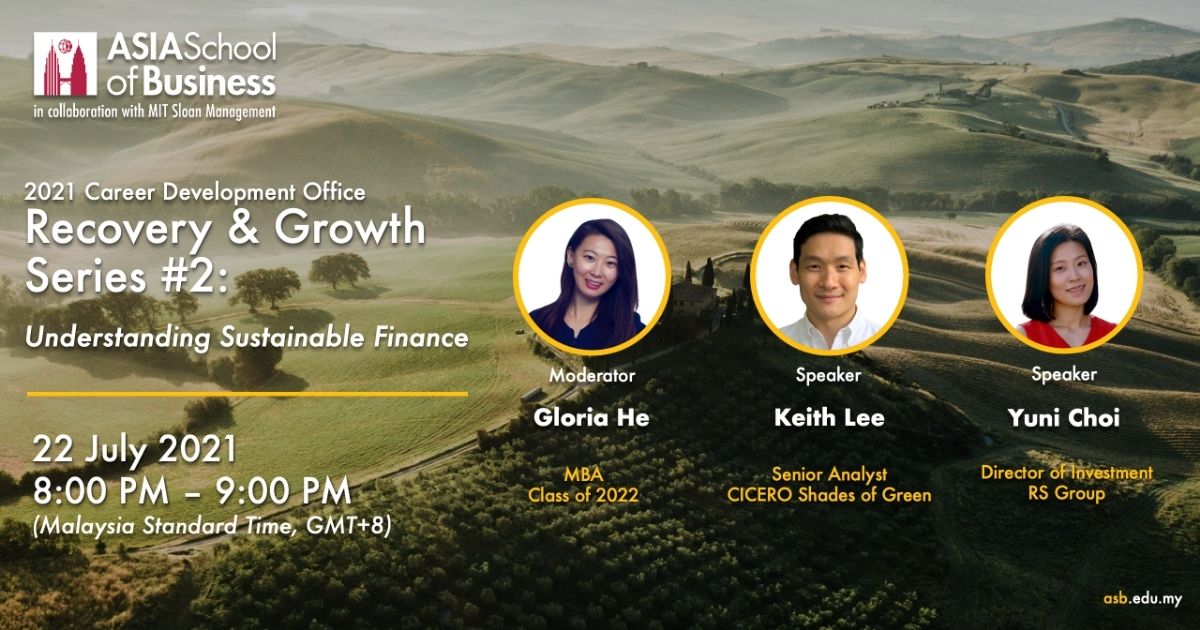
As companies and the financial world moves towards becoming more responsible and transparent to their members and stakeholders than ever before, a rise in sustainable finance initiatives can be seen. What does the future hold and what kind of career opportunities lie in this space? This article explores these questions.

Everybody has been talking about sustainability. Left and right, companies are announcing their commitment to reaching net-zero carbon emissions by 2050. While transitioning businesses to sustainable practices entail heavy investment, investors see these financing requirements as a new opportunity to generate more return.

According to BloombergNEF, the global sustainable debt market exceeds USD 730 billion in 2020, despite the pandemic, and has a 61% compounded annual growth rate for the past eight years. This showcases that there is an increasing demand to finance corporate sustainability initiatives. With such demand and growth, is sustainable finance an emerging industry MBA students should consider entering? 

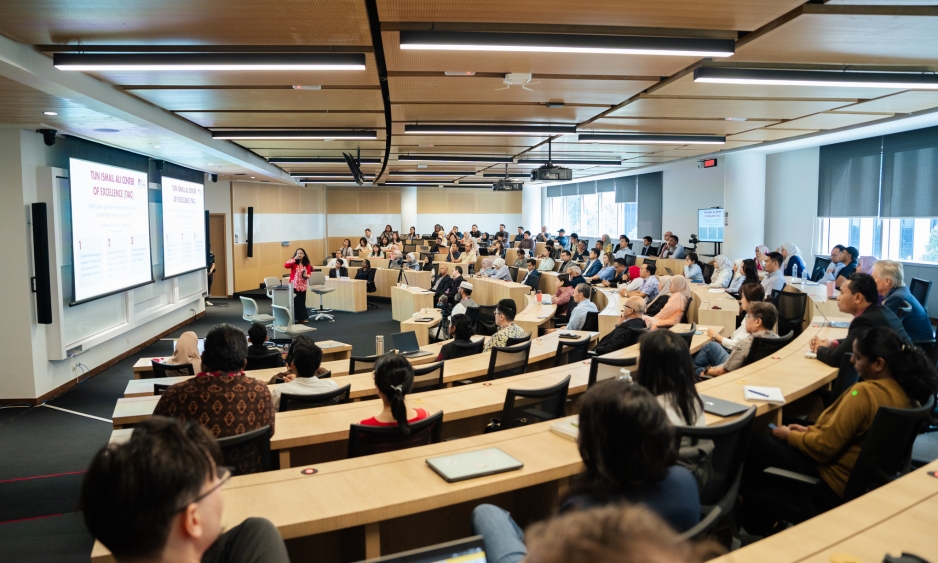
To shed more light on sustainability and sustainable finance, the Career Development Office at Asia School of Business (ASB) recently hosted a panel session inviting Keith Lee, Senior Analyst of CICERO Shades of Green, and Yuni Choi, Director of Investments of RS Group, as panelists to share about their experiences on sustainable finance with Gloria He from the MBA Class of 2022 as the moderator.

What is sustainability?

Before jumping into sustainable finance, let’s understand what ‘sustainability’ is? Sustainability or sustainable business ensures our actions stay within the planetary boundaries and a fairer distribution of wealth. At the same time, sustainability is a term people hear in conjunction with Environmental, Social, and Governance (ESG) issues in businesses.

During the webinar, Keith Lee focused and elaborated on the environmental issues. Most familiar to our ears is climate change, but he emphasized that there are other environmental issues. Including climate change, he highlighted nine planetary boundaries (from ocean acidification to land-system change, among others) proposed in 2009 by research scientist led by Johan Rockström that defines the Earth’s limit and how it can be “a safe operating space for humanity.”

Next, Yuni Choi zoomed in on the social aspect of sustainability, where she shared that we are experiencing a lot of inequality which causes uncertainties and volatilities. Alongside the environment, sustainability must also take into account a fairer distribution of wealth. A good example is that senior citizens can access basic goods and services in the community. There is a lot to understand about sustainability, but as the experts describe it, sustainability is simply doing good for the environment and people around us.

Diving into sustainable finance

These ESG issues create risks that are increasingly recognized as material to businesses. Therefore, it opens opportunities to financial managers lending to and investing in these businesses. Keith illustrated this in terms of the automobile industry, where he asked, “Would you invest in a car company that has no plans to produce electric vehicles?”

Producing a petrol-based vehicle that contributes to high levels of CO2 emissions and creates a risk to the environment opens an opportunity for investment in electrification. Keith simplified this scenario as transition risk arising from global efforts to address climate change, resulting in changes in regulation, technologies, and market conditions.

Yuni was positive about the increasing inflow of assets under management (AUM) in sustainable finance. However, the funded assets are still in the ‘light shades of green’, where most of the assets are on an exclusionary approach, such as funding companies that transition out from the tobacco industry instead of an inclusionary approach, such as a company entering the electric vehicle industries.

She believes there will be more robust ESG activity and greater focus on promoting companies with better ESG performance. She summarized it as impact investing, which means investing intentionally to create a positive social and environmental impact.

Yuni shared that we are still well below USD 1 trillion of investment. However, based on the latest data where investment stands at around USD 730 million, shows that there have been a ton of growth in this area of finance. A great example of ones of these funds is SJF Ventures III, where the fund has achieved tangible impact in six themes: clean energy, circular economy, health, education, workforce, and food.

As Keith shared, in layman’s terms, sustainable finance is “investments that are trying to do less harm, while mitigating environmental risk” and is aimed, as Yuni expressed, “towards investments with more positive impact.”

Does going sustainable mean less return?

Yuni has encountered the question of responsibility and return a million times and believes there is no trade-off between the two. There are two ways to look at it. First, investors are getting savvy and looking at an investment long-term and considering ESG issues. Financial models consider the impacts of issues such as the diversity of the board of directors, the carbon emissions of companies, and so on, in each business.

For example, a company who is polluting the environment may in the future, be regulated and pay a carbon price, deteriorating its profitability and affecting its long-term value. Second, established private equity firms and asset management are joining the bandwagon. Last year, BlackRock, a globally renowned investment manager, jumped into impact investing and is now a leader in the field.

Sustainability doesn’t degrade future returns because investments are supported with a logical point of view in investing, and established institutions are also paying more serious attention to impact investing.

Sustainability vs Greenwashing

Keith shed light on ‘greenwashing,’ defining it as “claims about sustainability that are blatantly not true”, which can be willful or through ignorance. Given the growing attention to sustainability, there is a temptation to slap ‘eco’ or ‘green’ in front of everything. Regulators, investors, and banks are now expecting practices and strategies to become sustainable, increasing the pressure for companies to represent themselves (accurately or not) as sustainable.

Keith emphasized that we have to make sure that the companies’ claims are meaningful from a scientific perspective. A great example is achieving the Paris Agreement goal to limit climate warming to 1.5 degrees Celsius by 2100. Companies were under pressure to contribute towards this “1.5 degrees” and started announcing that they will achieve net-zero carbon emissions by 2050.

But we can assess the company by asking, is the target meaningful? Have they set interim plans – for example, targets in 2030? How serious are they in achieving these targets? Are the performance measures linked to the remuneration of senior executives?

With a multilayer requirement around sustainability, companies may ‘greenwash’ sustainability claims, but for those in the field, we can equip ourselves with scientific facts and scrutinize the company’s strategies and plans, holding them accountable to serious actions to achieve those targets while reducing greenwashing.

What are the opportunities in sustainability?

Yuni shares that there are three types of organizations. First, there are the asset managers like private equities and venture capitals. Second are asset owners like family offices, foundations, and pension funds. Lastly, there are the service providers like the Big Four, ESG analytics, and the like.

In terms of roles, she sees two types of roles. One is an investment-related role, and the other is an impact measurement role – supporting the investment team. As the industry is booming, securing opportunities lies in building a network, putting yourself out there, and researching sustainable finance.

Keith highlighted interdisciplinary knowledge, as you need to understand finance and economics and how those link to environmental and social concepts. He also emphasized sharp skills such as machine learning and artificial intelligence because the industry lacks data to support analysis and institutions are looking for alternative data sources and analyzing unstructured information.

Final takeaways

As of writing this takeaway article, I am currently on the journey to sustainable finance, working as a summer associate in sustainability at a major commercial bank. My understanding of sustainability at the beginning of my journey was simply that sustainability is all about “reuse, reduce and recycle”, and supporting less plastic waste.

My perspective has since expanded. I’ve seen interrelated technical information on different industries’ impact on ESG, which eventually affects the bank’s overall profitability. Step-by-step, as sustainability leaders emerge and more regulators support sustainability, sustainability will become an integral part of doing business and our day-to-day living.