





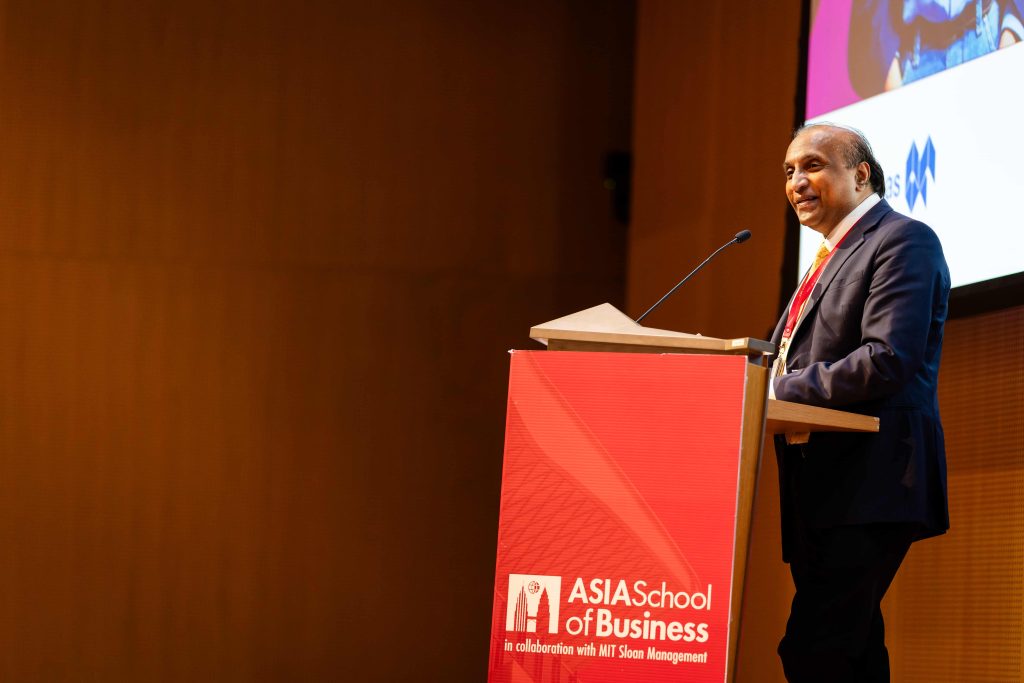
Good afternoon, distinguished guests, colleagues, and friends.
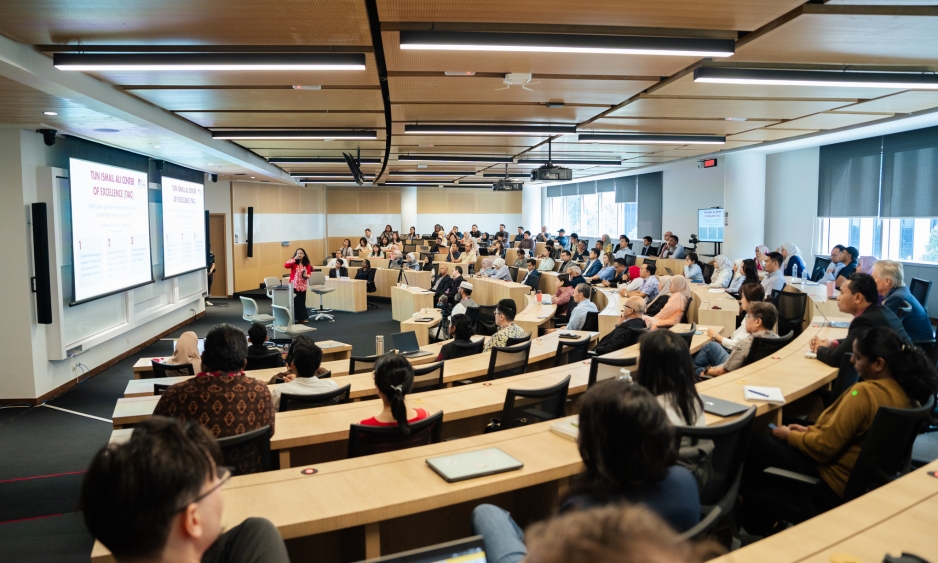
It is both a privilege and an honor to stand before you today as we mark the Preliminary Launch of the Tun Ismail Ali Center of Excellence in Monetary and Financial Economics at the Asia School of Business. This momentous occasion is the result of significant collaboration, vision, and dedication, and I am deeply grateful to all of you for joining us as we take this critical step forward.
First, allow me to extend my heartfelt gratitude to Tan Sri Zeti Aziz, the Founding Chair of ASB and former Governor of Bank Negara Malaysia, for delivering the first keynote address. Your invaluable insights set the tone for today’s event, and we are privileged to have you with us. Similarly, I would like to express my appreciation to Dato’ Seri Abdul Rasheed Ghaffour – who we affectionately refer to as Governor Rasheed – for sharing your distinguished perspectives in the second keynote. Your leadership at Bank Negara has been instrumental in guiding Malaysia’s monetary policy and financial system. Finally, we are honored by the presence of Professor Hélène Rey, the Lord Bagri Professor of Economics at London Business School, whose academic expertise and thought leadership in global financial systems provide a crucial context for our discussions today.
I would be remiss not to extend special thanks to Bank Negara Malaysia for its visionary support in the creation of the Tun Ismail Ali Center. Your commitment to excellence and innovation in monetary and financial economics has been integral in realizing this endeavor. In particular, I would like to acknowledge Deputy Dean Melati Nungsari and the dedicated staff at ASB who have worked tirelessly alongside our partners at Bank Negara. While I cannot claim credit for the Center’s formation, I have had the privilege of witnessing the relentless efforts that have brought us here today − efforts that will undoubtedly continue to shape the future of this initiative.
As we embark on this exciting journey, I would like to reiterate our commitment to making the Tun Ismail Ali Center a premier research hub in the fields of monetary policy, central banking, and financial economics. Our primary focus will be to address the unique challenges and opportunities facing emerging markets, where the need for innovative and contextually relevant solutions has never been more pressing.
In this regard, our work will be both academically rigorous and deeply connected to the realities of policy and practice. Too often, academic research becomes abstract, esoteric, and disconnected from the real-world challenges it seeks to address. Worse still, it becomes inaccessible to those who need it the most. Our vision for the Tun Ismail Ali Center is to bridge this gap by fostering research that is not only theoretically robust but also practically relevant to policymakers, practitioners, and communities across the globe.
Central to our mission is collaboration—with Bank Negara Malaysia, other key stakeholders in the financial sector, as well as Malaysian universities and research institutions. By forging these partnerships, we aim to catalyze impactful research that will drive policy innovation, financial stability, and economic development.
Our overarching vision is to build capacity for the future—to nurture the next generation of scholars, policymakers, and industry leaders in critical areas of monetary and financial economics. We are committed to ensuring that the Tun Ismail Ali Center will not only be a center of academic excellence but also a beacon of thought leadership that remains relevant and responsive to the evolving challenges of the global economy.
As we look forward to the work ahead, let us remember that our success will be measured not just by the quality of our research but by its ability to shape the future of monetary and financial systems in ways that are impactful, inclusive, and sustainable.
Thank you once again for being here to share in this milestone with us. Together, we will contribute to a legacy of innovation and excellence in monetary and financial economics.