Asia School of Business

Edit Content
Executive Education
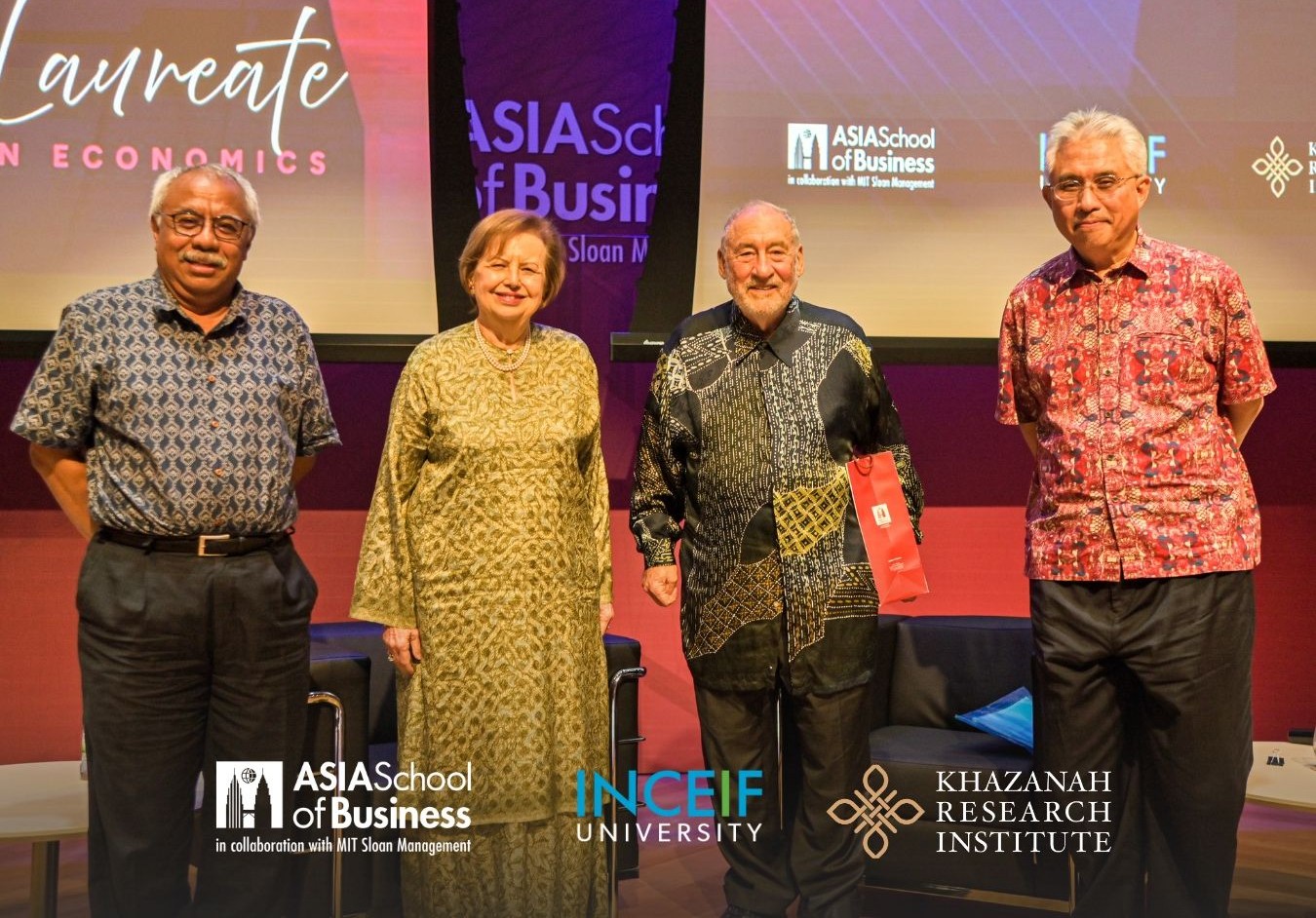
From the left: Dr Nungsari, Dr Zeti Aziz, Professor Joseph E. Stiglitz and Tan Sri Azman Mokhtar

Dear colleagues and friends,

On behalf of the Asia School of Business, thank you everyone for being here this afternoon.  Most of all I would like to express our profound gratitude to Professor Joseph Stiglitz for sharing his valuable time with us today.  Professor Stiglitz, we deeply appreciate your contribution to the ongoing dialogue about the future of the global economy.  Your remarks here today have been truly enriching, prescient and thought provoking.  It has been a great privilege to have this opportunity to listen to you today.

It was about twenty-eight years ago, when you were the Chief Economist at the World Bank, that we first encountered.  It was a tumultuous time for the East Asian region.  It was the time of the Asian Financial Crisis experienced in 1997-1998.  I recall, even at that time, your views were not quite the conventional wisdom that had prevailed in Washington.  It was always encouraging for us to hear that there were alternative perspectives that took into consideration issues that concerned growth and development.  The experience of this crisis had two important consequences for us – the drive towards building our resilience and to becoming more cohesive as a region.  This fortified our ability to effectively live through a number of other upheavals and turmoils – not to say that we were unscathed but we were not disrupted and were able to rise to the challenges and advance forward.

Then it was in 2008, in response to the great financial crisis, that had already erupted in 2007, in the Developed World, that the President of the United Nations General Assembly established a Commission led by Professor Joseph Stiglitz to propose reforms that would prevent such crisis in the international financial system in the future.  It was my honour to have been a member of that commission.  It was probably one of the high points of my career.  The report which was released in 2009 have had its findings become the subject of continued discussions and debate at high level international forums and its ideas have influenced policy discussions.  The report, however, probably made its biggest difference in Asia – where – wherever we could, we sought to strengthen our systems and financial infrastructure in the region.  Our motivation was that we wanted to be best positioned to manage future turbulence and turmoils.  Collectively, we now reap the payoffs.  East Asia now has emerged as a force to be reckoned with.

In his lecture today, Professor Stiglitz has highlighted that we will continue to be navigating in tumultuous waters brought about by the new politics and the new economic policies that are intertwined with the old issues that have continued to plague the world economy.  On top of this, he highlights the new set of problems presented by AI.  Now sixteen years later, he has led a new commission whose report was just launched in June this year – that addressed the Debt and Development crisis to promote sustainable development. Addressing these vulnerabilities are key to avoiding future financial crises and economic setbacks.

The global circumstances going forward appear to be bleak.  But as an optimist, I believe it is not quite so dismal.  There is still an opportunity to navigate ourselves in the right direction despite the turbulence so that we will arrive at the aspired destination.  For the emerging and developing economies, we can leverage on our comparative advantage – our agility to adjust and therefore, the ability to do better and thus contribute positively to the global economy.  Ladies and Gentlemen, please join me in showing our appreciation to Professor Joseph Stiglitz for the strong messages that he has conveyed to us today to enhance the prospects for the world economy.

From the left: Dr Nungsari, Dr Zeti Aziz, Professor Joseph E. Stiglitz and Tan Sri Azman Mokhtar

On 19 November, our CEO, President and Dean, Dr. Joseph Cherian, spoke at Elevate: Asia Pacific in Hong Kong, where he delivered his session, From Economics to Ecosystems, as part of the panel “Building Entrepreneurial and Innovation Ecosystems.” In this session, he discussed how business schools can serve as incubators of innovation—partnering with startups, corporations, and policymakers to nurture entrepreneurial mindsets and drive inclusive growth. His presentation slides are now available for viewing below

From the left: Dr Nungsari, Dr Zeti Aziz, Professor Joseph E. Stiglitz and Tan Sri Azman Mokhtar

Good afternoon, distinguished guests, colleagues, and friends.

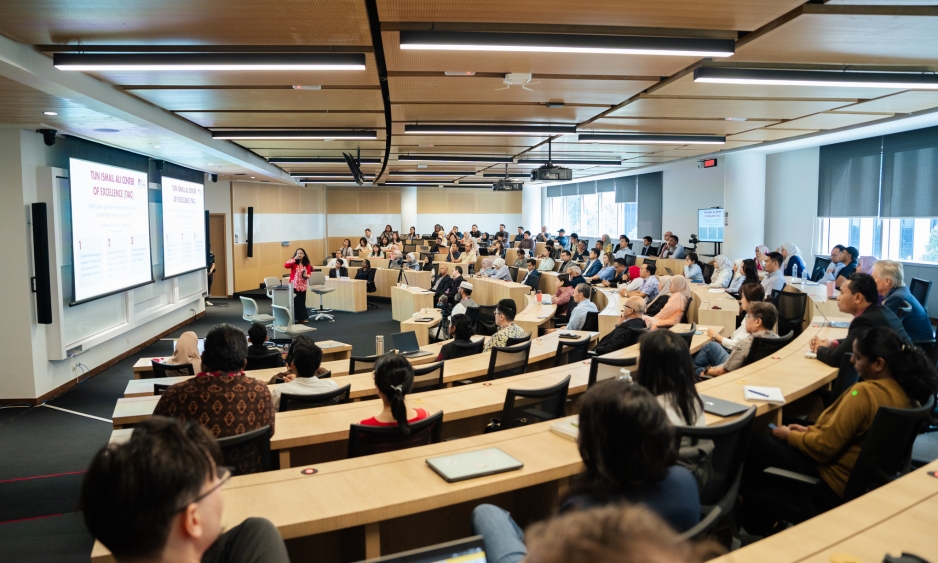
It is both a privilege and an honor to stand before you today as we mark the Preliminary Launch of the Tun Ismail Ali Center of Excellence in Monetary and Financial Economics at the Asia School of Business. This momentous occasion is the result of significant collaboration, vision, and dedication, and I am deeply grateful to all of you for joining us as we take this critical step forward.

First, allow me to extend my heartfelt gratitude to Tan Sri Zeti Aziz, the Founding Chair of ASB and former Governor of Bank Negara Malaysia, for delivering the first keynote address. Your invaluable insights set the tone for today’s event, and we are privileged to have you with us. Similarly, I would like to express my appreciation to Dato’ Seri Abdul Rasheed Ghaffour – who we affectionately refer to as Governor Rasheed – for sharing your distinguished perspectives in the second keynote. Your leadership at Bank Negara has been instrumental in guiding Malaysia’s monetary policy and financial system. Finally, we are honored by the presence of Professor Hélène Rey, the Lord Bagri Professor of Economics at London Business School, whose academic expertise and thought leadership in global financial systems provide a crucial context for our discussions today.

I would be remiss not to extend special thanks to Bank Negara Malaysia for its visionary support in the creation of the Tun Ismail Ali Center. Your commitment to excellence and innovation in monetary and financial economics has been integral in realizing this endeavor. In particular, I would like to acknowledge Deputy Dean Melati Nungsari and the dedicated staff at ASB who have worked tirelessly alongside our partners at Bank Negara. While I cannot claim credit for the Center’s formation, I have had the privilege of witnessing the relentless efforts that have brought us here today − efforts that will undoubtedly continue to shape the future of this initiative.

As we embark on this exciting journey, I would like to reiterate our commitment to making the Tun Ismail Ali Center a premier research hub in the fields of monetary policy, central banking, and financial economics. Our primary focus will be to address the unique challenges and opportunities facing emerging markets, where the need for innovative and contextually relevant solutions has never been more pressing.

In this regard, our work will be both academically rigorous and deeply connected to the realities of policy and practice. Too often, academic research becomes abstract, esoteric, and disconnected from the real-world challenges it seeks to address. Worse still, it becomes inaccessible to those who need it the most. Our vision for the Tun Ismail Ali Center is to bridge this gap by fostering research that is not only theoretically robust but also practically relevant to policymakers, practitioners, and communities across the globe.

Central to our mission is collaboration—with Bank Negara Malaysia, other key stakeholders in the financial sector, as well as Malaysian universities and research institutions. By forging these partnerships, we aim to catalyze impactful research that will drive policy innovation, financial stability, and economic development.

Our overarching vision is to build capacity for the future—to nurture the next generation of scholars, policymakers, and industry leaders in critical areas of monetary and financial economics. We are committed to ensuring that the Tun Ismail Ali Center will not only be a center of academic excellence but also a beacon of thought leadership that remains relevant and responsive to the evolving challenges of the global economy.

As we look forward to the work ahead, let us remember that our success will be measured not just by the quality of our research but by its ability to shape the future of monetary and financial systems in ways that are impactful, inclusive, and sustainable.

Thank you once again for being here to share in this milestone with us. Together, we will contribute to a legacy of innovation and excellence in monetary and financial economics.

Honored guests

Representatives from MIT Sloan

Dear colleagues and friends

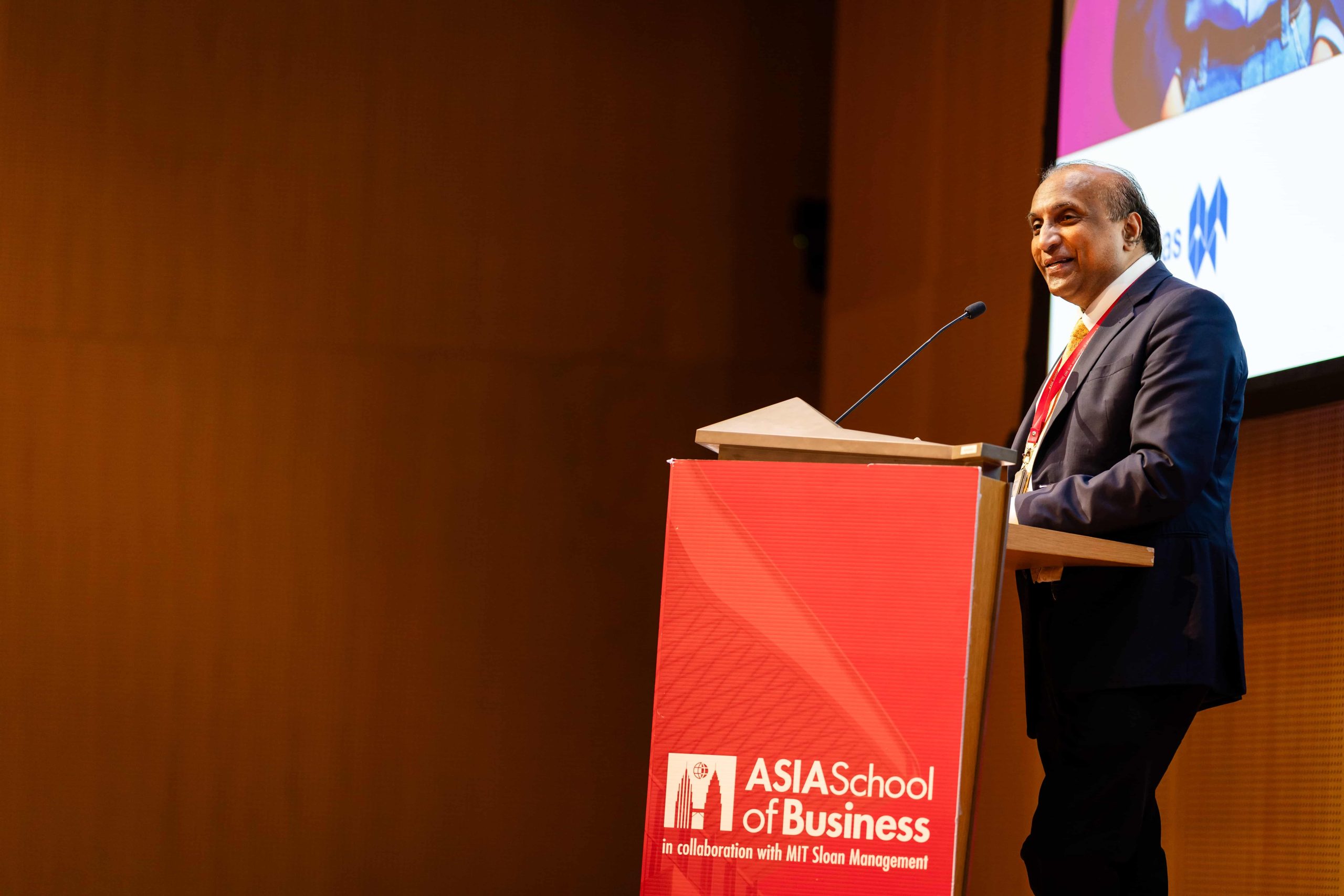
  1. It is my distinct honor to welcome you today to celebrate a truly meaningful milestone event, the 10th Anniversary of the Asia School of Business.
  2. It is with the strong conviction that resources dedicated to education is an important investment that the Bank entered into this venture. The investment in education is a vital investment that will determine our potential for growth.  It is all about investing in people. Not only will it unlock higher earning potential, it will also foster the potential for greater productivity gains and competitiveness. A higher skilled workforce is key to unlocking new discoveries, practices and opportunities.  It will also enhance social mobility and address inequality.  While it may take longer to manifest its returns, the payoffs will be seen over time and in the difference it will make to our growth performance.  Its returns will be in the profound impact that it will have in supporting and shaping the future trajectory of any entity or economy.
  3. The Asia School of Business, established in early 2015, in collaboration with the Massachusetts Institute of Technology’s Sloan School of Management set out to offer two key differentiating value propositions: firstly, the emphasis on the practical application of business management education – that apply theories of the classrooms to a broad range of organizational and institutional settings; and secondly, to be a global knowledge and learning center that is contextualized to the emerging world, that focuses on its different circumstances and conditions prevailing, and to recognize its associated distinguishing challenges and problems. Special focus is also accorded to Asia given its growing significance and influence in the global economy.
  4. MIT Sloan has had a tremendous role in accelerating the School’s unique place in business education. The first ten-year agreement was signed off on 2 January 2015 by MIT President Rafael Reif, on behalf of MIT Sloan and by myself on behalf of ASB. Early discussions of the details were held between the now BNM Deputy Governor Marzunisham Omar and Professor S.P. Kothari. The important personality that contributed to making this endeavor happen is the late Dean David Schmittlein of MIT Sloan. I must place on record our highest respect and deep appreciation to the late Dean David Schmittlein, who recognized our aspirations and embarked on this collaboration towards this common vision for the School.  He was a great supporter of our endeavors and throughout the entire period there was a great working relationship. We benefitted immensely from his wisdom.

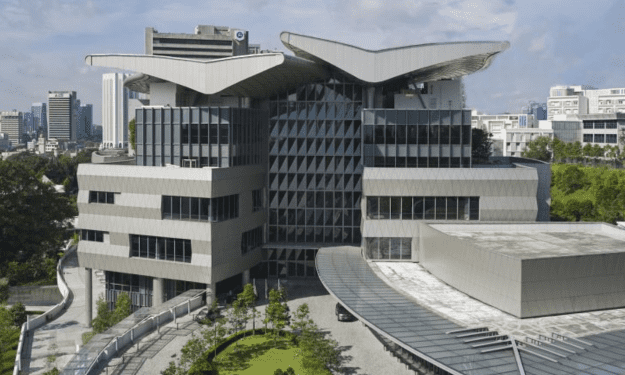
    In the early years, MIT Sloan provided us with support in developing the curriculum which was then applied to the circumstances in the emerging world, in particular in Asia.  The initial co-chair from MIT, former Dean Schmalensee was also active in the search of the early faculty and in promoting the school for student enrollment. Having overseen the new building at the Sloan School, we benefitted from his insights for the building of our magnificent campus. Completed in October 2020, our campus continues to effectively meet all the requirements of a business school. The second ten-year agreement with MIT Sloan was signed on 1st January this year.  We also wish to thank former interim dean Georgia Perakis for the support she extended to ASB.

  1. Special mention is also made of our first three deans and presidents of the School that have come from MIT. The first founding dean, Professor Charles Fine laid the early foundations for the school.  Interim Dean Professor Jake Cohen made the bold move to shift the program from a two-year to a one-year program while retaining the distinctive features of the program. Thereafter, we had Professor Sanjay Sarma who spearheaded the academic innovation with the introduction of micro-credentials.  Under ACE, the Agile Continuous Education that was introduced, flexible, stackable and modular micro-credentials in a range of topics were introduced for professionals to keep upskilling. This was created to fit any age and stage of careers and for lifelong learning.

    Importantly, our pedagogy has also continued to blend MIT Sloan’s Action Learning approach to education in which our students benefit from the practical orientation of the learning experience through the School’s large regional network of corporate partners. MIT Sloan’s faculty also teach in our programs both as visiting faculty here in Kuala Lumpur and during the immersion weeks at MIT Sloan’s campus in the USA. 

  1. Our stellar resident faculty drawn from all over the world has also grown from strength to strength. They lead in their teaching and research in subjects of finance, organizational behavior, supply chains, strategy, sustainability, governance, ethics, digitalization, artificial intelligence, economics and central banking. Reflective of their deep research and scholarly pursuits, they have won numerous international awards.  Increasingly, our faculty are also sought to advise international companies and governments for their research insights to address business challenges and policy strategies. 
  2. It is a source of great pride for us too that this year, our Dean, President and CEO has emerged from within the School’s own ranks. In May 2025, Distinguished Professor Joseph Cherian took on the reins of the School, and he has hit the ground running.  This smooth succession also retains continued connections with our previous leadership, where Professor Sanjay Sarma continues to contribute through the School’s Board of Governors and as an Eminent Visiting Professor.
  3. Then, our most recent achievement is being awarded the AACSB accreditation, where the School is now within the top 6% of global business schools, which recognises our excellence in teaching, learning, research, strategic management and innovation. I must congratulate the tremendous efforts and dedication of our faculty, academic managers, admissions, programs and academic innovation teams together with the administrative teams who have all worked together over the years towards achieving this global recognition.  
  4. After we had inked the Agreement with MIT Sloan on 2 January 2015, the School had moved quickly to gain regulatory approval for the establishment of the School in record time that ushered in our first MBA cohort starting in 2016 all of whom graduated 2-years later in 2018. In 2019, the Executive MBA (EMBA) was introduced where our academic teams have woven in new innovative and thoughtful elements which sets our programs apart from others.  These includes the Integrated Management Lab that develops cross-functional leadership as business terrains become more complex with greater interlinkages and interdependencies and where leaders must have integrated thinking, drive diverse team dynamics and have the ability to synthesize workable solutions.  Rooted in the behavioral sciences, our program aims to build the mindset to respond to challenges and setbacks with greater confidence, and emotional agility.    
  5. And then we also have our unique Master in Central Banking which brings together central bankers from across the world for a 12-month fully residential immersive experience – where the focus is on the broad functions of the Central Bank and its policy decision making. Taught by faculty with Central Banking experience, the students also spend six weeks at MIT Sloan.  They also form deep and enduring ties among themselves, learning about the experiences of working in the different respective emerging economies.
  6. Mid-way into our first decade, in 2020, the ICLIF Leadership and Governance Centre, which was established by Bank Negara Malaysia in 2003, was integrated into the School to support the offerings in executive education. ICLIF was initially set up to serve the financial services industry, post the Asian Financial Crisis, with the aim of producing a new generation of leaders to steer the financial industry in a fundamentally transformed financial landscape.  It soon expanded its mandate to include corporate and public sector participation.  It was the first of its kind in Asia, focusing on the emerging market experience, contextualized mainly to Asia in the areas of leadership development, organisational performance, corporate governance and digital transformation.
  7. We also continue to make significant strides in research. Our translational research now covers a diverse range of areas through our four endowed research centres: the ASEAN Research Centre, endowed by Maybank, looks into economic resilience, sustainability and inclusivity; the Centre for Technology, Strategy and Sustainability delves into business strategies, technology and the socio-political dynamics of emerging economies; the Centre for Sustainable Small-owners, endowed by Procter & Gamble, has empowered and improved the livelihoods of small-owners of the palm oil industry. The Tun Ismail Ali Centre of Excellence, endowed by Bank Negara Malaysia, will lead, collaborate and drive research excellence in monetary economics and financial economics. In addition, our ASB Hive provides an ecosystem for greater innovation and entrepreneurship in Malaysia, with hands-on startup bootcamps and incubators, designed to sharpen entrepreneurial skills.
  8. This decade of milestones and achievements were made possible by the steadfast support, hard work and dedication from all within our School. Our appreciation is to the faculty, academic managers, colleagues from across the student journey, academic programs offices, student wellbeing, executive education, registrar, academic innovation, administration and operations teams.  I would also like to record our appreciation to the Board of Governors, Board of Directors, the Master in Central Banking Program Advisory Board, the President’s Advisory Council, all whom have given much guidance to the School. 
  9. From its inception and throughout the years, the commitment and support from Bank Negara Malaysia, has been a solid foundation that has supported the School to grow and scale new endeavors. The support from the early days included providing the teaching and office spaces at Sasana Kijang, and residences for students at Lanai Kijang until our campus was ready.   And MIT Sloan, for the founding years and for the enduring relations that have been instrumental to the School’s establishment.  And now under the new leadership of Dean Richard Locke, we look forward to strengthening the relationship in the years to come.  Our gratitude is to all the friends and supporters of the School, which also includes the students and alumni, that have brought us to this point here today.
  10. As we come together today to celebrate the achievements and milestones, I believe the Asia School of Business will remain a catalyst for change, possessing the enduring capacity to stay the course and rise to the challenges of change. In a highly dynamic and a rapidly ever-changing environment, the demands for the capabilities to steer the course over an increasingly more challenging terrain is an imperative. For this, the full time MBA programs will likely continue to be an important experience that will allow for the interaction of those from different backgrounds and countries to learn from each other and to build long-lasting networks. The future will however be the education for those that may not be able to take a year off but whom still needs to keep abreast with the transformative changes taking place in the business environment and for those who recognize the need for lifelong learning. While the ASB Executive MBA offering has already gained momentum, this will likely become an increasingly important part of business education.  It will need to be in a hybrid form in terms of leveraging on technology to be offered live virtual and virtual while a part of it will still need to be in person, to allow for regional and global engagement to take place.
  11. In addition to having a leading-edge curriculum that is powerfully contextualized to the emerging world, the aim will be to equip and prepare future business professionals with the ability to effectively operate in a rapidly changing environment that will become increasingly more and more challenging.
  12. On this note, I wish all of you to an enjoyable rest of the afternoon as our faculty and staff showcase more of the School’s achievements and performances by our own talented ASB community.

Thank you.

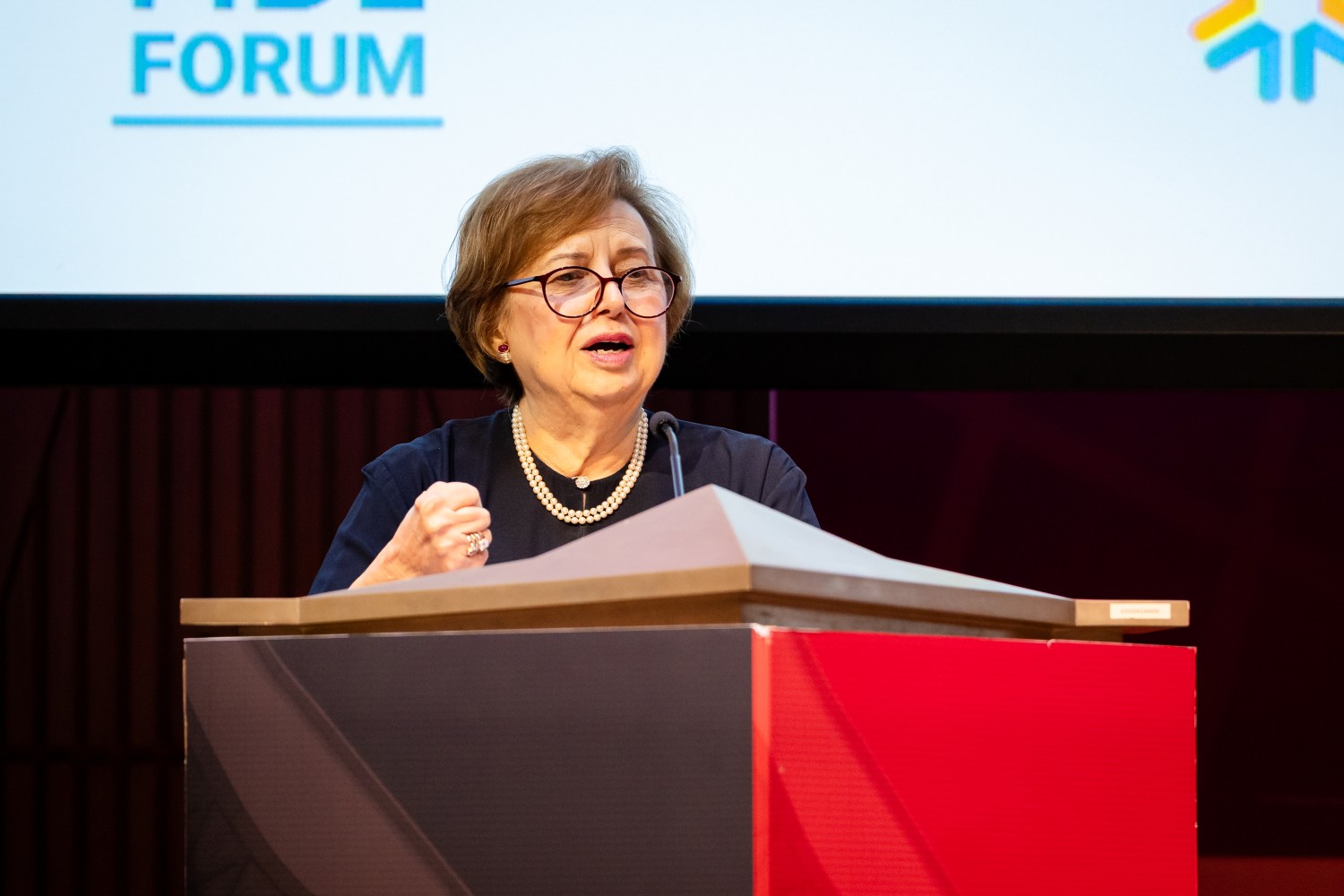
Tan Sri Dr Zeti Aziz, Founding Chair and Co-Chair of the Board of Governors

Eminent Visiting Professor Sanjay Sarma
Distinguished Professor Joseph Cherian

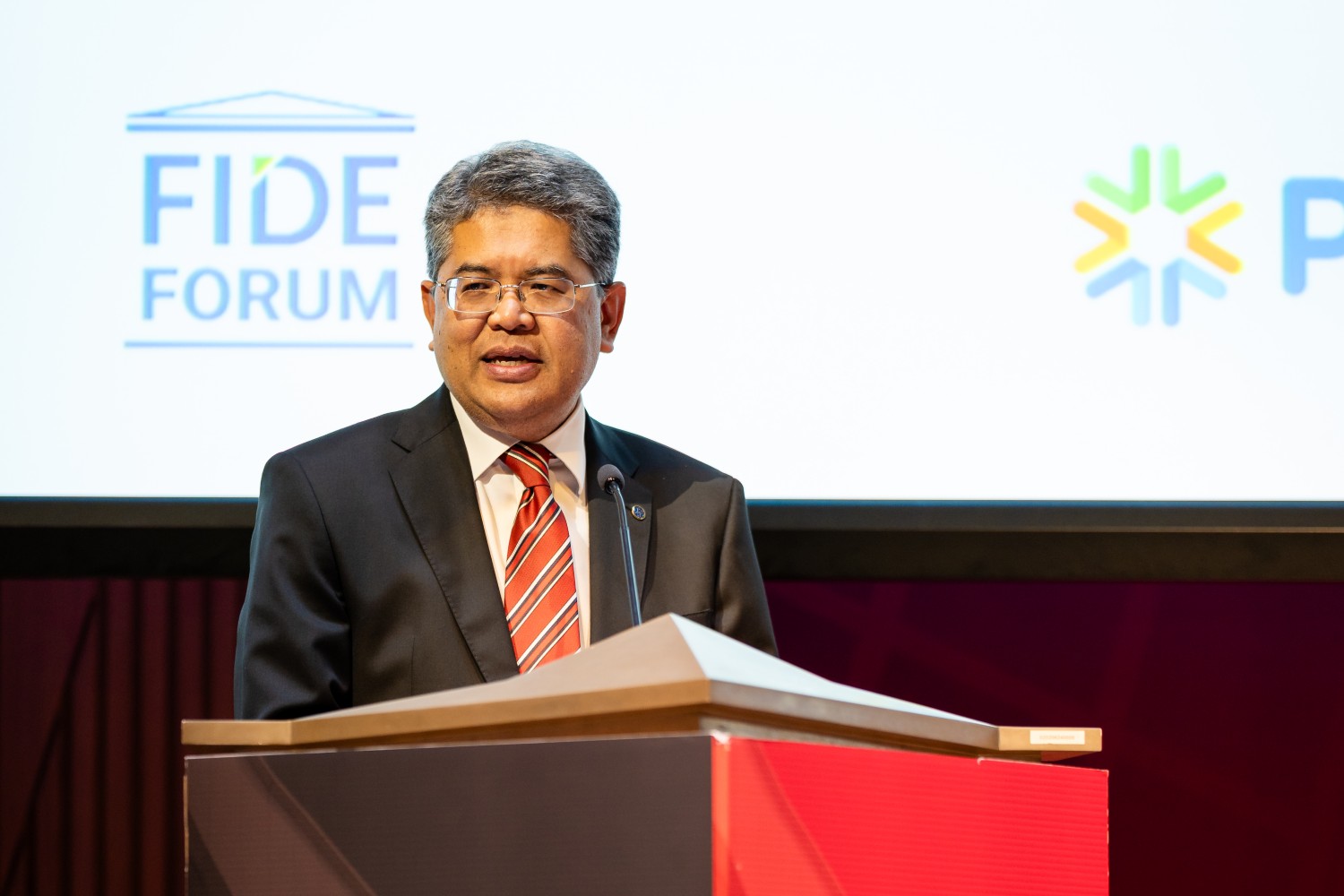
Members of the Board of Governors, Board of Directors, Advisory Board of the Master in Central Banking Program, representatives of MIT Sloan School of Management, Distinguished faculty members, staff, students, alumni, friends and guests of the Asia School of Business, I am delighted to join everyone here today in celebration of a decade of the Asia School of Business. The School has in the past 10 years, progressively grown to provide a range of unique and cutting-edge education in central banking, leadership, management, innovation and entrepreneurship, with teaching and immersive curricula that successive learners, whether graduating with ASB’s degrees or from the executive education programs, have found deep value in their experience.

As we reflect on the past decade, allow me to take you further back – 25 years ago – when Bank Negara Malaysia introduced the first of its 10-year Financial Sector Masterplan to guide the development of the financial sector to support Malaysia’s economic transformation. At that time, the Bank had envisioned and let me quote from the first Masterplan, “that while it may not be possible to project accurately how Malaysia’s financial sector will be structured in 10-years’ time, taking into account the forces at work and how the challenges facing the industry are being met, the future financial landscape can be expected to be characterised by a more diversified financial sector meeting the requirements of a more diversified economic structure.”

Even then, it was recognised that success in a rapidly evolving and competitive environment would require financial institutions to successfully leverage on advancements in technology, reengineer processes and critically, invest in human capital. Specifically, the Masterplan emphasised the importance of “employing and retaining highly skilled workers and the reskilling of existing workforce and promoting a culture of continuous learning” and acknowledging that people would be the defining factor of institutional success.

This remains true today. Indeed, in a world shaped by relentless innovation, complex interdependencies and accelerating advances in artificial intelligence and automation, people continue to be the cornerstone of resilience and adaptability.

The experience of Malaysia and many Asian economies, has shown that amidst profound changes and uncertainty, it is people – equipped with the right skills, mindsets and values – who drive transformation. Thus, education and capacity building remain as vital as ever in ensuring sustainable progress.

The vision to establish a world-class business school in the heart of Kuala Lumpur – one that combines academic excellence with real-world relevance and nurture leaders who are capable of navigating complexity and unrelenting change – was made possible through the leadership and strategic foresight of Tan Sri Dr Zeti. From the outset, this endeavour was never limited to meeting the talent needs of Malaysia alone. This is in recognition that a more interconnected world demands leaders who could thrive beyond national borders and collaborate across cultures.

I was deeply privileged to have been involved in this undertaking from the very beginning – including the early engagements with MIT Sloan School of Management. I recall the first visit I made in February 2012 to discuss the idea of establishing the Asia School of Business with the late Dean Schmittlein and Deputy Dean S.P. Kothari. I would not recommend visiting freezing cold Boston in February!

MIT Sloan also shared the vision of Asia’s rising role in the global economy and the benefits of understanding Asia in all its diversity, intricacies and huge potential. Subsequent discussions from 2012 led to the signing of the Collaboration Agreement between Tan Sri Dr Zeti and MIT President Rafael Reif on 2 January 2015 in Cambridge, Massachusetts. Following the School’s establishment in collaboration with MIT Sloan in 2015, the first intake of MBA students began in August 2016. The rest as people say, is history.

Underpinning this unique collaboration were many committed individuals from MIT, Bank Negara Malaysia and the Asia School of Business who together truly believed in the transformative power of continuous education and lifelong learning. From the earliest days, all have been instrumental in shaping the concept, building this School, and going forth to grow from a fledgling institution into a dynamic hub for learning, research, and innovation. The School’s programs, from the MBA, EMBA and the Master in Central Banking and with the integration of ICLIF’s executive education and more recently, ACE micro-credentials have all expanded the School’s scale and reach. All these are deepening the School’s impact, where it is primed to make an even bigger mark and contribution to talent development in Malaysia and beyond.

The School has and I trust will continue to nurture principled, pragmatic leaders with the know-how and confidence to drive change whether at a micro level in corporate business and start-up entrepreneurs, or at the macro level, as policy makers. More than a business school, the School is a catalyst for change, for individuals, organisations, and nation building, as well as to tackle some of the more pressing planetary concerns.

On behalf of Bank Negara Malaysia, I wish to express our warmest congratulations to the Asia School of Business for its 10th year establishment and gratitude to all who have played a role in bringing the School to where it is today, be it the governing or advisory boards that have guided the School, as well as the faculty, staff, students, corporate learners and alumni. And most of all, Tan Sri Dr Zeti for her vision, tenacity, clarity and drive in ideating and guiding us to where we are today.

As we mark this anniversary, the next chapter of the Asia School of Business will require the same spirit of boldness, innovation, and collaboration that sparked its founding. I have every confidence that this remarkable institution, driven by its committed leaders, academic and administrative teams, and vibrant learning community, will continue to lead with purpose and impact.

Thank you.