




Asia School of Business

Edit Content
Executive Education

An MBA can drive your career in a new direction—allowing you to change industry, function, location, or all three. As many as 35% of global MBA applicants list achieving such career changes as their reason for going to business school.
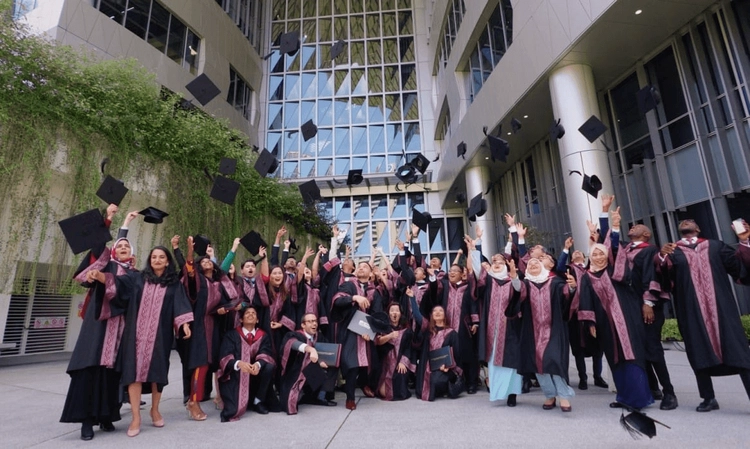
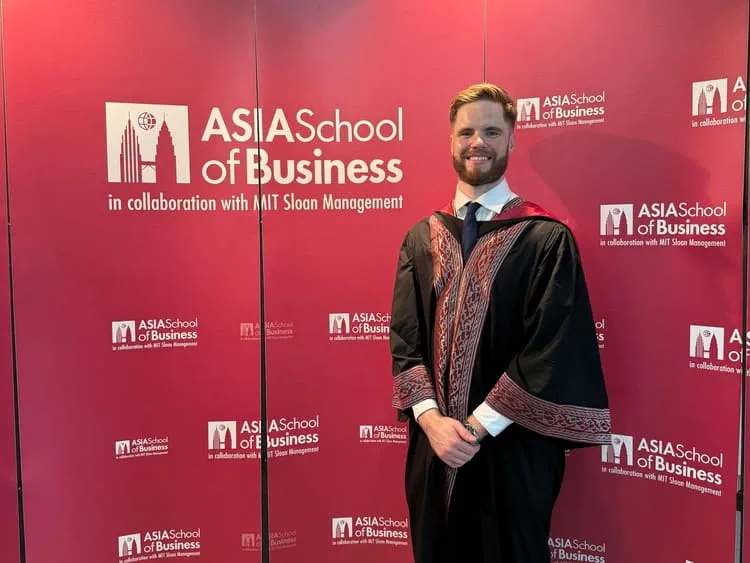
But for others, the benefits of studying an MBA go beyond career impact. When Thomas Maddison enrolled in an MBA at Asia School of Business (ASB) after a period working in Australia’s mining sector, his aims included expanding his network and experiencing a new culture, alongside gaining opportunities outside his industry.

Since graduating in 2025, Thomas has embarked on an entrepreneurial journey. He is currently in the early stages of developing a solution to help MBA graduates work on their leadership capabilities and be better prepared to secure jobs.

We spoke to Thomas about how the MBA has helped kickstart his journey to becoming an entrepreneur.


What is the entrepreneurial toolkit?

From building a network of likeminded professionals to strengthening your problem-solving and strategic thinking skills, an MBA can help build various tools necessary when launching your own startup. More than a quarter (29%) of learners pursue business education to become entrepreneurs, according to our 2025 Prospective Students Survey.

“The MBA has definitely helped me in my entrepreneurship journey,” says Thomas. “One of the main ways being that my customers are MBA students, so it’s massively helpful to have just come out of a cohort.”

Thomas cites key advantages that have come from his MBA network. For example, through getting to know potential buyers and CEOs throughout the program, he has learned how they think and work—which he feels is an advantage when developing ideas.

As his entrepreneurial journey develops, Thomas feels the skills he built during his MBA have prepared him for the various challenges this will bring.

“Some things really stuck out to me, which have helped me come to some big realizations,” says Thomas. “Once I get to the more advanced stages—we did things like financial modeling during the MBA, so I already have the experience.”


How can career development resources benefit entrepreneurs?

An MBA helps build a range of hard skills, such as technical literacy and data analysis, though soft skills are increasingly important in business—helping professionals manage teams and navigate challenges.

Research suggests that skills such as problem-solving and strategic thinking, as well as interpersonal skills such as communication, emotional intelligence, and adaptability, will increase in importance in the coming years.

For Thomas, the ASB Career Development Office (CDO) has been invaluable in helping him work in these areas. While the CDO provides students with a range of resources such as interview preparation, and access to employers, it also offers career coaching, individual mentoring, and workshops.

“There are some hard skills the CDO helps teach, like how to create a strong resume, but the soft skills are really important—how to prove it, how to show it, how to story tell,” explains Thomas.

“I can’t thank the CDO enough for the energy they put into the students, introducing us to their networks, and just being willing to take a bet on us,” he adds.


How can you make the most of MBA career support?

With a range of career development resources available, it’s important to be able to prioritize and determine which elements will be most helpful to you and your career progression.

For Thomas, the focus has been on progressing in his entrepreneurial journey, however he feels his approach can be applied across other career paths. He advises to seriously consider how career resources can provide the greatest benefit for achieving your goals.

“I did one or two steps, then I would come back and reevaluate. It wasn’t always linear, but that’s how I managed all the resources that were available to me,” he explains.

Having a clear idea of his goals when entering the program helped Thomas develop a targeted approach. He suggests evaluating your strengths and weaknesses before the program begins to understand where you need the most support.

“I knew what I wanted to do quite early on, which helped me use the resources to get to the next step,” he continues.

Although programs like the ASB MBA typically offer various forms of career support, having career goals in mind and being proactive upon entering the program will enable you to make the most of these resources.

“Be prepared to actually get tested in the first few months,” says Thomas. “Ask for feedback, ask your classmates, ask faculty, ask CEOs who have observed you, so you know what you really need to work on.”


Read the full article here.

This article was originally published on BusinessBecause, a network helping MBA students make connections before, during and after their MBA.

So you’re thinking of getting your MBA…but have you considered an MBA program with Global Partnerships? Global MBA programs provide their students with invaluable experiences in different locations, providing them with a global perspective on business. Through international connections, these MBA programs offer the opportunity to study and travel in different locations and understand business through an international lens.

There are numerous benefits to studying an MBA program that incorporates a global partnership. Globalisation and our increasingly interconnected reality have shaped the face of business, and global partnership programs prepare their MBA graduates for the challenges of international business.

A number of top universities across the world offer these global programs. Let’s take a look at the best MBA programs in the world with global partnerships:

Asia School of Business global partnership with MIT Sloan

Asia School of Business’ (ASB) MBA program in global partnership with MIT Sloan offers an exciting opportunity for students seeking a globally recognised but Asia-oriented course.

Students will study a curriculum based on MIT principles and taught by faculty of both ASB and MIT. As part of the 12-month course, students will undertake an immersive study period of up to three weeks at MIT Sloan in Cambridge, Massachusetts.

Alongside the curriculum, students will undertake a hands-on learning experience. This may involve an intensive problem-solving simulation, working with a host company in Asia, or pursuing a supported entrepreneurship opportunity.

Watch ASB Admissions Update 2025

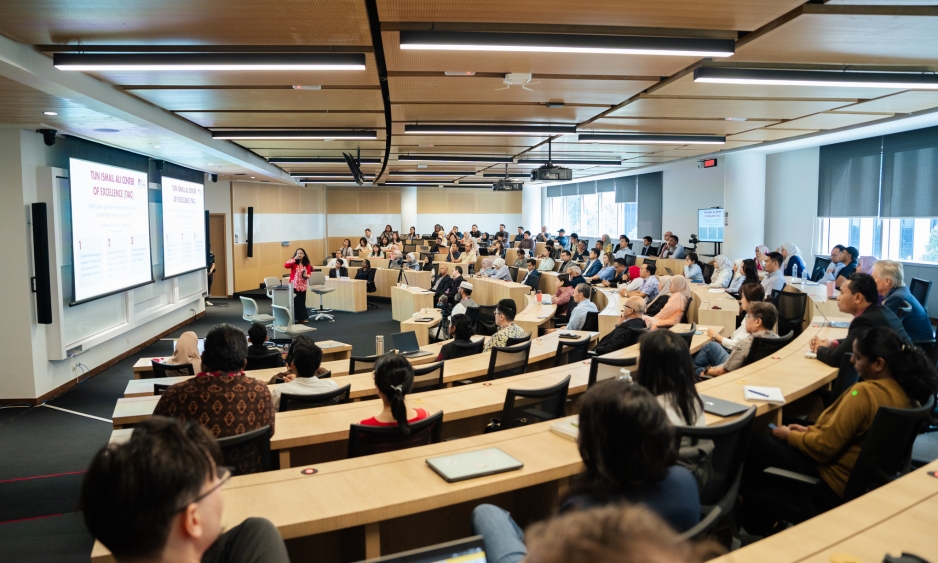
ASB’s campus in Kuala Lumpur boasts state-of-the-art facilities, including collaboration spaces and classrooms structured in the style of MIT Sloan. The campus is centrally located and accessible by public transport. Students will spend three terms studying on campus in Kuala Lumpur and one term studying at the MIT Sloan campus in Cambridge, Massachusetts.


Read the full article here.

This article was originally published on Global Admissions, an online platform that simplifies the university application process for international students.  The platform aims to make it easier for students worldwide to apply to universities.

Bubbly, personable, and intelligent, Khadijah Shamsul has made change-making a personal mission from the very start of her career.
In 2015, driven by a passion to instill confidence, self-worth, and identity in the next generation, Khadijah and her husband, Sheikh Faizal, founded NOUS Academy. As debaters in university days who have won awards and travelled the world, their mission was to equip youth and young adults with critical thinking and public speaking skills.

Since NOUS Academy’s inception, she and her team have trained over 8,000 students across various educational institutions.

But Khadijah’s impact isn’t confined to the classroom or the debate stage. She understands that true influence often happens in quiet, personal moments. Many of the students she mentors come from broken homes, where love and security are scarce.

Recognising this, Khadijah opened her home to these young minds, inviting them to share meals and engage in meaningful conversations, offering them the warmth and understanding they so desperately need.

A simple gesture like having a meal can really change someone’s life. Sometimes my students come to me and share problems they are facing at home. – Khadijah Shamsul

During the same time, Khadijah actively supported a friend leading Migrant 88, an NGO advocating for migrants’ and refugees’ rights. In 2018, she successfully fundraised RM25,000 in collaboration with the Azadi Association (a Swiss NGO) and delivered humanitarian aid to a new Rohingya refugee campsite in Teknaf, Bangladesh.

It was there that Khadijah witnessed period poverty firsthand.

While on a mission to build toilets in rural villages—where women were vulnerable to assault when going to the river at night—she noticed bloodstains on floors, mattresses, and chairs. When she asked about them, the response was stark:

Women here don’t have menstrual pads. If they have cloth, they use it. If not, they use newspapers. 

After three years of running NOUS Academy, Khadijah felt it was time to focus on her personal growth and how she could bring greater impact to the community. Although she graduated with an accounting degree and is now a co-founder of a startup, she was unsure how to elevate her organisation to the next level—until she discovered the Asia School of Business (ASB) MBA programme, a collaboration with MIT Sloan.

Defining Moments In Changemaking

The 20-month full-time MBA at the ASB was intense and demanding. Khadijah, along with 41 classmates, immersed herself in the programme, diving deep into Action Learning projects that took them to organisations across the globe.

Working with different teams while navigating different multicultural contexts and time pressure to meet deadlines, Khadijah had the opportunity to travel to Singapore, Indonesia, and Saudi Arabia, consulting and learning on the go. The experience was challenging, but it taught her a crucial lesson:

You can’t change yourself unless you embrace discomfort. At MIT, we say that learning there is like ‘drinking from a fire hose.’ The steep learning curve sometimes felt overwhelming, but once you embrace it, you gain immense benefits. – Khadijah Shamsul

The MBA journey was intense but truly rewarding. Khadijah travelled to various countries for action learning projects including a short stint at MIT.

This period of discomfort also prompted Khadijah to reevaluate her career goals for NOUS Academy. As she embarked on her MBA journey, it became clear that scaling her education startup wasn’t enough.

To make a bigger impact, she needed to rethink how she combined her passions for data, education, and development. This insight drove her to find new ways to merge these interests and drive meaningful change.

In 2020, Khadijah graduated with an MBA and began searching for a role where she could make a meaningful impact – one that would marry her newfound love for data and her drive to make an impact.

Graduating class of 2020 – Khadijah and her coursemates who now remain close friends.
Making Data Work For Changemaking

After months of searching for a way to merge these interests, she discovered LeadWomen, a consultancy dedicated to increasing female representation in senior leadership and on corporate boards in Malaysia, during a meet-and-greet session organised by ASB.

According to the latest data from the Securities Commission (SC), female representation on boards in Malaysia’s top 100 publicly listed companies (PLCs) has nearly doubled since 2016, rising from 16.6% to 31.4% in 2024[1].

As the Diversity Officer and Board Services & Digital Transformation Manager at LeadWomen, Khadijah played a pivotal role in training and developing female director members to be board-ready for Malaysian companies, significantly advancing equality and diversity in high-level decision-making.

During the pandemic lockdowns, Khadijah worked tirelessly at several organisations, deepening her passion for learning and development while continuing to merge data with social impact.

After a series of job iterations and 11 interviews, Khadijah found her perfect match at Teach For All, a global network dedicated to ensuring every child has access to an equitable and quality education.

As the Chief of Staff for the Communications team, Khadijah works behind the scenes to improve systems and processes, enabling changemakers on the ground to work more effectively and leveraging data to amplify the impact of their efforts.

Data is incredibly powerful. When we can extract it, make sense of it, and communicate it, we can turn good work into great work. That’s the kind of impact I’m making. – Khadijah Shamsul

Khadijah is driving positive change at Teach For All, using data to enhance global education equity.

Learning never stops

As a lifelong learner, Khadijah continues to embody the values she absorbed at ASB: to innovate, keep learning, and give back.

They (ASB) don’t believe in the idea that if something isn’t broken, don’t fix it. Instead, they say, if it’s not broken, let’s make it better! – Khadijah Shamsul

Now a newly minted mom, Khadijah seeks out bite-sized courses to further enhance her impact as a changemaker. She balances this with her dedication to motherhood, ensuring she remains present for her baby, even when schedules are unpredictable and the demands are high.

Khadijah is gracefully balancing her new season as a mother, lifelong learner, and changemaker.

Despite completing her MBA in 2020, Khadijah still cherishes the lessons from her time at ASB, often reflecting on this thought:

There are always teachable moments, no matter where you are. You can learn from the highest positions or the lowest. The only thing worse than death is living without learning to better yourself. You are your best investment, so never stop learning. – Khadijah Shamsul

Our sources:

  1. Tee, K. (2024). Malaysia leads Asia with 31.4pc female board members in Top 100 publicly listed companies, SC data reveals. Malay Mail. Link.

Read the full article here.

This article was originally published on Wiki Impact, an online platform dedicated to the impact industry in Malaysia. They share stories and data on social issues that matter.

It’s said that theory can only take you so far—and this is certainly true for a career in business.

While learning the fundamentals of business is an essential part of your MBA development, the chance to apply this knowledge in a practical setting will enhance your skill set and prepare you for the world of work after graduation.

It’s this belief in the importance of Action Learning that underpins the Asia School of Business MBA program.

Built upon the Malaysia-based school’s close partnership with MIT Sloan School of Management, pioneers of the Action Learning pedagogy—hence the MIT motto: “mind and hand”—ASB focuses on enhancing students’ MBA immersive experiences and preparing them for career success through a wide variety of practical opportunities.

The Action Learning philosophy

While Action Learning has long been a key focus at ASB, the school has recently updated the MBA curriculum to bring the principal to the very core of students’ experience.

Alongside their core MBA classes, students embark on a series of practical opportunities throughout the 12-month degree. This begins with an Industry Trek, where they spend time in a new country, networking with local leaders, experiencing the local culture, and understanding local business practices.

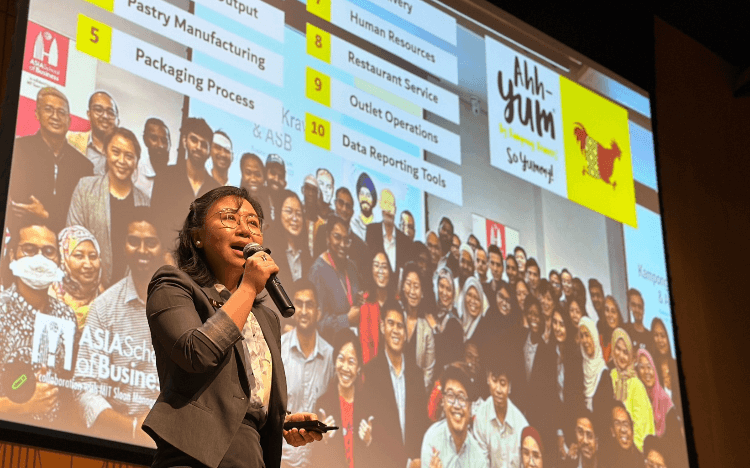
This is followed by a Business Practicum, where the entire cohort splits up into teams, working with a particular company to solve real business challenges across the company’s operations.

Next, students embark on a three week team-based project to various locations in Asia, hosted by companies across several industries and functions.

Finally, students undertake their own individual extended period or internship working with a host company.

“There’s real incremental value in the way that students are experiencing the MBA journey,” says Sangeeta Matu (pictured), director of Action Learning at ASB.

“They go on the Action Learning journey, twice with their cohort, then as a team, then as an individual; each time in different countries, industries, and teams to solve real business problems with the frameworks and tools they’ve learnt in class.”

These skills include problem identification, gathering and analyzing data, proposing solutions, and making presentations.

A diverse, culturally immersive experience

At the beginning of the Action Learning process students have the chance to review the opportunities on offer and opt for the projects they feel best fit with their career goals.

For Nazatul Ruhaiza Abdul Wahab, a former civil servant with the Ministry of Finance in Malaysia currently studying on the program, her choices have allowed her to focus on a diverse range of industries and problems.

A mother of three, Nazatul (pictured) holds more than 20 years of civil service experience. During the MBA she’s spent time working in marketing for Kuala Lumpur-based EQ Hotel, solving cultural enhancement issues for Phu Hu’ung Life Insurance in Vietnam, and interning with Tune Protect Group.

Gaining diverse immersive experiences has played a large part in her development outside of the classroom. Spending time in Vietnam, for example, meant learning the intricacies of a different country, navigating a language barrier, and working with people who hold alternative perspectives.

With Action Learning such a large part of the ASB MBA curriculum, shying away from the limelight is impossible as you are forced to actively participate.

“It has been a transformative and enriching experience for me. It has not only boosted my confidence, but also taught me to face challenges head on.”

Developing a holistic skill set

All of the various experiences students embark on during the ASB MBA are highly independent.

At the beginning, students connect with partner companies and are presented with problem statements; from then on the school encourages the student teams to own their engagement with the host.

At various points throughout the year, they must deliver presentations to faculty and their peers based on their project findings.

This system has helped Nazatul develop a broad range of skills. She’s enhanced her presentation abilities, developed her critical thinking and problem solving skills, and also been able to improve her understanding of data analytics.

Working within a team of diverse individuals who come from different countries and industries has also required her to become a more adept communicator.

“It has taught me to be adaptable, think critically, and collaborate effectively with others,” she explains. “It has also provided me with a broader perspective on various issues.”

Unlocking your career potential

Developing and honing such a broad spectrum of skills, Nazatul’s journey encapsulates what ASB was attempting to achieve when implementing the Action Learning process.

The holistic skill set prepares students to go on and achieve their career goals after graduation—whether that be to switch careers or to take the next step in their current industry.

It also prepares them to be highly adaptable leaders in a volatile modern business landscape, explains Sangeeta.

“To become agile, you need to apply your knowledge, and learned experience” she says. “Action Learning gives you a sequence of opportunities to develop agility in ways and areas that you may not otherwise have been exposed to. ASB offers a truly unique MBA program.”

For Nazatul, with several months until graduation she is still weighing up her future options. An opportunity with her intern company, Tune Protect Group, could be on the cards, while she could also return to the civil service. She’s even been offered the opportunity to undertake a PhD.

Whatever she decides, Nazatul feels passionate about the prospect of continuing to learn and progress in her career.

“When I took the challenge of pursuing an MBA I wanted to show my kids that you should have this period of continuous learning and wanting to improve yourself.

“The program not only enhances your skills and professional development, it also instills a mindset of continuous improvement.”

Read the full article here.

This article was originally published on BusinessBecause, a network helping MBA students make connections before, during and after their MBA.