



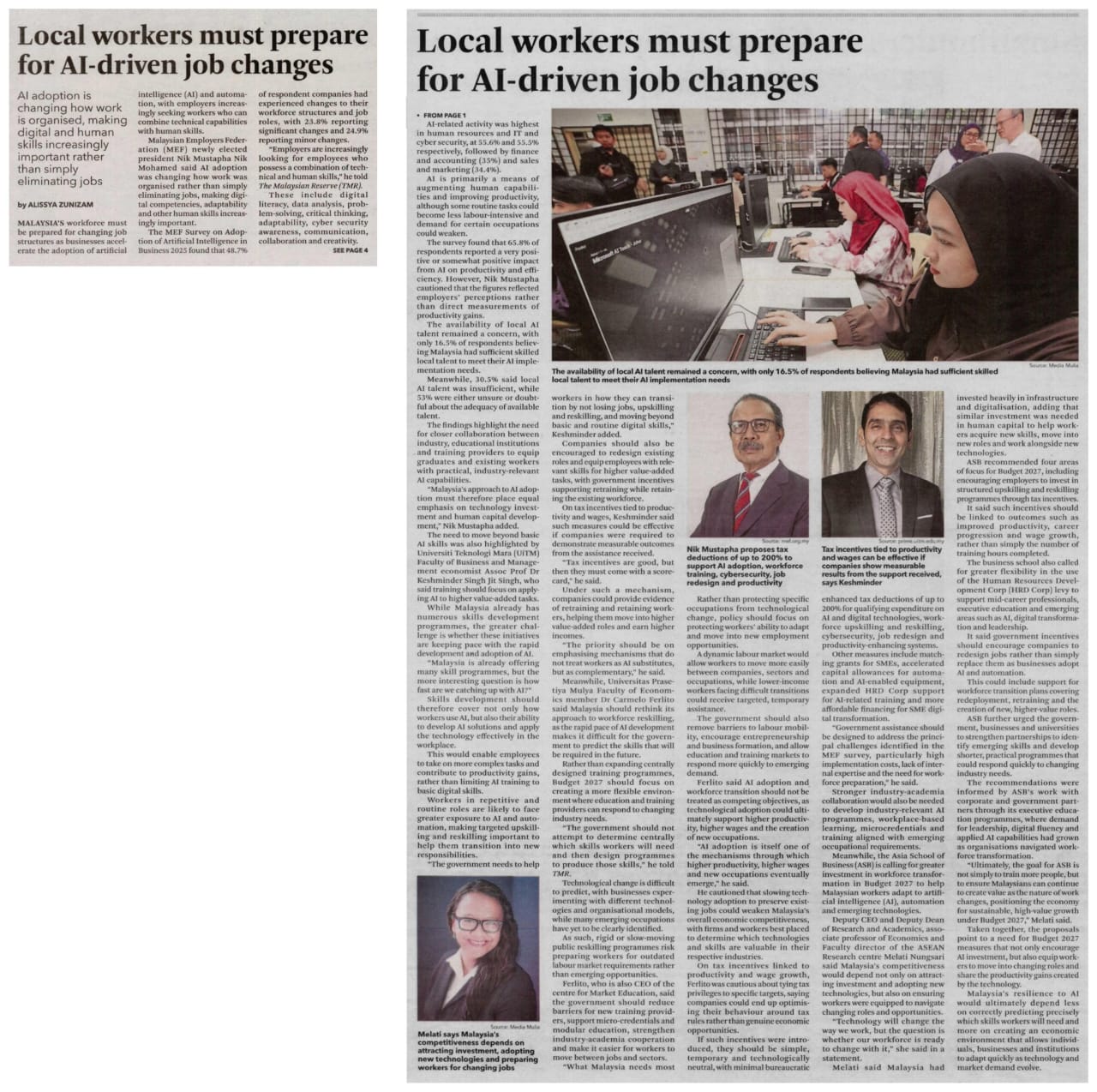
AI adoption is changing how work is organised, making digital and human skills increasingly important rather than simply eliminating jobs.
MALAYSIA’S workforce must be prepared for changing job structures as businesses accelerate the adoption of artificial intelligence (AI) and automation, with employers increasingly seeking workers who can combine technical capabilities with human skills.
Malaysian Employers Federation (MEF) newly elected president Nik Mustapha Nik Mohamed said AI adoption was changing how work was organised rather than simply eliminating jobs, making digital competencies, adaptability and other human skills increasingly important.
The MEF Survey on Adoption of Artificial Intelligence in Business 2025 found that 48.7% of respondent companies had experienced changes to their workforce structures and job roles, with 23.8% reporting significant changes and 24.9% reporting minor changes.
“Employers are increasingly looking for employees who possess a combination of technical and human skills,” he told The Malaysian Reserve (TMR).
These include digital literacy, data analysis, problem-solving, critical thinking, adaptability, cyber security awareness, communication, collaboration and creativity.
AI-related activity was highest in human resources and IT and cyber security, at 55.6% and 55.5% respectively, followed by finance and accounting (35%) and sales and marketing (34.4%).
AI is primarily a means of augmenting human capabilities and improving productivity, although some routine tasks could become less labour-intensive and demand for certain occupations could weaken.
The survey found that 65.8% of respondents reported a very positive or somewhat positive impact from AI on productivity and efficiency. However, Nik Mustapha cautioned that the figures reflected employers’ perceptions rather than direct measurements of productivity gains.
The availability of local AI talent remained a concern, with only 16.5% of respondents believing Malaysia had sufficient skilled local talent to meet their AI implementation needs.
Meanwhile, 30.5% said local AI talent was insufficient, while 53% were either unsure or doubtful about the adequacy of available talent.
The findings highlight the need for closer collaboration between industry, educational institutions and training providers to equip graduates and existing workers with practical, industry-relevant AI capabilities.
“Malaysia’s approach to AI adoption must therefore place equal emphasis on technology investment and human capital development,” Nik Mustapha added.
The need to move beyond basic AI skills was also highlighted by Universiti Teknologi Mara (UiTM) Faculty of Business and Management economist Assoc Prof Dr Keshminder Singh Jit Singh, who said training should focus on applying AI to higher value-added tasks.
While Malaysia already has numerous skills development programmes, the greater challenge is whether these initiatives are keeping pace with the rapid development and adoption of AI.
“Malaysia is already offering many skill programmes, but the more interesting question is how fast are we catching up with AI?”
Skills development should therefore cover not only how workers use AI, but also their ability to develop AI solutions and apply the technolog y effectively in the workplace.
This would enable employees to take on more complex tasks and contribute to productivity gains, rather than limiting AI training to basic digital skills.
Workers in repetitive and routine roles are likely to face greater exposure to AI and automation, making targeted upskilling and reskilling important to help them transition into new responsibilities.
“The government needs to help workers in how they can transition by not losing jobs, upskilling and reskilling, and moving beyond basic and routine digital skills,” Keshminder added.
Companies should also be encouraged to redesign existing roles and equip employees with relevant skills for higher value-added tasks, with government incentives supporting retraining while retaining the existing workforce.
On tax incentives tied to productivity and wages, Keshminder said such measures could be effective if companies were required to demonstrate measurable outcomes from the assistance received.
“Tax incentives are good, but then they must come with a scorecard,” he said.
Under such a mechanism, companies could provide evidence of retraining and retaining workers, helping them move into higher value-added roles and earn higher incomes.
“The priority should be on emphasising mechanisms that do not treat workers as AI substitutes, but as complementary,” he said.
Meanwhile, Universitas Prasetiya Mulya Faculty of Economics member Dr Carmelo Ferlito said Malaysia should rethink its approach to workforce reskilling, as the rapid pace of AI development makes it difficult for the government to predict the skills that will be required in the future.
Rather than expanding centrally designed training programmes, Budget 2027 should focus on creating a more flexible environment where education and training providers can respond to changing industr y needs.
“The government should not attempt to determine centrally which skills workers will need and then design programmes to produce those skills,” he told TMR.
Technological change is difficult to predict, with businesses experimenting with different technologies and organisational models, while many emerging occupations have yet to be clearly identified.
As such, rigid or slow-moving public reskilling programmes risk preparing workers for outdated labour market requirements rather than emerging opportunities.
Ferlito, who is also CEO of the centre for Market Education, said the government should reduce barriers for new training providers, support micro-credentials and modular education, strengthen industry-academia cooperation and make it easier for workers to move between jobs and sectors.
“What Malaysia needs most
Rather than protecting specific occupations from technological change, policy should focus on protecting workers’ ability to adapt and move into new employment opportunities.
A dynamic labour market would allow workers to move more easily between companies, sectors and occupations, while lower-income workers facing difficult transitions could receive targeted, temporary assistance.
The government should also remove barriers to labour mobility, encourage entrepreneurship and business formation, and allow education and training markets to respond more quickly to emerging demand.
Ferlito said AI adoption and workforce transition should not be treated as competing objectives, as technological adoption could ultimately support higher productivity, higher wages and the creation of new occupations.
“AI adoption is itself one of the mechanisms through which higher productivity, higher wages and new occupations eventually emerge,” he said.
He cautioned that slowing technology adoption to preserve existing jobs could weaken Malaysia’s overall economic competitiveness, with firms and workers best placed to determine which technologies and skills are valuable in their respective industries.
On tax incentives linked to productivity and wage growth, Ferlito was cautious about tying tax privileges to specific targets, saying companies could end up optimising their behaviour around tax rules rather than genuine economic opportunities.
If such incentives were introduced, they should be simple, temporary and technologically neutral, with minimal bureaucratic enhanced tax deductions of up to 200% for qualifying expenditure on AI and digital technologies, workforce upskilling and reskilling, cybersecurity, job redesign and productivity-enhancing systems.
Other measures include matching grants for SMEs, accelerated capital allowances for automation and AI-enabled equipment, expanded HRD Corp support for AI-related training and more affordable financing for SME digital transformation.
“Government assistance should be designed to address the principal challenges identified in the MEF survey, particularly high implementation costs, lack of internal expertise and the need for workforce preparation,” he said.
Stronger industry-academia collaboration would also be needed to develop industry-relevant AI programmes, workplace-based learning, microcredentials and training aligned with emerging occupational requirements.
Meanwhile, the Asia School of Business (ASB) is calling for greater investment in workforce transformation in Budget 2027 to help Malaysian workers adapt to artificial intelligence (AI), automation and emerging technologies.
Deputy CEO and Deputy Dean of Research and Academics, associate professor of Economics and Faculty director of the ASEAN Research Center, Melati Nungsari said Malaysia’s competitiveness would depend not only on attracting investment and adopting new technologies, but also on ensuring workers were equipped to navigate changing roles and opportunities.
“Technology will change the way we work, but the question is whether our workforce is ready to change with it,” she said in a statement.
Melati said Malaysia had invested heavily in infrastructure and digitalisation, adding that similar investment was needed in human capital to help workers acquire new skills, move into new roles and work alongside new technologies.
ASB recommended four areas of focus for Budget 2027, including encouraging employers to invest in structured upskilling and reskilling programmes through tax incentives.
It said such incentives should be linked to outcomes such as improved productivity, career progression and wage growth, rather than simply the number of training hours completed.
The business school also called for greater flexibility in the use of the Human Resources Development Corp (HRD Corp) levy to support mid-career professionals, executive education and emerging areas such as AI, digital transformation and leadership.
It said government incentives should encourage companies to redesign jobs rather than simply replace them as businesses adopt AI and automation.
This could include support for workforce transition plans covering redeployment, retraining and the creation of new, higher-value roles.
ASB further urged the government, businesses and universities to strengthen partnerships to identify emerging skills and develop shorter, practical programmes that could respond quickly to changing industry needs.
The recommendations were informed by ASB’s work with corporate and government partners through its executive education programmes, where demand for leadership, digital fluency and applied AI capabilities had grown as organisations navigated workforce transformation.
“Ultimately, the goal for ASB is not simply to train more people, but to ensure Malaysians can continue to create value as the nature of work changes, positioning the economy for sustainable, high-value growth under Budget 2027,” Melati said.
Taken together, the proposals point to a need for Budget 2027 measures that not only encourage AI investment, but also equip workers to move into changing roles and share the productivity gains created by the technology.
Malaysia’s resilience to AI would ultimately depend less on correctly predicting precisely which skills workers will need and more on creating an economic environment that allows individuals, businesses and institutions to adapt quickly as technology and market demand evolve.
Originally published by The Malaysian Reserve online and print.