



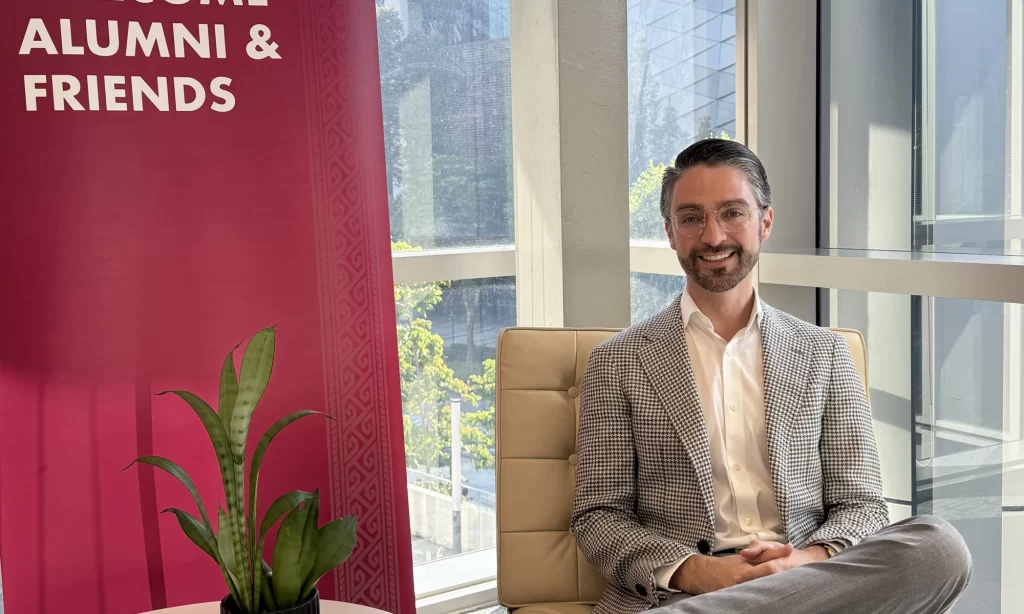
For Andrew Foley, Asia School of Business (ASB) MBA Class of 2018, business education was never only about mastering frameworks or analyzing numbers. It was about learning how organizations make decisions in the real world, how people respond to change, and how leaders can move between ideas, cultures, and practical realities.
Today, Andrew is an Assistant Professor of Management & Organizations at New York University (NYU) Stern School of Business, where he teaches Strategic Management. His path into academia was shaped in part by his time at the Asia School of Business, where he was part of the inaugural MBA class. Before joining ASB, Andrew was a Venture for America fellow in New Orleans, working with incubators and accelerators to support startups and strengthen local entrepreneurial communities.
After two years of working closely with emerging businesses, Andrew wanted to deepen his understanding of organizations in a more formal academic setting. He was considering either an MBA or a PhD in business when ASB caught his attention.
“What drew me to ASB was its focus on Action Learning,” Andrew shared. “I liked the idea of being able to study organizations and also be working alongside them during my studies.”
That combination of classroom learning and direct engagement with companies became one of the defining parts of his MBA experience. Through Action Learning, Andrew was not only studying how executives and team leaders solve complex problems. He was seeing those decisions unfold in real business environments, with real stakeholders, constraints, and competing interests.
One of the classes that left the strongest impression on Andrew was strategy, taught by MIT Professor Pierre Azoulay during his time as a visiting professor at ASB. For Andrew, it was the first academic experience that pushed him to think deeply about the various factors determining whether some organizations survive and thrive even as their industries evolve.
Those insights continue to shape how Andrew studies organizations and approaches his work as an academic. Today, he teaches strategy at NYU Stern, a role that reflects the lasting impact the course had on both his intellectual development and his journey into academia.
Beyond the classroom, Andrew’s Action Learning experience in Thailand offered another powerful lesson. He worked on a project with a major big-box retailer that was trying to understand how to encourage people to spend more time in large retail spaces instead of community-based markets such as wet markets and local fisheries.
At first glance, the business case seemed straightforward. Larger retail spaces offered more control, consistency, and regulation. But as Andrew and his team spent time communicating with people, they began to understand that customer behavior was not driven by convenience or price alone.
People’s shopping habits were tied to daily rituals, cultural practices, and relationships with their communities. “I spent most of my time not doing fancy data analysis, we were just talking to people.”, he reflected.
For Andrew, this became one of ASB’s most valuable lessons: business decisions do not happen in a vacuum. They happen in organizations filled with people, perspectives, and competing priorities. Learning how to make decisions is important, but learning how to implement them in a way that people can understand, accept, and support is just as critical.
“As you go through that process, you develop a really good intuition for not only how to make good decisions, but how to implement them in a way that will create value for everyone involved,” he said.
That intuition has stayed with him. Looking back, Andrew says ASB helped him become more comfortable identifying not just the best idea, but the idea that could realistically work within an organization.
When asked, “In one sentence, how would you describe ASB?” Andrew answered that ASB teaches you to “think across worlds.” As an MBA student, he was in a new country, surrounded by a global student body, and partnering with companies across Southeast Asia. That experience required him to understand perspectives that were unfamiliar, and sometimes perspectives he did not immediately agree with.
For Andrew, that skill remains deeply valuable. It is the ability to listen, interpret, and solve problems through someone else’s lens, especially when the problem is complex, expensive, and tied to different cultures or organizational realities. It’s also a key strategic concern: diversification decisions, competitive interactions, and many others depend on the ability to take the cultural and behavioral perspectives of stakeholders to create value for organizations.
He also sees Malaysia, and Southeast Asia more broadly, as a powerful place to study business today. The region, he noted, is in a dynamic phase of growth and change. It is globally integrated, but also renegotiating its role in relation to the rest of the world. There is a lot of upskilling, movement out of traditional supply chain roles, and growth into headquarters-type functions. With industries moving up the value chain, companies expanding their mandates, and new forms of digital payment reshaping how people do business, the region offers MBA students a front-row seat to transformation.
For Andrew, Malaysia remains memorable not only because of its business environment, but also because of its people and culture. He still remembers seeing the Petronas Twin Towers for the first time, describing the moment as “magical.” He also spoke about Malaysia’s warm and collectivistic culture, the ease of finding community, and, of course, the food, including nasi lemak, roti canai, and rendang.
When asked what advice he would give to current and future ASB students, Andrew offered a simple but thoughtful framework: know which “hat” you are wearing.
In the classroom, he said, you should wear your student hat. Be diligent, because much of what you learn will become relevant in the real world. During Action Learning, however, you need to put on your company stakeholder hat. While much of what you learn in the classroom will be useful, you should avoid trying to apply every lesson immediately. Instead, listen carefully and stay open to the real needs of the company, understand what stakeholders want, and pay attention to what they are ready to allow.
For Andrew, the ability to move between those two roles is what makes the Asia School of Business experience so powerful. “If you can juggle between those two and go back with a certain degree of dexterity, you’re going to be fine,” he said. “And this is going to be one of the best professional experiences you’ve ever had.”