



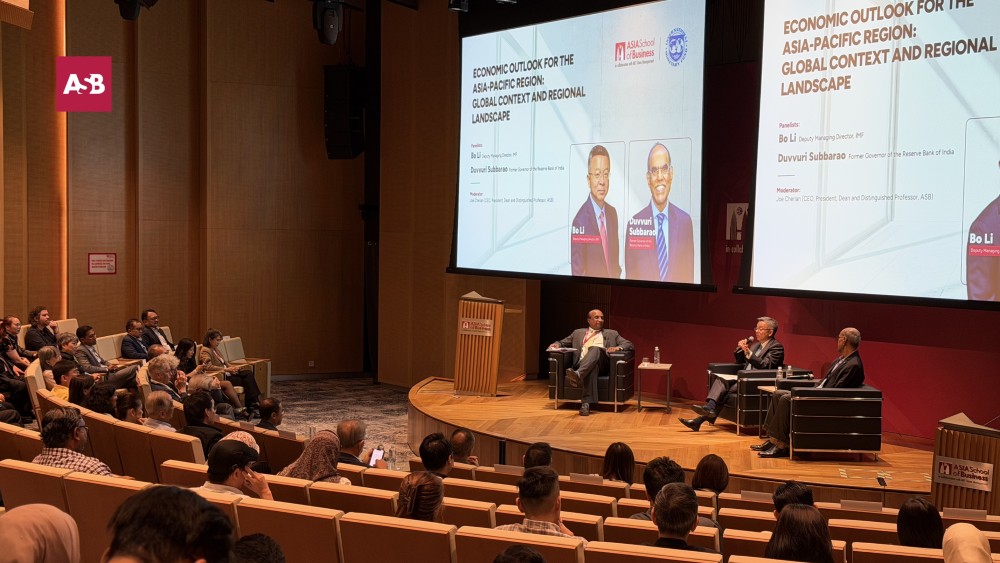
The Asia School of Business (ASB) hosted a high-level fireside chat in Kuala Lumpur on 4 May 2026, convening senior policymakers, academics, industry leaders, and students to discuss the evolving global economic landscape in collaboration with the International Monetary Fund (IMF). The event featured Dr Li Bo, Deputy Managing Director of the IMF, and Dr Duvvuri Subbarao, former Governor of the Reserve Bank of India, and was moderated by Professor Joseph Cherian, CEO, President, Dean, and Distinguished Professor of ASB.
The discussion took place against a backdrop of rising geopolitical tensions, shifting trade and financial linkages, and mounting pressures on the multilateral system—forces that are reshaping the global policy environment.
Drawing on the IMF’s latest World Economic Outlook (April 2026), Dr Li described a global economy navigating persistent uncertainty, with risks increasingly linked to fragmentation across trade, capital flows, and technology. Global growth is projected to moderate to around 3.1% in 2026 (3.2% in 2027), reflecting tighter financial conditions and elevated geopolitical risks. Inflation is expected to rise temporarily to about 4.4% in 2026 before easing to 3.7% in 2027, interrupting the recent disinflation trend due to higher energy and food prices. While the baseline assumes a contained geopolitical environment, downside risks dominate. In an adverse scenario involving a broader or prolonged conflict, global growth could weaken further (toward 2.5%), while inflation could rise to around 5½ – 6% in 2026, driven by commodity price shocks and renewed supply disruptions.
Dr Li argued that the world is experiencing “one of the largest energy shocks in history disrupting maritime and air traffic, destroying critical infrastructure. This could impact economies around the world, including here in Asia Pacific through higher and more volatile commodity prices, and supply chain disruptions. Also, second round effects on inflation and inflation expectations, and through confidence and risk off sentiments in financial markets.” In such an environment, he emphasized that policymakers would face difficult trade-offs, particularly in balancing inflation control against growth concerns.
Dr Subbarao commented that “ this is a supply shock. Supply shocks are difficult to handle because they affect inflation and output in opposite directions. Central banks have to navigate very carefully. But if supply shocks persist long enough inflation expectations will go up. Then central banks will have to act.”
Dr Subbarao further highlighted that institutional strength will be critical in determining how economies in the region navigate heightened uncertainty. He underscored the importance of credible macroeconomic frameworks and structural reforms in sustaining growth while managing external risks. He also noted that, despite broader political developments in the United States, monetary policy institutions remain robust, credible, and globally respected.
The discussion underscored the growing challenge of balancing openness with resilience in an increasingly fragmented global economy. Developments in the Middle East—and their implications for energy markets, trade routes, and financial conditions—featured prominently. Both speakers stressed the continued importance of international cooperation in managing cross-border risks.
Turning to artificial intelligence, Dr Li outlined both the opportunities and risks associated with AI, including its potential to boost productivity and long-term growth, while also posing challenges for labour markets and policy frameworks. He noted that policy responses could include reconsidering the taxation of capital as a way to mitigate distributional effects and support more inclusive outcomes.
Dr Subbarao added that outcomes in Asia will depend heavily on policy choices, particularly in education, digital infrastructure, and regulatory frameworks.
The discussion concluded with a recognition that policymaking is becoming increasingly complex, as geopolitical fragmentation and technological change strain existing frameworks. For Asia, sustaining growth in this environment will require a careful balance between openness, resilience, and institutional credibility.