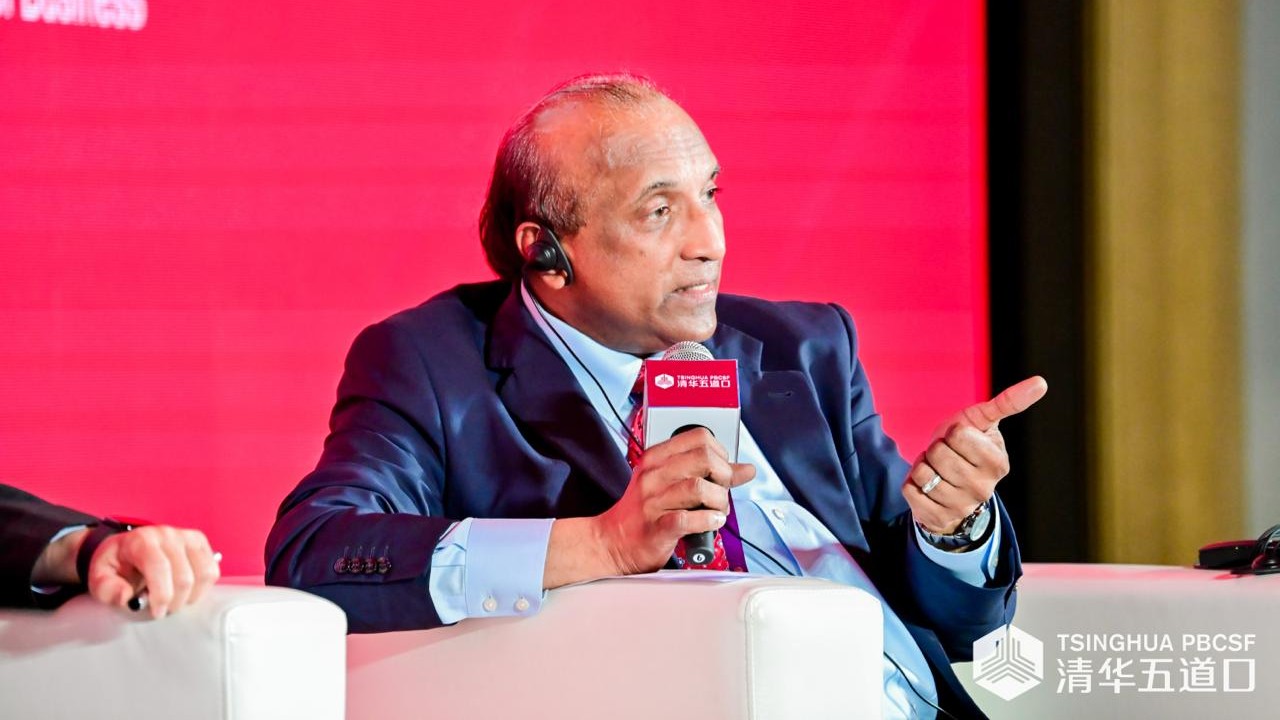






Asia School of Business President & Dean, Professor Joseph Cherian, recently participated in the 2026 Tsinghua PBCSF Global Finance Forum, held on May 18 & 19, 2026, in Chengdu, China. During the forum, Professor Cherian joined a panel discussion, where he shared his perspectives on key financial trends and challenges shaping the industry.
In addition, Professor Cherian participated in the Tsinghua PBCSF Dean’s International Strategic Advisory Council closed-door meeting and gave a media interview to China Daily.
An excerpt from Professor Cherian’s Q&A session during the panel discussion is shared below, followed by the full forum recording.
(Q1)From a global perspective, how will aging fundamentally reshape the financial ecosystem, particularly in areas such as pensions, capital markets, asset management, and insurance? What is your view on this profound shift?
From a U.S. lifecycle and capital markets perspective, several important lessons emerge that may also be relevant for countries facing similar demographic transitions.
- During the baby boomer era (1960–2025), U.S. equity markets experienced extraordinary growth, supported in large part by sustained demand for equities from retirement and wealth accumulation portfolios. Over this 65-year period, U.S. equity markets generated total returns of approximately 11% per annum. As a result, an investment of approximately USD 1,200 in 1960 would have grown to well over USD 1 million by 2025.
- The key question going forward is how capital markets will evolve in the post–baby boomer era, characterized by aging populations and slower demographic growth. As societies age, one could reasonably expect future equity risk premiums to moderate, resulting in lower expected long-term equity returns relative to historical experience.
- This demographic shift places increased importance on the design and sustainability of pension systems.
(i) During the accumulation phase, retirement savings should ideally be invested prudently through low-cost, highly diversified portfolios incorporating glide-path strategies that gradually shift from higher-risk to lower-risk assets as individuals approach retirement. This approach aligns closely with principles of liability-driven investing (LDI) and broader asset-liability management (ALM) frameworks.
(ii) During the retirement or decumulation phase, retirees primarily seek:
- stable and predictable income,
- income that lasts throughout retirement, and
- protection against inflation and rising living costs.
One financial product that addresses these objectives is the inflation-indexed life annuity. Such products should be provided efficiently and at low cost, potentially supported through appropriate forms of government facilitation or intervention to improve accessibility and affordability.
(iii) In this context, pension systems may ultimately need to evolve toward hybrid defined contribution/defined benefit (DC/DB) structures that combine individual savings flexibility with elements of income security and longevity protection.
- Consequently, asset management and insurance companies must be prepared to offer affordable, outcome-oriented retirement solutions tailored to the needs of aging populations. At present, relatively few pension systems adequately address the true objectives of retirees. Too often, the industry remains focused on distributing products that maximize commissions or fees rather than delivering long-term client outcomes. This mindset will need to change as demographic pressures intensify.
(Q2)Against the backdrop of low interest rates and demographic aging, pension funds are playing an increasingly important role as patient capital. What changes are taking place in the asset allocation strategies of such patient capital? More importantly, how will these changes reshape the structure of capital markets?
Patient capital, by definition, is long-term capital. Drawing from my experience as former Head of Portfolio Management in New York, where I managed approximately USD 67 billion across global asset classes and investment strategies, I can confidently say that few things are more detrimental to retirement portfolios than:
- excessive fees,
- frequent trading that generates unnecessary transaction costs, and
- attempts to market-time retirement portfolios.
By market timing, I refer to investors treating their retirement savings as though they were running a Global Tactical Asset Allocation (GTAA) hedge fund strategy – rapidly shifting in and out of asset classes in response to short-term market movements. In most cases, this behavior destroys long-term value. Retirement investing should not be approached opportunistically or tactically at every market turn. Rather, investors are generally better served by maintaining disciplined diversification over the long term. Reducing unnecessary trading also minimizes commissions and transaction costs paid to intermediaries.
With respect to alternative investments, high-quality strategies in private equity, private credit, hedge funds, digital assets, or security token products can all have a legitimate role within institutional portfolios, particularly when they offer appropriate risk-adjusted returns and are priced attractively.
That said, investors should avoid falling into the trap of return chasing. At present, there is considerable enthusiasm surrounding areas such as private credit, artificial intelligence, and data center-related investments. While these sectors and financial products are likely to remain important components of the global economy, enthusiasm should not translate into excessive portfolio concentration. Sound portfolio construction ultimately depends on prudent diversification, disciplined risk management, and avoiding over-allocation to fashionable asset classes or investment themes.
Originally published by Tsinghua PBCSF.