





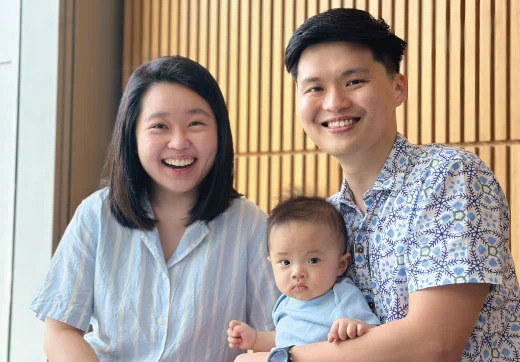
Daphne Chan and Iven Lai won’t tell you an Executive MBA is easy. Instead, they’ll tell you what it actually requires: trade-offs, support, and a good heaping of ruthless prioritization. Daphne is an Asia School of Business (ASB) EMBA Class of 2024 alumna, while Iven is a current EMBA student in the Class of 2026. As parents to a young daughter, Anya, they juggle demanding careers in banking, family life, and their EMBA journey. In this interview, they tackle the question many working parents ask before they ever apply: Is an EMBA too much when you already have a career—and a family?
They had a plan. But overnight, everything changed.
Daphne says it with a laugh, looking at Anya: “We actually planned to have you after I completed my EMBA.” But Anya had other plans. “When I first found out I was pregnant… I was like, ‘oops, you came early.’” It was, as she puts it, “pure shock”—followed quickly by excitement.
Anya’s arrival posed a new kind of question: not Should we do this? But How do we do this now?
For Daphne, it came down to one thing: “It’s really prioritizing. I knew my priorities at that time, and I knew I needed to stay flexible.”
Iven reached the same conclusion through an analytical lens. “I view life like a portfolio,” he says, “and time is my finite resource.” When time is finite, squeezing everything in stops being the goal. Allocating it does. “I had to allocate my time… for her, family, hobbies or studies,” he explains. His decision was clear: “More time spent on the baby and studies, and the rest… like hobbies take kind of a backseat for now.”
Prioritizing and allocating time helped them make the week workable. But even the best system gets tested.
The hardest stretch
“There was a time,” Daphne says, when Anya would wake “four times… in seven hours.” In the middle of that blur, she remembers thinking: “Whoa, I really need a break. Why did I do this to myself?”
And even in that fog of parenthood, nothing else pauses. Work still expects them sharp, and assignments still come due. What kept them going then wasn’t pushing harder. It was speaking up before they burnt out.
“Definitely there’s a time when we are both exhausted,” Daphne says. “For me personally, I will definitely communicate it… ‘I think I need a break… just give me one or two hours, then I’ll recharge and come back.’” Open communication, she adds, “is key.”
Iven describes what that looked like at home: switching off without keeping score. “Whenever she feels tired, then I will step up,” he says. “Whenever I feel tired… she will step up and take a more leading role.”
They couldn’t create more time. So they built around the time they had.
What made it possible
For Iven, that meant using whatever pockets already existed. “Sometimes during commutes, I would… watch videos or listen to articles,” he says. At home, the window was simple: “study after she sleeps.”
It also meant being upfront with the people he was accountable to. “Most of my EMBA group discussions, I will tell them that, ‘hey, I know we need to have a discussion… but can we do it after Anya sleeps?’” Once that constraint was on the table, the group could plan around it. “Most of the discussions are done around 9 to 10 pm when Anya’s asleep.”
And the reality was none of this works without support. Iven doesn’t pretend otherwise. “Fortunately, I have quite a good support system,” he says. At home: “My mother helps to take care of the household.” At work: “I have a good team that I can depend on.” And at school: “I have a great cohort, teammates that understand my situation.”
The outcome wasn’t a perfectly balanced life. But it was a workable one.
So—is it too much?
Some days can be a stretch. Daphne and Iven don’t dress it up. But even now, they would still do it all over again.
Daphne calls the experience “transformational”—a change in how she sees herself and the roles she carries. For Iven, it shows up as “laser focus”: “I know that I have no time to waste anymore,” he says. “My time is so limited.”
And if there’s one thing they want other working parents to hear, it’s this: don’t wait for perfect timing. “You will never find a perfect time. There’s no perfect time,” Daphne says. Still, she adds, “if you’re determined enough, it will work out… so just do it.”
Iven echoes the same belief: “Just take the plunge into the EMBA, and everything will work out eventually.” Daphne agrees: “Both journeys are equally rewarding—having your own child and the pursuit of knowledge!”
Also published by The Exchange Asia.