Asia School of Business

Global Inquiry, Local Heart

KUALA LUMPUR: Unjuran awal Keluaran Dalam Negara Kasar (KDNK) Malaysia yang menunjukkan ekonomi berkembang 5.8 peratus pada suku kedua 2024, mendorong keyakinan terhadap keteguhan ekonomi negara, kata Profesor Ozer Karagedikli (bergambar).

Karagedikli yang juga Professor of Praxtice dan Pengarah Pusat Penyelidikan Perbankan Pusat di Asia School of Business (ASB) itu berkata, Malaysia mempunyai potensi ekonomi yang besar, justeru kadar pertumbuhan ini mungkin tercapai.

Read the full article HERE.
Originally published by Utusan Sarawak.

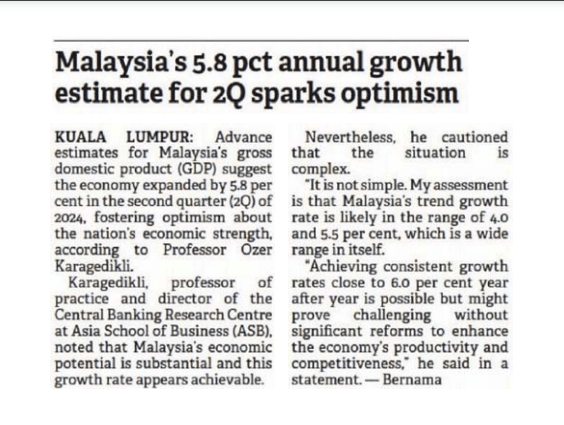
KUALA LUMPUR: Advance estimates for Malaysia’s gross domestic product (GDP) suggest the economy expanded by 5.8 per cent in the second quarter (2Q) of 2024, fostering optimism about the nation’s economic strength, according to Professor Ozer Karagedikli.

Karagedikli, professor of practice and director of the Central Banking Research Centre at Asia School of Business (ASB), noted that Malaysia’s economic potential is substantial and this growth rate appears achievable.

Nevertheless, he cautioned that the situation is complex.

“It is not simple. My assessment is that Malaysia’s trend growth rate is likely in the range of 4.0 and 5.5 per cent, which is a wide range in itself.

“Achieving consistent growth rates close to 6.0 per cent year after year is possible but might prove challenging without significant reforms to enhance the economy’s productivity and competitiveness,” he said in a statement. – Bernama

Originally published by The Borneo Post

KUALA LUMPUR: Unjuran awal Keluaran Dalam Negara Kasar (KDNK) Malaysia yang menunjukkan ekonomi berkembang 5.8 peratus pada suku kedua 2024, mendorong keyakinan terhadap keteguhan ekonomi negara, kata Profesor Ozer Karagedikli.

Karagedikli yang juga Professor of Practicedan Pengarah Pusat Penyelidikan Perbankan Pusat di Asia School of Business (ASB) itu berkata, Malaysia mempunyai potensi ekonomi yang besar, justeru kadar pertumbuhan ini mungkin boleh dicapai.

Bagaimanapun, beliau dalam kenyataan hari ini menegaskan situasi ini adalah kompleks.

“Ini tidak mudah. Penilaian saya adalah trend kadar pertumbuhan Malaysia mungkin berada dalam julat 4.0 hingga 5.5 peratus, iaitu julat yang luas.

“Mencapai kadar pertumbuhan yang konsisten hampir 6.0 peratus tahun demi tahun adalah munasabah, tetapi mungkin menghadapi cabaran tanpa pembaharuan ketara untuk meningkatkan produktiviti dan daya saing ekonomi,” katanya.

Beliau turut menekankan ketidaktentuan ekonomi global boleh menimbulkan risiko kepada prospek ekonomi Malaysia.

“Angka KDNK terkini mewujudkan banyak aspek untuk dibincangkan oleh ahli ekonomi sektor kewangan.

“Bagaimanapun, bagi pembuat dasar dan orang ramai, cabaran sebenar terletak dari segi mengekalkan kadar pertumbuhan itu dari masa ke masa. Ini adalah sesuatu yang kita harapkan,” kata Karagedikli.

Jabatan Perangkaan Malaysia (DOSM) pada 19 Julai mengumumkan ekonomi Malaysia diunjurkan berkembang 5.8 peratus pada suku kedua 2024, meningkat daripada 4.2 peratus pada suku sebelumnya.

Ia merupakan pertumbuhan tertinggi sejak suku keempat 2022 yang mencatatkan 7.4 peratus.

Bank Negara Malaysia (BNM) dijangka mengumumkan data rasmi KDNK suku kedua 2024 pada Jumaat.

Originally published by Berita Harian.

KUALA LUMPUR: Advance estimates for Malaysia’s gross domestic product (GDP) suggest the economy expanded by 5.8 per cent in the second quarter (2Q) of 2024, fostering optimism about the nation’s economic strength, according to Professor Ozer Karagedikli.

Karagedikli, professor of practice and director of the Central Banking Research Centre at Asia School of Business (ASB), noted that Malaysia’s economic potential is substantial and this growth rate appears achievable.

Nevertheless, he cautioned that the situation is complex.

“It is not simple. My assessment is that Malaysia’s trend growth rate is likely in the range of 4.0 and 5.5 per cent, which is a wide range in itself.

“Achieving consistent growth rates close to 6.0 per cent year after year is possible but might prove challenging without significant reforms to enhance the economy’s productivity and competitiveness,” he said in a statement.

He also pointed out that global economic uncertainties might pose risks to Malaysia’s economic outlook.

“The latest GDP figure offers much for financial sector economists to discuss.

“However, for policymakers and the broader public, the real challenge lies in sustaining such growth rates over time. That is something we all hope for,” Karagedikli added.

On July 19, the Department of Statistics Malaysia reported an estimated 5.8 per cent expansion in 2Q 2024, up from 4.2 per cent in the previous quarter and the highest growth since 7.4 per cent in 4Q 2022.

Bank Negara Malaysia is set to release the official 2Q 2024 GDP data on Friday.

Originally published by Bernama.

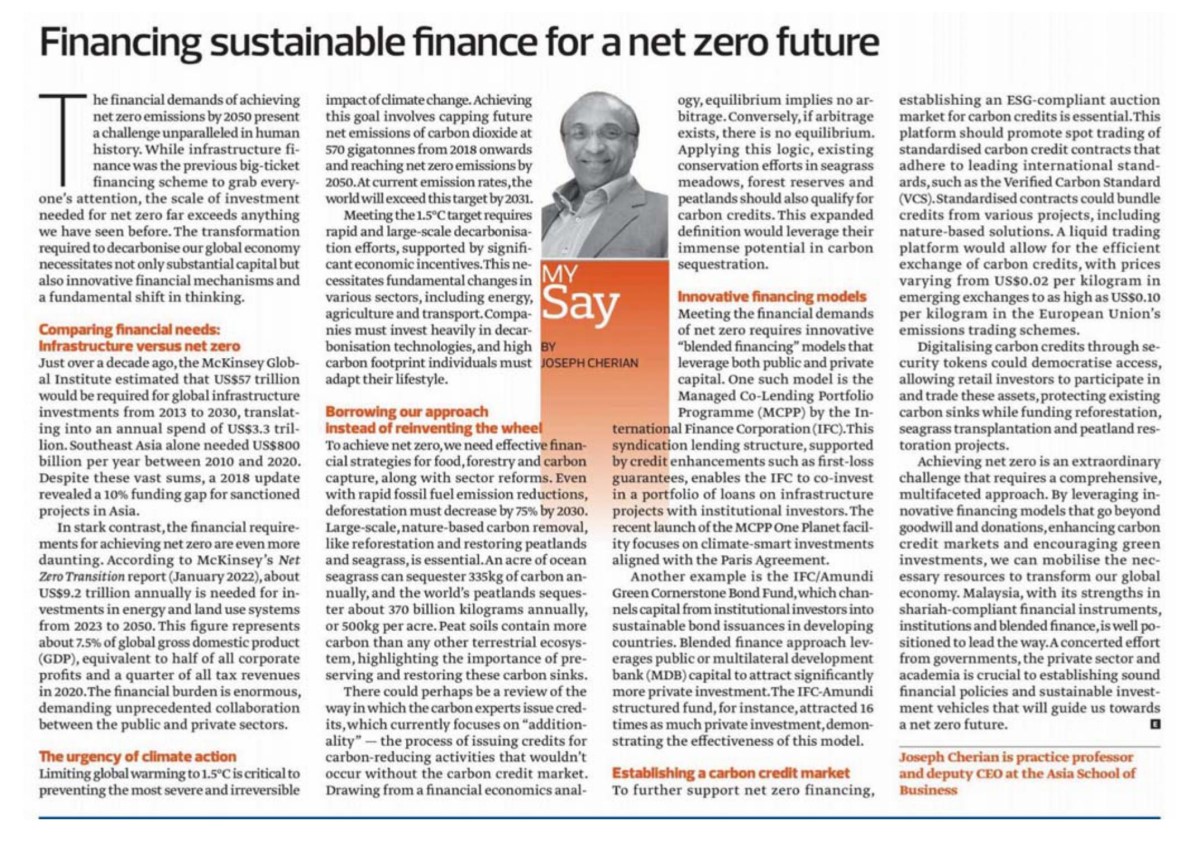
The financial demands of achieving net zero emissions by 2050 present a challenge unparalleled in human history. While infrastructure fi- nance was the previous big-ticket financing scheme to grab every- one’s attention, the scale of investment needed for net zero far exceeds anything we have seen before. The transformation required to decarbonise our global economy necessitates not only substantial capital but also innovative financial mechanisms and a fundamental shift in thinking.

Comparing financial needs: Infrastructure versus net zero

Just over a decade ago, the McKinsey Glob- al Institute estimated that US$57 trillion would be required for global infrastructure investments from 2013 to 2030, translat- ing into an annual spend of US$3.3 tril- lion. Southeast Asia alone needed US$800 billion per year between 2010 and 2020. Despite these vast sums, a 2018 update revealed a 10% funding gap for sanctioned projects in Asia.

In stark contrast, the financial require- ments for achieving net zero are even more daunting. According to McKinsey’s Net Zero Transition report (January 2022), about US$9.2 trillion annually is needed for in- vestments in energy and land use systems from 2023 to 2050. This figure represents about 7.5% of global gross domestic product (GDP), equivalent to half of all corporate profits and a quarter of all tax revenues in 2020. The financial burden is enormous, demanding unprecedented collaboration between the public and private sectors.

The urgency of climate action

Limiting global warming to 1.5°C is critical to preventing the most severe and irreversible impact of climate change. Achieving this goal involves capping future net emissions of carbon dioxide at 570 gigatonnes from 2018 onwards and reaching net zero emissions by 2050. At current emission rates, the world will exceed this target by 2031.

Meeting the 1.5°C target requires rapid and large-scale decarbonisa- tion efforts, supported by signifi- cant economic incentives. This ne- cessitates fundamental changes in various sectors, including energy, agriculture and transport.Compa- nies must invest heavily in decar- bonisation technologies, and high carbon footprint individuals must adapt their lifestyle.

Borrowing our approach instead of reinventing the wheel

To achieve net zero, we need effective finan- cial strategies for food, forestry and carbon capture, along with sector reforms. Even with rapid fossil fuel emission reductions, deforestation must decrease by 75% by 2030. Large-scale, nature-based carbon removal, like reforestation and restoring peatlands and seagrass, is essential. An acre of ocean seagrass can sequester 335kg of carbon an- nually, and the world’s peatlands seques- ter about 370 billion kilograms annually, or 500kg per acre. Peat soils contain more carbon than any other terrestrial ecosys- tem, highlighting the importance of pre- serving and restoring these carbon sinks.

There could perhaps be a review of the way in which the carbon experts issue cred- its, which currently focuses on “addition- ality”- the process of issuing credits for carbon-reducing activities that wouldn’t occur without the carbon credit market. Drawing from a financial economics analogy, equilibrium implies no ar- bitrage. Conversely, if arbitrage exists, there is no equilibrium. Applying this logic, existing conservation efforts in seagrass meadows, forest reserves and peatlands should also qualify for carbon credits. This expanded definition would leverage their immense potential in carbon sequestration.

Innovative financing models

Meeting the financial demands of net zero requires innovative “blended financing” models that leverage both public and private capital. One such model is the Managed Co-Lending Portfolio Programme (MCPP) by the In- ternational Finance Corporation (IFC).This syndication lending structure, supported by credit enhancements such as first-loss guarantees, enables the IFC to co-invest in a portfolio of loans on infrastructure projects with institutional investors. The recent launch of the MCPP One Planet facil- ity focuses on climate-smart investments aligned with the Paris Agreement.

Another example is the IFC/Amundi Green Cornerstone Bond Fund, which chan- nels capital from institutional investors into sustainable bond issuances in developing countries. Blended finance approach lev- erages public or multilateral development bank (MDB) capital to attract significantly more private investment. The IFC-Amundi structured fund, for instance, attracted 16 times as much private investment, demon- strating the effectiveness of this model.

Establishing a carbon credit market

To further support net zero financing, establishing an ESG-compliant auction market for carbon credits is essential. This platform should promote spot trading of standardised carbon credit contracts that adhere to leading international stand- ards, such as the Verified Carbon Standard (VCS).Standardised contracts could bundle credits from various projects, including nature-based solutions. A liquid trading platform would allow for the efficient exchange of carbon credits, with prices varying from US$0.02 per kilogram in emerging exchanges to as high as US$0.10 per kilogram in the European Union’s emissions trading schemes.

Digitalising carbon credits through se- curity tokens could democratise access, allowing retail investors to participate in and trade these assets, protecting existing carbon sinks while funding reforestation, seagrass transplantation and peatland res- toration projects.

Achieving net zero is an extraordinary challenge that requires a comprehensive, multifaceted approach. By leveraging in- novative financing models that go beyond goodwill and donations, enhancing carbon credit markets and encouraging green investments, we can mobilise the nec- essary resources to transform our global economy. Malaysia, with its strengths in shariah-compliant financial instruments, institutions and blended finance, is well po- sitioned to lead the way.A concerted effort from governments, the private sector and academia is crucial to establishing sound financial policies and sustainable invest- ment vehicles that will guide us towards a net zero future.

Originally published by The Edge.