Asia School of Business

Global Inquiry, Local Heart
Asia School of Business, P&G and Temasek Foundation CSS Impact Report 2024 highlights five key findings of smallholders programme

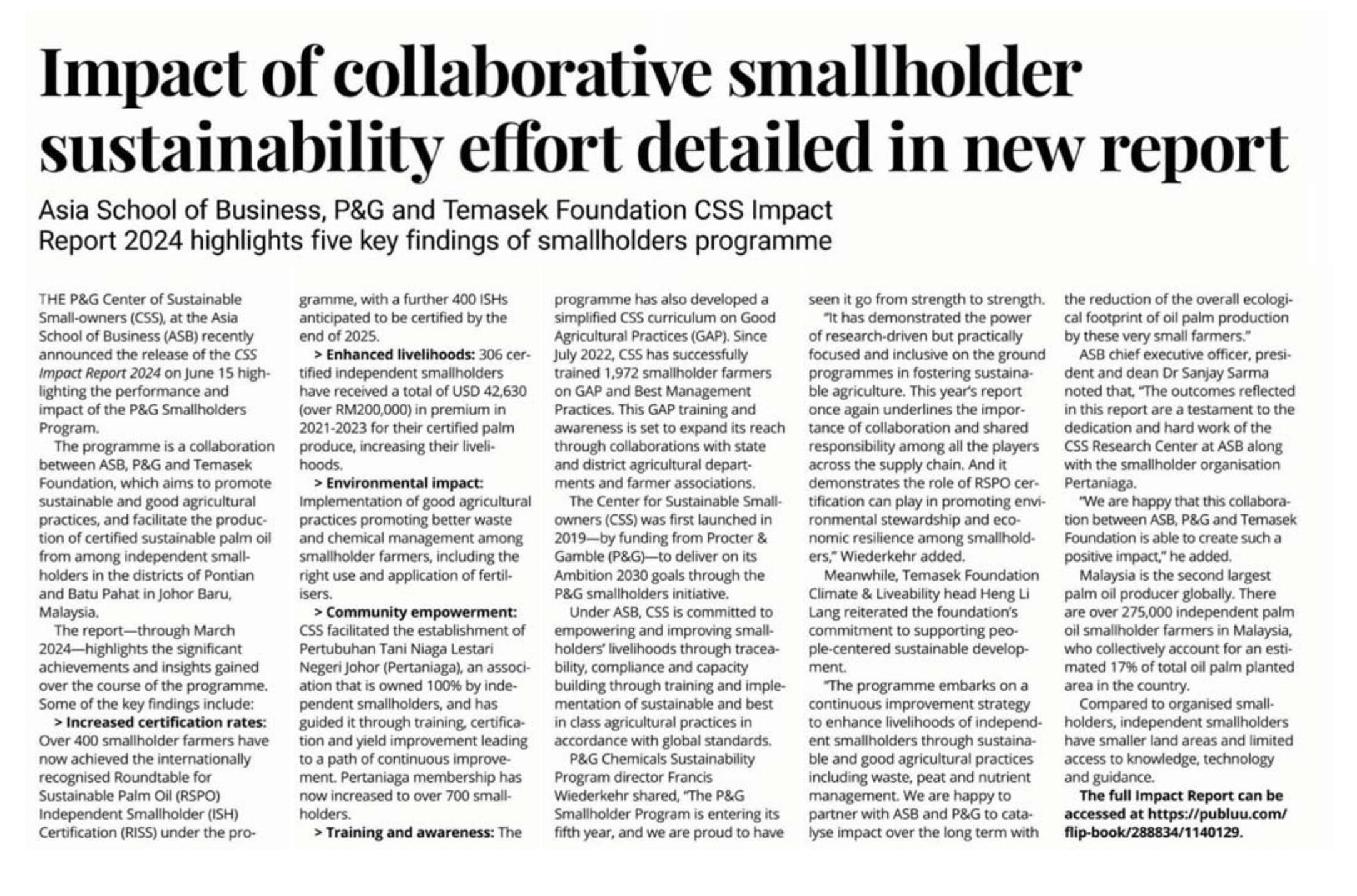
THE P&G Center of Sustainable Small owners (CSS), at the Asia School of Business (ASB) recently announced the release of the CSS Impact Report 2024 on June 15 highlighting the performance and impact of the P&G Smallholders Program.

The programme is a collaboration between ASB, P&G and Temasek Foundation, which aims to promote sustainable and good agricultural practices, and facilitate the production of certified sustainable palm oil from among independent smallholders in the districts of Pontian and Batu Pahat in Johor Baru, Malaysia.

The report through March 2024 highlights the significant achievements and insights gained over the course of the programme. Some of the key findings include:

  • Increased certification rates: Over 400 smallholder farmers have now achieved the internationally recognised Roundtable for Sustainable Palm Oil (RSPO) Independent Smallholder (ISH) Certification (RISS) under the programme, with a further 400 ISHS anticipated to be certified by the end of 2025
  • Enhanced livelihoods: 306 certified independent smallholders have received a total of USD 42,630 (over RM200,000) in premium in 2021-2023 for their certified palm produce, increasing their livelihoods.
  • Environmental impact: Implementation of good agricultural practices promoting better waste and chemical management among smallholder farmers, including the right use and application of fertilisers.
  • Community empowerment: CSS facilitated the establishment of Pertubuhan Tani Niaga Lestari Negeri Johor (Pertaniaga), an associ ation that is owned 100% by independent smallholders, and has guided it through training, certification and yield improvement leading to a path of continuous improvement. Pertaniaga membership has now increased to over 700 smallholders.
  • Training and awareness: Theprogramme has also developed a simplified CSS curriculum on Good Agricultural Practices (GAP). Since July 2022, CSS has successfully trained 1,972 smallholder farmers on GAP and Best Management Practices. This GAP training and awareness is set to expand its reach through collaborations with state and district agricultural departments and farmer associations.

The Center for Sustainable Small owners (CSS) was first launched in 2019 by funding from Procter & Gamble (P&G) to deliver on its Ambition 2030 goals through the P&G smallholders initiative. Under ASB, CSS is committed to empowering and improving smallholders’ livelihoods through traceability, compliance and capacity building through training and implementation of sustainable and best in class agricultural practices in accordance with global standards.

P&G Chemicals Sustainability Program director Francis Wiederkehr shared, “The P&G Smallholder Program is entering its fifth year, and we are proud to have seen it go from strength to strength. “It has demonstrated the power of research driven but practically focused and inclusive on the ground programmes in fostering sustainable agriculture.

This year’s report once again underlines the importance of collaboration and shared responsibility among all the players across the supply chain. And it demonstrates the role of RSPO certification can play in promoting environmental stewardship and economic resilience among smallholders,” Wiederkehr added. Meanwhile, Temasek Foundation Climate & Liveability head Heng Li Lang reiterated the foundation’s commitment to supporting people centered sustainable development.

“The programme embarks on a continuous improvement strategy to enhance livelihoods of independent smallholders through sustainable and good agricultural practices including waste, peat and nutrient management. We are happy to partner with ASB and P&G to catalyse impact over the long term with the reduction of the overall ecological footprint of oil palm production by these very small farmers.”

ASB chief executive officer, president and dean Dr Sanjay Sarma noted that, “The outcomes reflected in this report are a testament to the dedication and hard work of the CSS Research Center at ASB along with the smallholder organisation Pertaniaga. “We are happy that this collaboration between ASB, P&G and Temasek Foundation is able to create such a positive impact,” he added.

Malaysia is the second largest palm oil producer globally. There are over 275,000 independent palm oil smallholder farmers in Malaysia, who collectively account for an estimated 17% of total oil palm planted area in the country. Compared to organised smallholders, independent smallholders have smaller land areas and limited access to knowledge, technology and guidance.

Originally published by The Star.

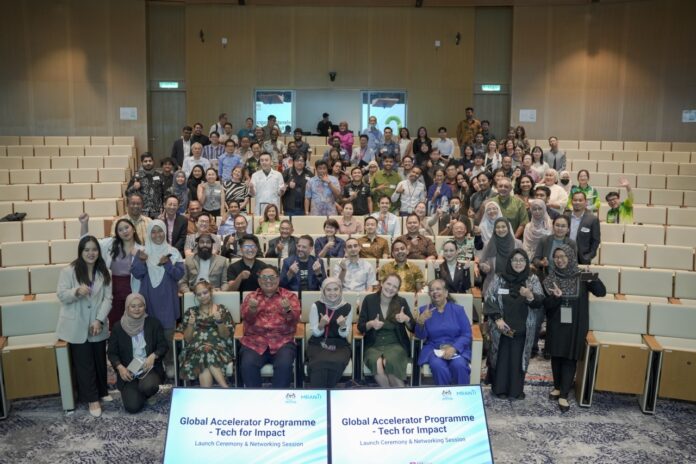
Continuing its mission of accelerating the development of demand-driven R&D efforts, The Malaysian Research Accelerator for Technology & Innovation (TIPM/MRANTI), Malaysia’s central research and innovation commercialisation agency, has officially launched the 2024 cycle of its Global Accelerator Programme (GAP).

With a focus on addressing pressing global challenges, TIPM/MRANTI GAP invites enterprising companies to embark on a transformative journey to scale up their innovative solutions, offering participants a unique blend of support, investment opportunities, and global recognition.

The programme launch also introduced this year’s GAP collaborators, with representatives from each institution attending the launch, including the Asia School of Business (ASB).

Through its range of degrees, executive education, research, and micro-credential programmes, ASB spearheads the development of agile, transformative, and principled leaders toward the advancement of the emerging world, in areas that include sustainability, AI, corporate governance, finance, operations management, and leadership.

This year, the programme targets an enrollment of at least 20 companies, offering them access to learning opportunities from industry experts via workshops and masterclasses. Participants also get the chance to network with other participating companies through team-building and engagement activities, facilitating opportunities to spark inter-industry networks.

Additionally, inclusion in the National Technology and Innovation Sandbox (NTIS) offers resources and support to foster innovation and development, granting businesses the space to test and validate their tech solutions in a controlled live environment under relaxed regulations.

With the theme Tech for Impact, GAP 2024 looks to curate the potential of local and global companies in addressing three key thematic areas under the United Nations’ Sustainable Development Goals (UN SDGs). These areas are Food Security & Sustainability (UN SDG 2), Healthcare (UN SDG 3), and Renewable Energy (UN SDG 7). These areas have been identified through extensive research as the most pressing issues both nationally and globally. While there have been improvements in overall sustainability efforts on a national level, development in these three areas has stagnated. Through the accelerator programme, participating companies gain access to multiple support mechanisms. This includes funding from global and local investors, and backing from R&D and business management entities.

“The main aims of GAP are empowerment and problem-solving. It functions as a catalyst for companies, equipping them with the necessary resources and network to navigate the complexities of growth and upscaling. In doing so, GAP helps them make a meaningful difference in their industries and beyond by addressing ongoing issues that affect the public in real-time. V-Farm, for example, introduced an effective vertical gardening solution which addressed food security and environmental concerns,” shares Safuan Zairi, Chief Ecosystem Officer of MRANTI, adding “We do not just hand out resources, we help our participants use them to their fullest potential for maximum impact, both for national development, and the benefit of the rakyat.”

This programme will be hosted at ASBhive under the oversight of ASB’s Innovation and Entrepreneurship Center (IEC), a key hub in Malaysia’s entrepreneurial ecosystem, marking a significant milestone for ASB. Joseph Cherian, Deputy CEO of ASB remarked, “We are thrilled and eager to establish with MRANTI to jointly operate this programme. ASB is pleased to collaborate with MRANTI on their endeavours by providing our respected faculty members, and experts who have achieved global acclaim in fields such as AI, Sustainability, Organisational Behaviour, and Matching Platforms. Our collaboration includes overseeing the programme from strategic planning and execution to module development, encompassing mentorship and progress tracking. As collaborators, we want to cultivate entrepreneur-leaders who consistently tackle demanding issues and challenge the status quo, with agility, creativity, and resourcefulness.”

Part of ASB’s collaboration with MRANTI includes the nomination to The Earthshot Prize, a prestigious global sustainability award based in the United Kingdom, for this year’s cycle. The Earthshot Prize was founded by His Royal Highness, The Prince of Wales in 2020 and aims to discover, spotlight, and scale innovative solutions that work to repair and regenerate our planet, with five winners winning the award annually.

Participating companies of the 2024 GAP cycle now have the opportunity to be nominated for the The Earthshot Prize. The collaboration also serves as a testament to ASB’s and MRANTI’s commitment to recognising and rewarding innovative solutions addressing crucial environmental challenges.

As of the last cycle, the programme has successfully impacted 20 companies and 50 entrepreneurs, amassing a value creation totalling RM22.42 million, with RM21.63 million in revenue and RM790,610 in investments. Some of these successes include LuwjistikVStream RevolutionSonicboom Solutions , and Izmir Technologies Industries in 2022, whilst 2023 saw Entomal BiotechCS Leaflabs, WeAssist, and Mobiva making their mark.

These achievements inspire MRANTI to aim higher in catalysing the growth of local and global companies, as well as, advancing innovative solutions. GAP 2024 will run from September to November, and all eligible companies are encouraged to apply and take advantage of this unique opportunity to accelerate their growth and take their innovations to the next level.

For more details on GAP 2024, please visit mranti.my/gap.

Originally published by Disruptr MY.