





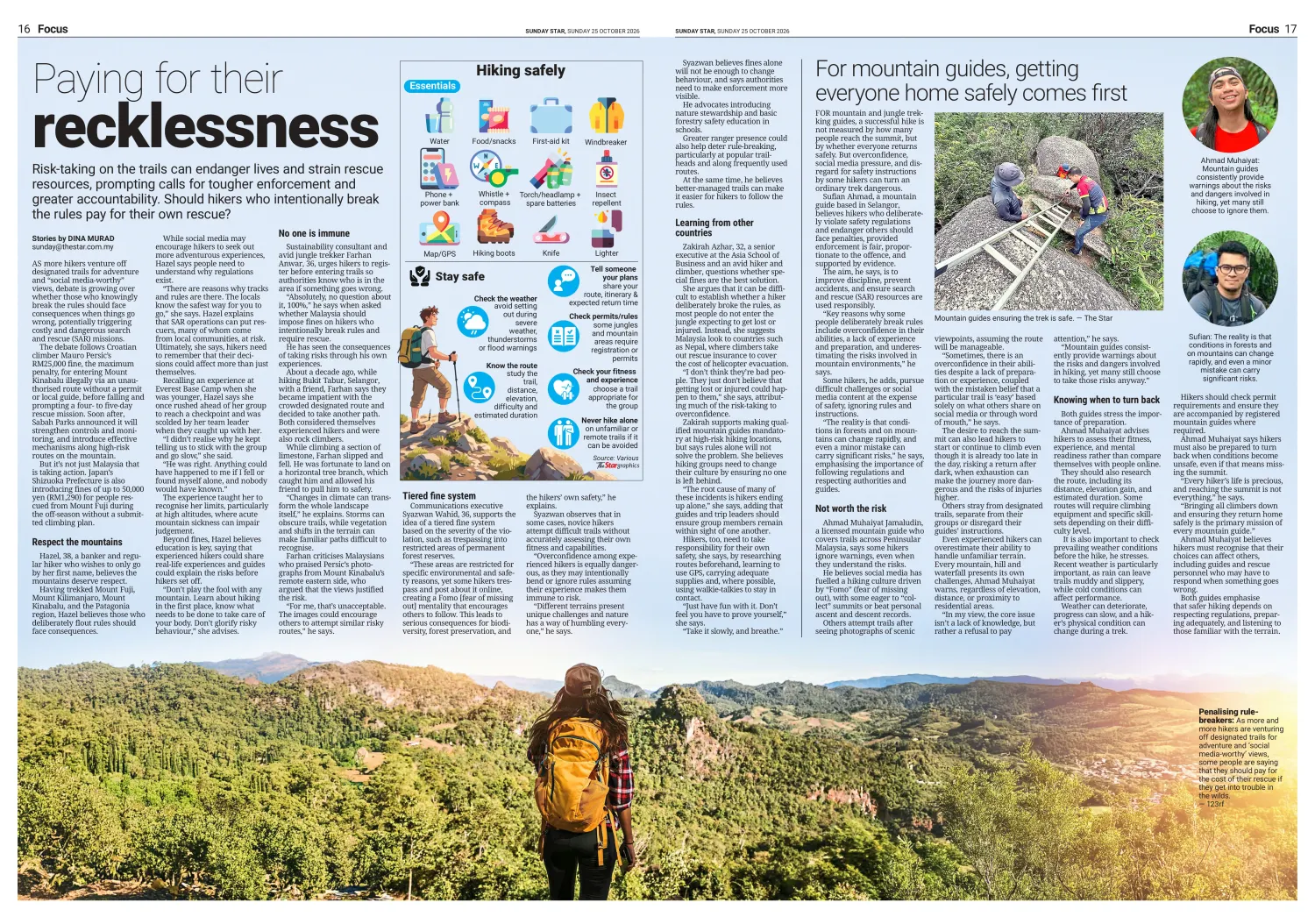
Risk-taking on the trails can endanger lives and strain rescue resources, prompting calls for tougher enforcement and greater accountability. Should hikers who intentionally break the rules pay for their own rescue?
AS more hikers venture off designated trails for adventure and “social media-worthy” views, debate is growing over whether those who knowingly break the rules should face consequences when things go wrong, potentially triggering costly and dangerous search and rescue (SAR) missions.
The debate follows Croatian climber Mauro Persic’s RM25,000 fine, the maximum penalty, for entering Mount Kinabalu illegally via an unauthorised route without a permit or local guide, before falling and prompting a four- to five-day rescue mission. Soon after, Sabah Parks announced it will strengthen controls and monitoring, and introduce effective mechanisms along high-risk routes on the mountain.
But it’s not just Malaysia that is taking action. Japan’s Shizuoka Prefecture is also introducing fines of up to 50,000 yen (RM1,290) for people rescued from Mount Fuji during the off-season without a submitted climbing plan.
Respect the mountains
Hazel, 38, a banker and regular hiker who wishes to only go by her first name, believes the mountains deserve respect.
Having trekked Mount Fuji, Mount Kilimanjaro, Mount Kinabalu, and the Patagonia region, Hazel believes those who deliberately flout rules should face consequences.
While social media may encourage hikers to seek out more adventurous experiences, Hazel says people need to understand why regulations exist.
“There are reasons why tracks and rules are there. The locals know the safest way for you to go,” she says.
Hazel explains that SAR operations can put rescuers, many of whom come from local communities, at risk. Ultimately, she says, hikers need to remember that their decisions could affect more than just themselves.
Recalling an experience at Everest Base Camp when she was younger, Hazel says she once rushed ahead of her group to reach a checkpoint and was scolded by her team leader when they caught up with her.
“I didn’t realise why he kept telling us to stick with the group and go slow,” she said.
“He was right. Anything could have happened to me if I fell or found myself alone, and nobody would have known.”
The experience taught her to recognise her limits, particularly at high altitudes, where acute mountain sickness can impair judgement.
Beyond fines, Hazel believes education is key, saying that experienced hikers could share real-life experiences and guides could explain the risks before hikers set off.
“Don’t play the fool with any mountain. Learn about hiking in the first place, know what needs to be done to take care of your body. Don’t glorify risky behaviour,” she advises.
No one is immune
Sustainability consultant and avid jungle trekker Farhan Anwar, 36, urges hikers to register before entering trails so authorities know who is in the area if something goes wrong.
“Absolutely, no question about it, 100%,” he says when asked whether Malaysia should impose fines on hikers who intentionally break rules and require rescue.
He has seen the consequences of taking risks through his own experiences.
About a decade ago, while hiking Bukit Tabur, Selangor, with a friend, Farhan says they became impatient with the crowded designated route and decided to take another path. Both considered themselves experienced hikers and were also rock climbers.
While climbing a section of limestone, Farhan slipped and fell. He was fortunate to land on a horizontal tree branch, which caught him and allowed his friend to pull him to safety.
“Changes in climate can transform the whole landscape itself,” he explains. Storms can obscure trails, while vegetation and shifts in the terrain can make familiar paths difficult to recognise.
Farhan criticises Malaysians who praised Persic’s photographs from Mount Kinabalu’s remote eastern side, who argued that the views justified the risk.
“For me, that’s unacceptable. The images could encourage others to attempt similar risky routes,” he says.
Tiered fine system
Communications executive Syazwan Wahid, 36, supports the idea of a tiered fine system based on the severity of the violation, such as trespassing into restricted areas of permanent forest reserves.
“These areas are restricted for specific environmental and safety reasons, yet some hikers trespass and post about it online, creating a Fomo (fear of missing out) mentality that encourages others to follow. This leads to serious consequences for biodiversity, forest preservation, and the hikers’ own safety,” he explains.
Syazwan observes that in some cases, novice hikers attempt difficult trails without accurately assessing their own fitness and capabilities.
“Overconfidence among experienced hikers is equally dangerous, as they may intentionally bend or ignore rules assuming their experience makes them immune to risk.
“Different terrains present unique challenges and nature has a way of humbling everyone,” he says.
Syazwan believes fines alone will not be enough to change behaviour, and says authorities need to make enforcement more visible.
He advocates introducing nature stewardship and basic forestry safety education in schools.
Greater ranger presence could also help deter rule-breaking, particularly at popular trailheads and along frequently used routes.
At the same time, he believes better-managed trails can make it easier for hikers to follow the rules.
Learning from other countries
Zakirah Azhar, 32, a senior executive at the Asia School of Business and an avid hiker and climber, questions whether special fines are the best solution.
She argues that it can be difficult to establish whether a hiker deliberately broke the rules, as most people do not enter the jungle expecting to get lost or injured. Instead, she suggests Malaysia look to countries such as Nepal, where climbers take out rescue insurance to cover the cost of helicopter evacuation.
“I don’t think they’re bad people. They just don’t believe that getting lost or injured could happen to them,” she says, attributing much of the risk-taking to overconfidence.
Zakirah supports making qualified mountain guides mandatory at high-risk hiking locations, but says rules alone will not solve the problem. She believes hiking groups need to change their culture by ensuring no one is left behind.
“The root cause of many of these incidents is hikers ending up alone,” she says, adding that guides and trip leaders should ensure group members remain within sight of one another.
Hikers, too, need to take responsibility for their own safety, she says, by researching routes beforehand, learning to use GPS, carrying adequate supplies and, where possible, using walkie-talkies to stay in contact.
“Just have fun with it. Don’t feel you have to prove yourself,” she says.
“Take it slowly, and breathe.”
For mountain guides, getting everyone home safely comes first
FOR mountain and jungle trekking guides, a successful hike is not measured by how many people reach the summit, but by whether everyone returns safely. But overconfidence, social media pressure, and disregard for safety instructions by some hikers can turn an ordinary trek dangerous.
Sufian Ahmad, a mountain guide based in Selangor, believes hikers who deliberately violate safety regulations and endanger others should face penalties, provided enforcement is fair, proportionate to the offence, and supported by evidence.
The aim, he says, is to improve discipline, prevent accidents, and ensure search and rescue (SAR) resources are used responsibly.
“Key reasons why some people deliberately break rules include overconfidence in their abilities, a lack of experience and preparation, and underestimating the risks involved in mountain environments,” he says.
Some hikers, he adds, pursue difficult challenges or social media content at the expense of safety, ignoring rules and instructions.
“The reality is that conditions in forests and on mountains can change rapidly, and even a minor mistake can carry significant risks,” he says, emphasising the importance of following regulations and respecting authorities and guides.
Not worth the risk
Ahmad Muhaiyat Jamaludin, a licensed mountain guide who covers trails across Peninsular Malaysia, says some hikers ignore warnings, even when they understand the risks.
He believes social media has fuelled a hiking culture driven by “Fomo” (fear of missing out), with some eager to “collect” summits or beat personal ascent and descent records.
Others attempt trails after seeing photographs of scenic viewpoints, assuming the route will be manageable.
“Sometimes, there is an overconfidence in their abilities despite a lack of preparation or experience, coupled with the mistaken belief that a particular trail is ‘easy’ based solely on what others share on social media or through word of mouth,” he says.
The desire to reach the summit can also lead hikers to start or continue to climb even though it is already too late in the day, risking a return after dark, when exhaustion can make the journey more dangerous and the risks of injuries higher.
Others stray from designated trails, separate from their groups or disregard their guides’ instructions.
Even experienced hikers can overestimate their ability to handle unfamiliar terrain. Every mountain, hill and waterfall presents its own challenges, Ahmad Muhaiyat warns, regardless of elevation, distance, or proximity to residential areas.
“In my view, the core issue isn’t a lack of knowledge, but rather a refusal to pay attention,” he says.
“Mountain guides consistently provide warnings about the risks and dangers involved in hiking, yet many still choose to take those risks anyway.”
Knowing when to turn back
Both guides stress the importance of preparation.
Ahmad Muhaiyat advises hikers to assess their fitness, experience, and mental readiness rather than compare themselves with people online.
They should also research the route, including its distance, elevation gain, and estimated duration. Some routes will require climbing equipment and specific skillsets depending on their difficulty level.
It is also important to check prevailing weather conditions before the hike, he stresses. Recent weather is particularly important, as rain can leave trails muddy and slippery, while cold conditions can affect performance.
Weather can deteriorate, progress can slow, and a hiker’s physical condition can change during a trek.
Hikers should check permit requirements and ensure they are accompanied by registered mountain guides where required.
Ahmad Muhaiyat says hikers must also be prepared to turn back when conditions become unsafe, even if that means missing the summit.
“Every hiker’s life is precious, and reaching the summit is not everything,” he says.
“Bringing all climbers down and ensuring they return home safely is the primary mission of every mountain guide.”
Ahmad Muhaiyat believes hikers must recognise that their choices can affect others, including guides and rescue personnel who may have to respond when something goes wrong.
Both guides emphasise that safer hiking depends on respecting regulations, preparing adequately, and listening to those familiar with the terrain.
Penalising rule-breakers: As more and more hikers are venturing off designated trails for adventure and ‘social media-worthy’ views, some people are saying that they should pay for the cost of their rescue if they get into trouble in the wilds.
Originally published by Sunday Star.