


Three Presidents. One conversation. A decade of leadership.
What does it take for a business school to stay globally relevant while remaining deeply rooted in its region in an era shaped by AI and shifting geopolitical dynamics?
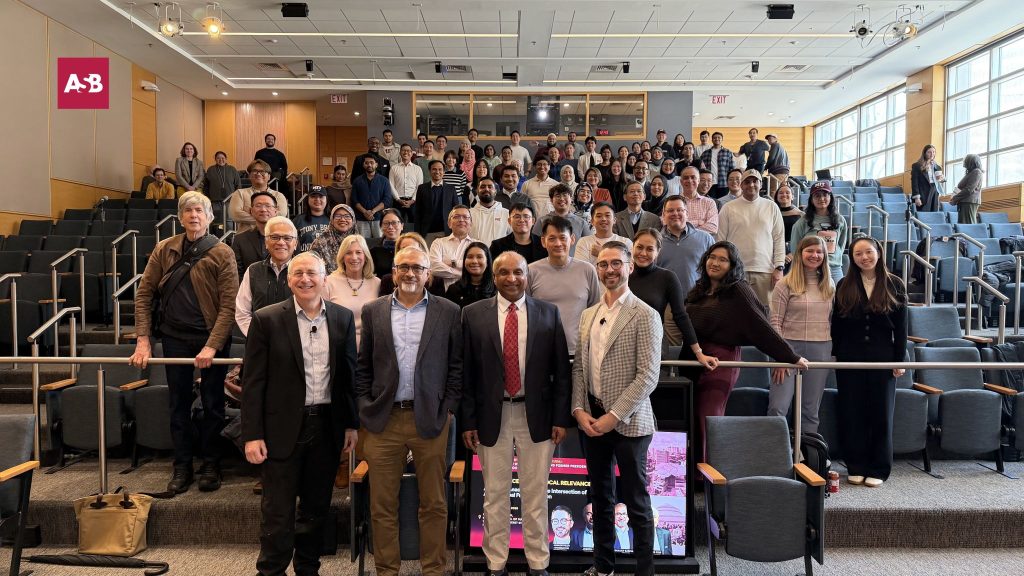
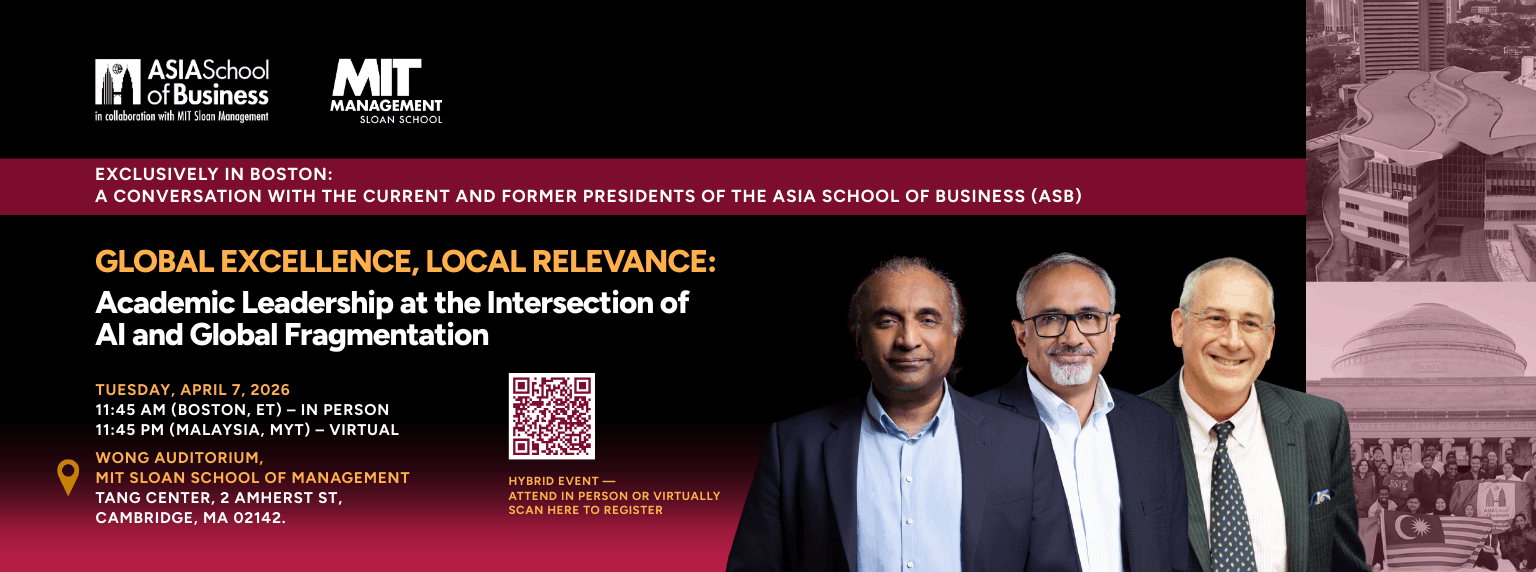
On 7 April 2026, the Asia School of Business (ASB) brought together three generations of the School’s leadership at MIT Sloan School of Management in Cambridge, Massachusetts: current CEO, President and Dean Professor Joe Cherian; former President Professor Sanjay Sarma; and Founding President Professor Charles Fine.
Held at MIT Sloan’s Wong Auditorium, the Presidential Dialogue, titled “Global Excellence, Local Relevance: Academic Leadership at the Intersection of AI and Global Fragmentation,” offered a rare opportunity to reflect on ASB’s journey over the past decade while examining the future of education, leadership, and global competitiveness.
The conversation explored how business schools can balance global ambition with meaningful local relevance, particularly as institutions respond to advances in AI, geopolitical fragmentation, evolving talent demands, and the changing role of higher education. It also traced the deliberate choices that have shaped ASB across different stages of its development, from its founding vision to its continued evolution as a globally connected institution rooted in Asia.
“We have a cross-disciplinary approach… a very engineering way of thinking about problems,” shared Professor Joe, highlighting ASB’s evolving trajectory and its focus on addressing complex challenges through perspectives that extend beyond traditional disciplinary boundaries.
For Professor Sanjay, the transformation taking place is even more fundamental.
“AI is no longer just another technology. It’s a way of thinking required to navigate a complex world.”
His reflections emphasized that education must move beyond the transfer of technical knowledge. One insight that particularly resonated with members of ASB’s 2026 cohort was his observation that, by focusing on solving enough real-world problems, individuals naturally develop the skills needed to navigate uncertainty and change.
Reflecting on ASB’s founding philosophy, Professor Charles emphasized the importance of cultural and intellectual bridging.
“We built a culture that could engage both the East and the West and understand the challenges of both.”
His remarks reinforced ASB’s original vision: not to replicate established Western institutions or remain confined within regional boundaries, but to create a distinctive learning environment positioned at the intersection of Asia and the world.
The dialogue was moderated by Andrew Foley, Assistant Professor of Management and Organizations at NYU Stern School of Business and a member of ASB’s inaugural MBA cohort in 2018. As both moderator and alumnus, Andrew brought a unique perspective to the conversation, connecting the School’s institutional journey with the experiences of those who have studied within it.
Reflecting on the session, Andrew noted that one of his main takeaways was the intentionality behind ASB’s development.
“Hearing directly from the School’s leadership made clear that its trajectory has been anything but accidental; it reflects a deliberate effort to build an institution that is both globally credible and deeply rooted in its context.”
He also observed that the discussion extended beyond ASB. The lessons shared around institutional positioning, leadership, and long-term strategy hold relevance for business schools more broadly, particularly newer institutions seeking to establish a distinctive identity within an increasingly crowded global landscape.
Among those attending the dialogue were students from the MBA and EMBA 2026 cohorts, who participated while completing their MIT immersion. For them, the session offered a thoughtful overview of the ASB–MIT journey and a clearer understanding of how each stage of leadership has contributed to the School’s growth.
One student reflected that the dialogue provided both the ASB community and wider audiences with a richer understanding of the School’s evolution, including the distinct strategic approaches that have guided it over time. As a rare cross-leadership conversation, the session traced ASB’s journey from its founding to its continued development as a young business school seeking to define a league of its own.
Other students noted that the discussion reaffirmed ASB’s commitment to Action Learning, real-world impact, and industry-connected education. It also highlighted the expectations placed on ASB students: to go beyond academic achievement, develop a global mindset, navigate uncertainty, and lead with purpose.
For some, hearing about the resilience required during ASB’s early years was also a timely reminder of the responsibility carried by its students and alumni: to honor the School’s founding vision by living its values and carrying that purpose forward.
As AI continues to reshape industries, the way people work, and the capabilities expected of future leaders, the dialogue reinforced a clear idea: the future of business education lies not only in achieving global excellence, but also in maintaining local relevance, contextual understanding, and the ability to bridge cultures, disciplines, and perspectives.
ASB’s evolution offers an example of how a young institution can build a distinctive identity through deliberate leadership, a clear sense of purpose, and an enduring commitment to connecting Asia with the world.