



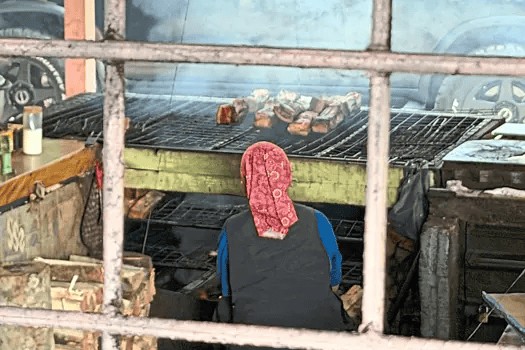
ANYONE who has been to Sabah and made the long weekend run to Kundasang in Ranau District is familiar with the crawl: the narrow road, the brake lights, the slow shuffle past Pekan Nabalu. Most of us also know the reward along this road. There are several wooden stalls by the roadside on the Tamparuli-Ranau stretch where smoke rises off open flames, and crowds of locals and tourists stand over plates of smoked meat.
Look closely at the signboards along the road, and regulars will notice something that has changed in the last five years. Many of those stalls no longer advertise sinalau bakas, meaning smoked wild boar in the native language; instead, they advertise sinalau wogok. Wild boar meat has now been replaced by domestic pig meat.
That single word swap compresses the story of Sabah’s food system into two syllables. It is not a marketing decision. It is the visible end of a supply chain that broke in 2021 and has not been rebuilt.
What happened
African swine fever (ASF) reached Sabah in late 2020 and was confirmed in February 2021. WWF-Malaysia surveys across 28 sites in 10 forest reserves and parks recorded a decline of at least one order of magnitude in bearded pig detections, with numbers still low five years on.
The Sabah Wildlife Department puts the loss at about 90% of the state’s wild boar, and has kept a hunting ban in place because the population is recovering very slowly. That was the right call and remains so. Resuming the wild meat trade risks spreading the virus again. This writer is not arguing for resuming it.
But we should be honest about what the ban cost. It removed a protein source and a cultural practice that many interior and non-Muslim communities in Sabah have relied on for generations. In doing so, it also effectively removed income from hunters, middlemen, and stall operators.
The disease caused the scarcity; the policy decided who would carry the cost. And that cost has fallen heaviest on rural households with the fewest alternatives. If the wild supply stays closed, as it should, then the responsibility shifts to building a replacement that actually works.
Where the meat really comes from
Roadside stalls did the sensible thing and switched to domestic pork, so we recently went around asking where that pork comes from, interviewing several sellers along the Tamparuli-Ranau road. Most of them told us that the pork they now smoke is not sourced from Sabah farms, and in many cases not from Malaysia at all. It is imported frozen from overseas and then brought to these sellers in bulk.
In other words, a dish sold to tourists as a taste of Sabah increasingly depends on meat shipped in from overseas. This matches official policy: Sabah has approved six companies in Europe from which pork can be imported to ease shortages.
It also matches the national picture. It’s been reported that Malaysia’s pork self-sufficiency stood at just 67.8% in 2024, against a target of 90% by 2030. Registered pig farms fell from 435 in 2024 to 338 in 2025, and production dropped by about 15 %, with the shortfall covered by imports.
Sabah sits at the weak end of that picture. Sarawak rebuilt after ASF and now exports thousands of live pigs weekly, while Sabah is still told that European imports are needed to stabilise supply.
Why imports are not a safety net
Imports seem to fill the gap on paper. In practice, they move the risk somewhere we cannot control. Every kilogramme of pork from Europe carries the cost of fuel, refrigeration, and freight across half the world, priced in foreign currency. Those costs are climbing sharply. Benchmark crude oil rose past US$113 (RM462) a barrel in early September amid disruption in the Middle East, with tanker and freight costs rising alongside.
Those costs do not stay with the importer. They pass to the distributor, then the stall, then the customer. Sabah is already feeling it: live pig prices in the state rose from about RM11 to RM16 per kilo in the first half of this year, even as prices fell in Peninsular Malaysia. The seller on the Ranau road has two choices: either raise prices and lose customers, or absorb the cost and lose income. Neither is sustainable for a small family business.
And it does not stop at the stall. Malaysia also relies heavily on imported livestock feed grain. The same fuel and freight pressures land on feed for whatever local farms remain, on cooking gas, on the price of rice.
A state that depends on long, fuel-intensive supply chains for its protein is exposed every time the global price of oil moves, and its lowest-income households feel it first.
That is what “self-sufficiency” really means. It is not a number in a ministry report. It is whether a price shock in a distant shipping lane decides what a family in Ranau can afford to eat.
A sustainable plate
Sustainability in Sabah is usually discussed as forest cover and carbon. But a food system that depends on fuel and freight from the other side of the world, while local producers struggle to restart, is not sustainable either. It is a vulnerability we have grown used to.
The stalls on the Tamparuli-Ranau road are still there, still smoking, still crowded. Whether the meat on the grill comes from a Sabah farm or a container ship is not a question about nostalgia. It is a question about whether Sabah can feed itself when the next price shock arrives.
Dr Jeron Joseph is a researcher at the Asean Research Centre (ARC), Asia School of Business (ASB), Kuala Lumpur. The views expressed here are solely the writer’s own and do not represent those of the ARC, ASB, or its affiliates
Originally published by The Star.